Toyota Tundra Years to Avoid and Best Years to Buy
Toyota Tundra years to avoid are 2007 and 2008. Learn which model years have air pump failures, exhaust manifold cracks, and which Tundra years are safe to buy.
The Toyota Tundra is a full-size pickup truck produced since 2000 that benefits from Toyota’s legendary reliability reputation — but two model years have air injection pump and exhaust problems worth avoiding entirely.
I’ve reviewed the NHTSA complaint data on every Tundra model year, and here’s what the numbers actually show.
The Toyota Tundra years to avoid are concentrated in the early Gen2 era. The secondary air injection pump failure triggers $1,500-$3,000 repairs.
The 2007 and 2008 Toyota Tundra have the highest complaint rates of any Tundra model year. Toyota is the most reliable brand overall.
Even bad Tundra years are better than most competitors’ good years — but two model years deserve a hard pass.
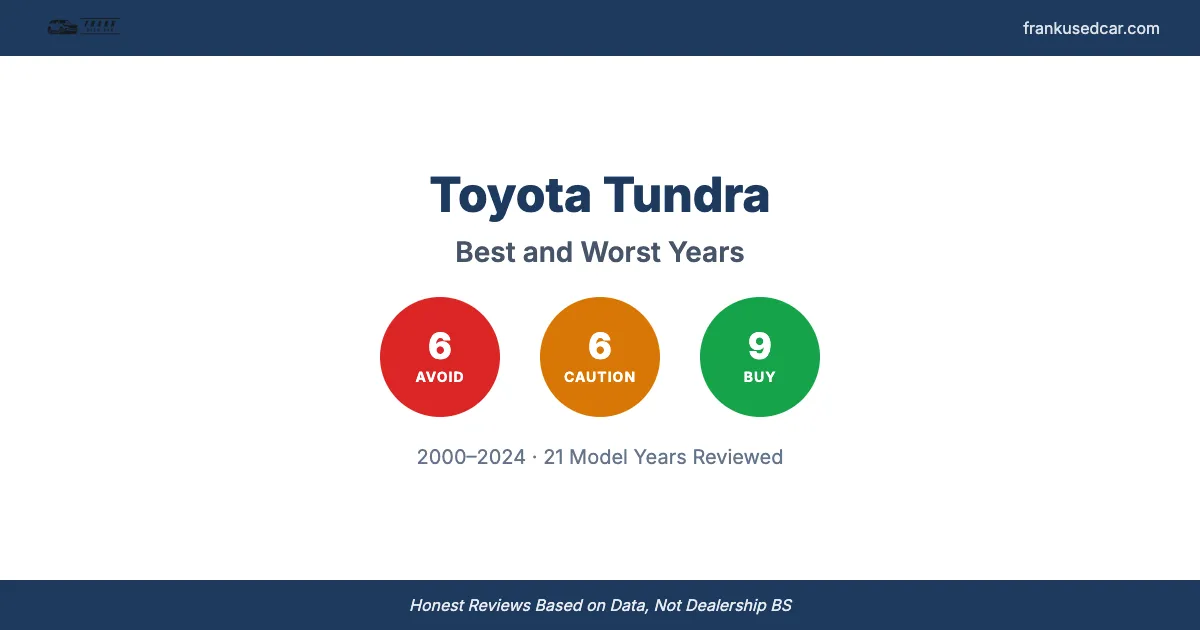
Here’s the full year-by-year verdict at a glance:
| Year | Generation | Frank’s Verdict | Key Issue |
|---|---|---|---|
| 2000-2006 | Gen1 | BUY | Older but reliable 4.7L V8 |
| 2007 | Gen2 | AVOID | Air injection pump + cam tower seal + exhaust manifold |
| 2008 | Gen2 | AVOID | Same triple failure as 2007 |
| 2009 | Gen2 | CAUTION | Declining air injection pump risk |
| 2010-2013 | Gen2 | BUY | Air pump sorted, proven 5.7L V8 |
| 2014 | Gen2 | CAUTION | Facelift first year, some air pump reports |
| 2015-2017 | Gen2 | BUY | Post-facelift, same proven drivetrain |
| 2018-2020 | Gen2 | BUY | Mature Gen2, lowest complaint rates |
| 2021 | Gen2 | BUY | Final Gen2, proven platform |
| 2022 | Gen3 | CAUTION | New twin-turbo V6, first-year platform |
| 2023-2024 | Gen3 | BUY | Maturing Gen3, early bugs addressed |
Which Toyota Tundra Years Should You Avoid?
The 2007 and 2008 Toyota Tundra are the two model years to avoid, based on NHTSA complaint density and the cost of the secondary air injection pump failure, cam tower seal leaks, and exhaust manifold cracking.
Three additional years — the 2009, 2014, and 2022 — earn CAUTION ratings for less severe but still noteworthy issues.
The Tundra’s problems are concentrated in early Gen2 models. Once Toyota sorted the air injection pump issue, the Tundra became one of the most reliable full-size trucks you can buy.
Let’s start with the worst offender — the 2007 Tundra.
What Problems Does the 2007 Toyota Tundra Have?
The 2007 Toyota Tundra was the first year of the Gen2 redesign, and it has the highest complaint count of any Tundra model year.
Three problems dominate: secondary air injection pump failure, cam tower seal oil leaks, and exhaust manifold bolt cracking.
The air injection pump fails between 60,000 and 100,000 miles. Repair costs run $1,500 to $3,000. Diagnostic codes P2440 and P2441 confirm the failure.
Cam tower seal leaks appear between 70,000 and 90,000 miles. Oil seeps from the top of the 5.7L V8 engine. Repair costs $500 to $1,500.
Exhaust manifold bolts crack between 50,000 and 80,000 miles. The bolts break from repeated heat cycling. Replacement runs $1,200 to $2,500.
The air injection pump failure is the Tundra’s signature problem. It throws a check engine light, won’t pass emissions, and the repair isn’t cheap.
Door handle breakage at 40,000 miles and driveshaft vibration at highway speeds round out the complaint list.
Frank’s Verdict: AVOID. The 2007 Tundra is a $5,000+ repair bill waiting to happen. The air injection pump alone costs $1,500-$3,000, and the cam tower seal and exhaust manifold aren’t far behind. Get a 2010+ instead.
What Is the Tundra Air Injection Pump Problem?
The Toyota Tundra secondary air injection pump fails because the check valves corrode and allow exhaust gases to flow backward into the pump, destroying the internal components and triggering diagnostic codes P2440 and P2441.
The pump exists for emissions control. It injects fresh air into the exhaust stream during cold starts to reduce pollutants.
Corrosion in the check valves breaks the one-way seal. Exhaust gases reach the pump motor and burn out the internals.
Dealer repair costs $1,500 to $3,000 for genuine Toyota parts. Aftermarket bypass kits run $500 to $800 but eliminate the emissions system.
Some owners bypass the system entirely — it’s cheaper, but you’ll fail emissions testing in states that require it.
Does the 2007 Tundra Have Cam Tower Seal Leaks?
Yes, the 2007 Toyota Tundra has documented cam tower seal leaks where oil seeps from the top of the 5.7L V8 engine, typically appearing between 70,000 and 90,000 miles and costing $500-$1,500 to repair.
The leak starts as a cosmetic issue. Oil weeps down the side of the engine block without affecting performance.
Left unaddressed, the leak worsens. Oil reaches the exhaust manifold, creating smoke and a burning smell.
Repair requires removing the valve covers to access the cam tower seals. Labor accounts for most of the cost.
What Problems Does the 2008 Toyota Tundra Have?
The 2008 Toyota Tundra continued every problem from the 2007 — secondary air injection pump failure, cam tower seal leaks, and exhaust manifold cracking — with similar failure rates and repair costs.
Air injection pump failure hits between 50,000 and 90,000 miles. Same P2440 and P2441 codes. Same $1,500 to $3,000 repair.
Cam tower seal leaks appear between 60,000 and 80,000 miles. Exhaust manifold cracking shows up around 60,000 miles.
Water pump leaks at 70,000 miles add a fourth failure point. Replacement costs $500 to $900.
The 2008 didn’t fix any of the 2007’s problems. Toyota didn’t fully address the air injection issue until later production runs.
Frank’s Verdict: AVOID. Same problems as the 2007 with no improvements. Skip both and start your search at 2010.
The 2009 Tundra improved on these issues but still has some air injection pump risk — see below.
Why Is the 2012 Toyota Tundra a Good Year to Buy?
The 2012 Toyota Tundra is one of the best years in the Gen2 lineup. The air injection pump issues that plagued 2007-2008 were largely resolved.
The 5.7L iForce V8 is in its reliability sweet spot, and the overall complaint rate is low.
Toyota addressed the air injection pump design starting around 2010. By 2012, the failure rate dropped to a fraction of the 2007-2008 levels.
The 5.7L iForce V8 in the 2012 Tundra is a proven powerplant. Owners routinely report 200,000+ miles with basic maintenance.
Frame rust is possible at 80,000+ miles in salt belt states. This affects all Gen2 Tundras, not just the 2012.
The 2012 is part of the refined Gen2 era (2010-2013) where Toyota had sorted out the early production problems. This is a solid buy.
Frank’s Verdict: BUY. The 2012 Tundra is a proven, reliable truck. The air injection pump issues were largely resolved by this point. Check the frame for rust if the truck spent time in salt-belt states, but otherwise this is a confident buy.
Now let’s look at a few caution years that aren’t dealbreakers but warrant extra scrutiny.
Is the 2009 Toyota Tundra Worth Buying?
The 2009 Toyota Tundra is a caution year — it was the last model year with notable air injection pump complaints, though failure rates were declining significantly compared to 2007-2008.
Air injection pump issues still appear at 70,000 to 100,000 miles. The frequency dropped, but the problem didn’t disappear.
Frame rust concerns affect trucks in northern climates at 80,000+ miles. Road salt accelerates corrosion on the Gen2 frame.
Brake rotor warping shows up as early as 30,000 miles. Replacement costs $300 to $600 per axle.
The 2009 is the transition year. Most trucks are fine, but the air injection pump still shows up in complaint reports.
Frank’s Verdict: CAUTION. Declining air injection pump risk but not eliminated. Check if the pump has been serviced. The 2010+ is a safer bet.
The 2014 is a more recent caution year.
What Problems Does the 2014 Toyota Tundra Have?
The 2014 Toyota Tundra was the first year of the Gen2 facelift, and while the air injection pump failure rate had dropped significantly, some units still experience the problem at 60,000-80,000 miles.
Interior trim rattles and squeaks are common first-year facelift complaints. Infotainment system lag frustrates owners.
These problems are annoying, not catastrophic. The 2014 doesn’t belong in the same category as 2007-2008.
The 2014 is a borderline year. Most trucks are fine, but the air injection pump still shows up in some complaint reports.
Frank’s Verdict: CAUTION. Most 2014 Tundras are solid, but check for air injection pump work in the service history. The 2015+ is a safer bet.
The 2022 brought an entirely new platform.
What Problems Does the 2022 Toyota Tundra Have?
The 2022 Toyota Tundra launched the Gen3 with a completely new twin-turbo V6 replacing the legendary 5.7L V8, and as a first-year platform, it carries some early-production risk including software glitches and turbo-related concerns.
Toyota built the Gen3 on the new TNGA-F platform. The 3.4L i-FORCE twin-turbo V6 produces 389 hp — more than the old V8.
Software issues with the infotainment and driver assist systems appeared from day one. Rear suspension creaking surfaced around 10,000 miles.
Replacing a proven V8 with a turbocharged V6 is a bold move. The early reports are mostly positive, but first-year turbocharged engines always carry uncertainty.
Frank’s Verdict: CAUTION. Too early to know if the twin-turbo V6 will match the 5.7L V8’s legendary longevity. If you want a proven Tundra, get a 2015-2021 with the V8.
These individual year problems feed into larger patterns across the Tundra lineup.
What Are the Most Common Toyota Tundra Problems?
The most common Toyota Tundra problems across all model years are secondary air injection pump failure, cam tower seal oil leaks, exhaust manifold bolt cracking, and frame rust — though the Tundra has far fewer problems overall than domestic full-size trucks.
| Problem | Severity | Cost | Affected Years |
|---|---|---|---|
| Air injection pump failure | SERIOUS | $1,500-$3,000 | 2007-2012 |
| Cam tower seal leak | MODERATE | $500-$1,500 | 2007-2010 |
| Exhaust manifold cracking | MODERATE | $1,200-$2,500 | 2007-2010 |
| Frame rust | SERIOUS | $1,000-$10,000+ | 2007-2011 (salt belt) |
The Tundra has fewer problems than the F-150, Silverado, or Ram. When it does have a problem, the air injection pump is the big one.
How Serious Is the Tundra Air Injection Pump Failure?
The Toyota Tundra air injection pump failure is the single most common and expensive problem in the model’s history — it affects primarily 2007-2012 models, costs $1,500-$3,000 to repair, and triggers check engine lights that prevent passing emissions testing.
Diagnostic codes P2440 and P2441 confirm the failure. The pump can be repaired, bypassed, or replaced.
Bypass eliminates the emissions system for $500-$800. Full replacement with OEM parts costs $1,500-$3,000.
States with emissions testing require a functional air injection system. Bypass isn’t legal everywhere.
Does the Tundra Have Exhaust Manifold Problems?
Yes, the Toyota Tundra has documented exhaust manifold problems primarily in 2007-2010 models — the manifold bolts crack or break, causing an exhaust leak that gets louder over time and costs $1,200-$2,500 to repair.
The bolts crack from repeated heat cycling. Metal expands and contracts with every drive cycle until fatigue causes fractures.
You’ll hear an exhaust tick at cold startup. The sound fades as the engine warms and metal expands to temporarily seal the gaps.
Bolt extraction is the expensive part. Broken bolts lodged in the cylinder head require careful drilling.
Does the Tundra Have Frame Rust Issues?
Yes, certain Toyota Tundra model years — particularly 2007-2011 trucks in salt belt states — have frame rust and corrosion issues similar to (but less severe than) the Tacoma’s infamous frame rust recall.
The Tundra never received a frame replacement program like the Tacoma did. Frame rust treatment costs $1,000 to $3,000.
Inspect the frame cross-members and rear leaf spring mounts. These areas collect road salt and moisture.
Severe frame rust can compromise structural integrity. Any Tundra from the rust belt needs a frame inspection before purchase.
How Reliable Is the Toyota Tundra by Year?
The Toyota Tundra reliability is excellent overall, with 2010+ Gen2 models earning 8/10 or higher — the 2007-2008 air injection pump issues are the only significant exceptions.
| Year Range | Generation | Frank’s Rating | Key Strength | Key Risk |
|---|---|---|---|---|
| 2000-2006 | Gen1 | 7/10 | Simple, durable 4.7L V8 | Aging, limited towing |
| 2007-2008 | Gen2 | 4/10 | Capable 5.7L V8 | Air pump + cam seal + manifold |
| 2009 | Gen2 | 6/10 | Declining failure rates | Residual air pump risk |
| 2010-2013 | Gen2 | 8/10 | Proven 5.7L, issues resolved | Frame rust (salt belt) |
| 2014 | Gen2 | 7/10 | Facelift updates | Some air pump reports |
| 2015-2017 | Gen2 | 9/10 | Refined Gen2, clean record | Minimal |
| 2018-2020 | Gen2 | 9/10 | Mature platform, TSS added | Minimal |
| 2021 | Gen2 | 8/10 | Final Gen2 | End-of-cycle |
| 2022 | Gen3 | 6/10 | New twin-turbo V6 power | First-year platform risk |
| 2023-2024 | Gen3 | 7/10 | Maturing Gen3 | Long-term turbo unknown |
The Tundra’s 5.7L iForce V8 is one of the most reliable truck engines ever made. From 2013 onward, the Tundra is as close to bulletproof as full-size trucks get.
Has the Toyota Tundra Been Recalled?
The Toyota Tundra has been subject to several NHTSA recalls, with the most significant affecting 2007-2021 models for power steering issues and 2007-2010 models for the accelerator pedal sticking defect.
| Recall ID | Year(s) | Date Issued | Issue | Fix |
|---|---|---|---|---|
| 21V920000 | 2007-2021 | Nov 2021 | Power steering gear assembly oil leak causing sudden loss of assist | Dealer inspection and gear replacement |
| 10V017000 | 2007-2010 | Jan 2010 | Accelerator pedal friction lever may stick in partially depressed position | Dealer installation of reinforcement bar |
| 07V579000 | 2007 | Dec 2007 | Driveshaft slip yoke improperly heat-treated on 4WD models | Propeller shaft replacement |
The Takata airbag recall also affected multiple Tundra model years. This was an industry-wide issue, not Tundra-specific.
A recall isn’t always bad news — it means the manufacturer acknowledged and fixed the problem for free. Verify recall completion on any used Tundra through the NHTSA recall database.
Now that you know what to avoid, here are the years worth buying.
What Are the Best Toyota Tundra Years to Buy?
The best Toyota Tundra years to buy used are the 2010-2013, 2015-2017, and 2018-2020 models — refined Gen2 trucks with the proven 5.7L iForce V8 and the lowest complaint rates of any Tundra generation.
If I were buying a used Tundra today, I’d get the 2018. The 5.7L V8 is bulletproof at this point, Toyota Safety Sense comes standard, and prices are starting to come down.
Budget pick: 2010-2013. Refined Gen2 with the air pump sorted and the most affordable prices. The 2012 is the sweet spot.
Mid-range pick: 2015-2017. Post-facelift interior, updated tech, same proven drivetrain. Still holds value well.
Premium pick: 2018-2020. Mature platform, TRD Pro option, Toyota Safety Sense standard. The last of the V8 Tundras.
For more Toyota models and their best years, see the Toyota reliability guide.
Is the 2018 Toyota Tundra Worth Buying Used?
Yes, the 2018 Toyota Tundra is one of the most reliable full-size trucks you can buy used — it has the proven 5.7L iForce V8, Toyota Safety Sense standard, and a reputation for running well past 200,000 miles with basic maintenance.
The air injection pump problems are ancient history by 2018. Complaint rates are near zero.
Toyota Safety Sense adds pre-collision braking, lane departure alert, and adaptive cruise control. These features were optional or unavailable on earlier Tundras.
Is the 2015 Toyota Tundra a Good Used Buy?
Yes, the 2015 Toyota Tundra is an excellent used truck — it’s the first year of the Gen2 facelift with an updated interior, the air injection pump issues were resolved, and the 5.7L V8 is in its reliability sweet spot.
The 2015 facelift brought a redesigned front end and improved cabin materials. Mechanically, it’s the same proven platform.
Prices on the 2015-2017 Tundras offer the best value-to-reliability ratio in the Gen2 lineup.
Is the Toyota Tundra a Reliable Truck Overall?
Yes, the Toyota Tundra is one of the most reliable full-size trucks you can buy — it outlasts the Ford F-150 and Chevrolet Silverado in long-term durability, though it offers fewer features and towing capacity than its domestic competitors.
The Tundra doesn’t tow as much or offer as many cab configurations as the F-150. It doesn’t have the Silverado’s available diesel option.
What the Tundra does offer is longevity. The 5.7L iForce V8 routinely reaches 300,000 miles. Transmission failures are rare outside the domestic truck world.
Toyota is the most reliable brand overall. Even bad Tundra years are better than most competitors’ good years. The 2007-2008 air pump problems are frustrating, but they’re fixable — not fatal.
For comparison, see the Ford F-150 years to avoid and the Chevy Silverado best and worst years.
How Do You Inspect a Used Toyota Tundra Before Buying?
Check these seven items before buying any used Toyota Tundra to avoid the most common and expensive problems reported by owners.
- Scan for diagnostic codes P2440 and P2441 — these indicate air injection pump failure (2007-2012 models).
- Inspect the top of the engine for oil seepage at the cam tower seals (2007-2010 models).
- Listen for an exhaust tick at cold start — this indicates a cracked manifold bolt (2007-2010 models).
- Crawl under and inspect the frame for rust perforation, especially on salt belt trucks (2007-2011 models).
- Check for brake rotor warping by feeling for pulsation during braking.
- Verify recall completion on the NHTSA website using the VIN.
- Request full service history — air injection pump replacement or bypass should be documented.
A $100-$200 pre-purchase inspection catches problems that cost thousands to fix. Never skip it on a used Tundra.
For more tips on evaluating any used vehicle, see the used car buying guide.
Verdict Summary
| Year | Verdict | Top Problem | Repair Cost |
|---|---|---|---|
| 2007 | AVOID | Air injection pump failure | $1,500-$3,000 |
| 2008 | AVOID | Air injection pump failure | $1,500-$3,000 |
| 2009 | CAUTION | Declining air pump risk | $1,500-$3,000 |
| 2012 | BUY | Minimal — refined Gen2 | N/A |
| 2014 | CAUTION | Some air pump reports | $1,500-$3,000 |
| 2018 | BUY | Near-zero complaints | N/A |
| 2022 | CAUTION | First-year turbo V6 platform | TBD |
Also see: Toyota Best & Worst Years