Best and Worst Toyota Camry Years to Buy
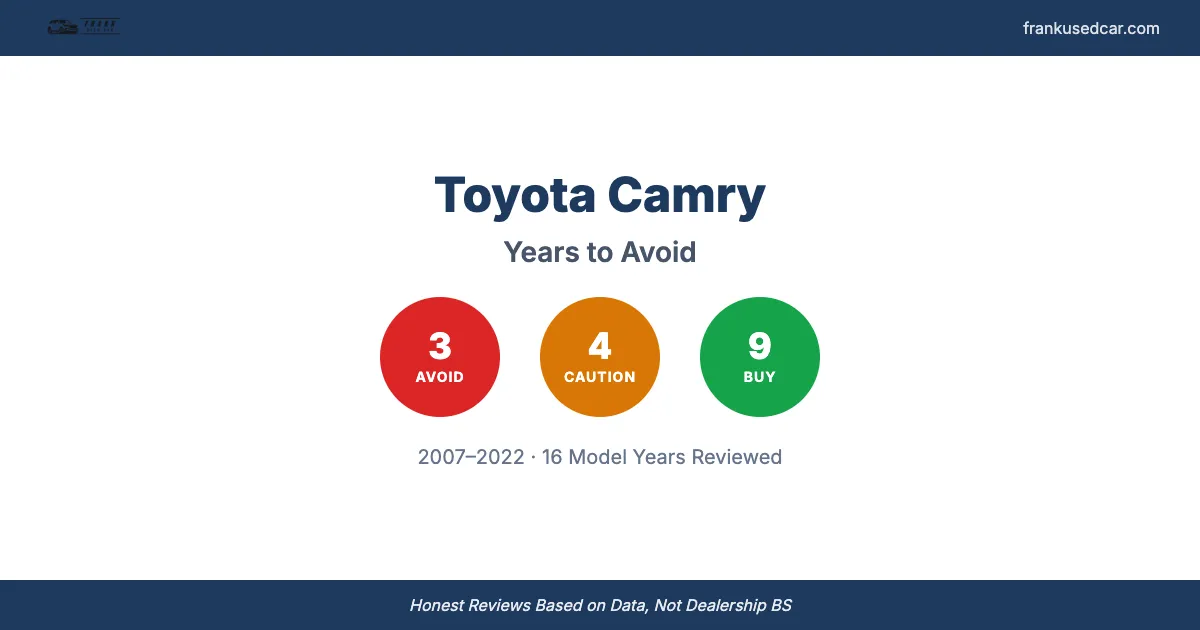
Toyota Camry best and worst years ranked by generation. 2020 is Frank's top pick. Avoid 2007-2009 entirely. Reliability data, repair costs, and buying advice.
The Toyota Camry is America’s best-selling midsize sedan — but the difference between the best and worst model years is the difference between a $20,000 bargain and a $5,000 money pit. The Toyota Camry has been in production since 1982 across eight generations. Best years like the 2020 have near-zero NHTSA complaints. Worst years like the 2007 have 3,572 — the highest of any Camry ever made.
I’ve bought, inspected, or helped friends buy over 50 used cars in 20 years — and the Camry is the single most requested car. I also owned a 2007 Camry that burned a quart of oil every 1,000 miles. Here’s which model years are actually worth your money.
This guide covers the Toyota Camry best and worst years by generation, reliability by year, and which year gives you the best value at every budget. Here’s the full ranked overview:
| Year | Frank’s Verdict | Key Strength or Issue |
|---|---|---|
| 2020 | BUY — TOP PICK | Mature Gen8, TSS 2.5, near-zero complaints |
| 2021 | BUY | 56 complaints, zero recalls, identical to 2020 |
| 2022 | BUY | Continued Gen8 refinement, near-zero complaints |
| 2016 | BUY | Peak Gen7 reliability, feature-rich |
| 2017 | BUY | TSS-P available, last Gen7, mature |
| 2015 | BUY | Gen7 refresh, proven 2AR-FE engine |
| 2014 | BUY | Mid-Gen7, budget sweet spot at $12K-$16K |
| 2019 | OK | 317 complaints, most issues resolved |
| 2018 | CAUTION | 632 complaints, transmission hesitation, fuel pump recall |
| 2012 | CAUTION | First Gen7, torque converter issue (4-cyl) |
| 2013 | CAUTION | Same torque converter concern |
| 2010 | CAUTION | Declining oil issue, recall baggage |
| 2011 | CAUTION | Last 2AZ-FE year, 608 complaints |
| 2007 | AVOID | WORST Camry ever — 3,572 complaints, oil burn, dash melt |
| 2008 | AVOID | Oil consumption, 1,000+ complaints |
| 2009 | AVOID | Oil + acceleration recalls, 2,000+ complaints |
| 2002-2003 | AVOID | Transmission failures, $3,280 avg repair bill |
Why Is the 2020 Camry Frank’s Top Pick?
The 2020 Toyota Camry is Frank’s top pick because it combines the mature Gen8 TNGA-K platform with near-zero NHTSA complaints, standard Toyota Safety Sense 2.5, and an available hybrid powertrain rated at 52 MPG combined — at used prices that have finally entered the depreciation sweet spot.
The 2018 was the first Gen8 year. It came with a buggy Direct Shift-8AT transmission that hesitated and rough-shifted. Toyota issued TSB #T-SB-0330-17 for PCM reprogramming. NHTSA logged 632 complaints for the 2018. By 2020, those gremlins were gone.
Standard Toyota Safety Sense 2.5 gives you pre-collision braking, adaptive cruise control, lane departure alert, and automatic high beams. Every 2020 Camry has it — no trim-gating.
The hybrid option delivers 52 MPG combined. Used hybrid premium runs $1,500-$3,500 over the gas model. At 12,000 miles per year and $3.50/gallon, the hybrid saves about $505 annually in fuel.
A 2020 Camry SE with 35K miles lists around $20,000-$24,000. A new Camry starts at $28,000+. You’re saving $4,000-$8,000 for a mechanically identical car with all the transmission bugs sorted out.
I helped a coworker find a 2020 Camry LE last spring. 28,000 miles. $21,500. Six months later — zero issues. That’s exactly what a mature Gen8 Camry does.
Frank’s Verdict: BUY — TOP PICK. The 2020 Toyota Camry delivers refined Gen8 reliability at the depreciation sweet spot. Near-zero NHTSA complaints. Standard safety tech. Available 52 MPG hybrid. This is the Camry to buy.
The 2020 is the best Gen8 pick — but Gen7 has some of the strongest value plays in the entire Camry lineup.
What Are the Best Gen6 Camry Years? (2007-2011)
The Gen6 Toyota Camry (2007-2011) is the worst generation in the Camry’s history — every single model year carries either an AVOID or CAUTION verdict, making this the one generation I tell everyone to skip entirely.
The Gen6 runs the infamous 2AZ-FE four-cylinder engine. A piston ring defect causes excessive oil consumption — 1 quart per 1,000 miles on affected units. The repair bill for piston ring replacement runs $2,000-$3,500.
The 2007 is the worst Camry ever made. NHTSA logged 3,572 complaints — 7x the baseline rate. Oil consumption, dashboard melting, transmission sticking, and the unintended acceleration recalls all hit this single model year.
| Year | Frank’s Verdict | Key Detail | NHTSA Complaints |
|---|---|---|---|
| 2007 | AVOID | Oil burn + dash melt + trans, worst ever | 3,572 |
| 2008 | AVOID | Oil consumption dominant, 258 oil-specific reports | 1,000+ |
| 2009 | AVOID | Oil + acceleration recalls | 2,000+ |
| 2010 | CAUTION | Oil declining, 9 recalls | 606 |
| 2011 | CAUTION | Last 2AZ-FE year, 5 recalls | 608 |
I owned a 2007 Camry. It burned a quart of oil every 1,000 miles. The dashboard cracked and became sticky in the Texas heat. The accelerator pedal recall letter arrived three months after I bought it. That car is the reason I started researching model years before buying — and eventually the reason this site exists.
The 3.5L 2GR-FE V6 in the Gen6 doesn’t have the oil consumption issue — it’s the 2.4L 2AZ-FE four-cylinder that’s the problem. But V6 models are rare on the used market and still carry the dashboard and recall baggage.
The Gen5 (2002-2006) has its own problems. The 2002-2003 models have transmission failures averaging $3,280 to fix. If you’re shopping below $8,000, skip Gen5 and Gen6 entirely and look at Gen7.
Gen7 is where the Camry gets good again — and the best Gen7 years are genuine bargains.
Is the 2010 or 2011 Camry Worth the Risk?
The 2010 and 2011 Toyota Camry are borderline. The oil consumption issue from the 2AZ-FE is technically still present — Toyota’s TSB covers 2007-2011. Complaint rates dropped significantly compared to 2007-2009.
Check the oil level cold before any test drive. If it’s a quart low or you see blue exhaust smoke at startup, walk away. Floor mat and accelerator recalls must be verified as completed by VIN. Dashboard warranty extension expired in 2017 — any cracking is the owner’s cost now at $1,500-$2,500 to replace.
If someone offers you a 2010 or 2011 Camry with documented oil consumption checks and all recalls completed, it’s a $6,000-$10,000 car that might last another 100K miles. But for $2,000-$4,000 more, a 2014 Camry eliminates every one of these concerns. That’s the math I’d do.
What Are the Best Gen7 Camry Years? (2012-2017)
The best Gen7 Toyota Camry years are the 2014, 2015, 2016, and 2017, which resolved the 2012-2013’s torque converter issues and introduced the proven 2.5L 2AR-FE engine — making them the strongest value picks in the entire Toyota Camry best and worst years lineup.
Gen7 brought a new 2.5L 2AR-FE engine. No more oil consumption. The 2AZ-FE piston ring defect is history. A 6-speed automatic replaced the old 5-speed. The 3.5L 2GR-FE V6 carried over.
The 2012-2013 were the first Gen7 years. Torque converter shudder on four-cylinder models prompted a Toyota extended service campaign. Verify fix completion on any 2012-2014.
By 2014, the platform matured. The 2015 refresh added features and styling updates. The 2017 is the last Gen7 with available TSS-P.
| Year | Frank’s Verdict | Key Detail |
|---|---|---|
| 2012 | CAUTION | Torque converter issue (4-cyl) |
| 2013 | CAUTION | Same torque converter concern |
| 2014 | BUY | Mid-Gen7, budget sweet spot |
| 2015 | BUY | Refresh year, proven reliability |
| 2016 | BUY | Excellent reliability, feature-rich |
| 2017 | BUY | TSS-P available, last Gen7, mature |
A 2015-2017 Camry with 70K-110K miles runs $14,000-$18,000. That’s a car with 100K+ miles of life left, no oil consumption worries, and modern safety features — at half the price of new.
I helped three different friends buy Gen7 Camrys in 2024. All went with 2015-2016 models between $14,500 and $16,800. Zero issues across all three. The 2AR-FE engine just works.
Is the 2014 Toyota Camry a Good Used Buy?
Yes, the 2014 Toyota Camry is a strong mid-budget buy. It’s the first Gen7 model year where the torque converter issue is either fixed or verifiable. The oil consumption defect of the 2AZ-FE is gone. Prices have settled into the $12,000-$16,000 sweet spot.
The 2.5L 2AR-FE doesn’t have the piston ring issue. Backup camera comes standard from 2014. Torque converter concern from 2012-2013 has a Toyota extended service campaign — verify completion.
The 2014 is where I start recommending Camrys to budget buyers. Everything below this year carries either oil consumption risk or transmission uncertainty. At $12,000-$16,000, the 2014 is reliable transportation for another decade.
Is the 2016 Toyota Camry Worth Buying?
Yes, the 2016 Toyota Camry is one of the most reliable Camry model years ever made. Very low NHTSA complaint density. Feature-rich interior. Prices have depreciated to $14,000-$18,000 with typical mileage of 60K-110K miles.
Between the 2015 and 2017, the 2016 sits in the reliability sweet spot — all the 2015 refresh improvements with one more year of production maturity. The 2017 costs $1,000-$2,000 more for TSS-P availability. Worth it only if you prioritize adaptive cruise control.
A neighbor bought a 2016 Camry SE with 72,000 miles for $15,200 in early 2025. Oil changes and a set of tires — that’s the entire maintenance story so far. That’s peak Gen7.
What Are the Best Gen8 Camry Years? (2018-Present)
The best Gen8 Toyota Camry years are the 2020, 2021, and 2022, which fixed the 2018’s first-year transmission hesitation and benefit from standard Toyota Safety Sense 2.5 — the 2020 is Frank’s overall top pick for the entire Toyota Camry best and worst years lineup.
Gen8 rides on Toyota’s TNGA-K platform. The 2.5L Dynamic Force A25A-FKS engine pairs with an 8-speed Direct Shift-8AT. Hybrid models use an eCVT for 52 MPG combined. V6 option continued through 2023.
NHTSA logged 632 complaints for the 2018 — transmission hesitation and rough shifting were the top issues. The 2019 improved to 317 complaints. By 2020, near-zero complaints.
| Year | Frank’s Verdict | Key Detail | NHTSA Complaints |
|---|---|---|---|
| 2018 | CAUTION | Transmission hesitation, fuel pump recall | 632 |
| 2019 | OK | Most issues resolved, fuel pump recall | 317 |
| 2020 | BUY — TOP PICK | Near-zero complaints, TSS 2.5 | Near-zero |
| 2021 | BUY | 56 complaints, zero recalls | 56 |
| 2022 | BUY | Same quality, above depreciation sweet spot | Near-zero |
| 2023-2024 | BUY | Excellent, approaching new prices | Near-zero |
The 2020 Camry often costs $2,000-$4,000 LESS than the 2021 with similar miles — and the reliability is identical. That’s the irrational used market working in your favor.
The 3.5L V6 was available in Gen8 through 2023. The 2GR-FKS produces 301 hp and is genuinely reliable. But V6 models hold value better, so the price gap narrows.
The fuel pump recall (expanded January 2025) affects 2018-2020 models. Check completion by VIN before purchasing any early Gen8.
Is the 2021 Toyota Camry a Good Used Buy?
Yes, the 2021 Toyota Camry is an excellent used buy. Only 56 NHTSA complaints filed. Zero recalls issued. One of the cleanest model years in the entire Camry history.
Mechanically identical to the 2020 with minor updates. The only reason the 2021 isn’t Frank’s top pick over the 2020 is price. The 2021 typically costs $2,000 more for no meaningful reliability difference.
At $22,000-$26,000 with 20K-45K miles, the 2021 is a solid pick. If you find a 2021 priced close to a comparable 2020, take the 2021. The 2020 is the smarter money play when there’s a price gap.
Is the Toyota Camry Hybrid Worth Buying Used?
Yes, the Camry Hybrid is worth buying used. The 2020-2022 models deliver 52 MPG combined with the same Toyota reliability as the gas version. The $1,500-$3,500 used price premium over gas models pays for itself in fuel savings within 3-7 years at average driving.
The Camry Hybrid uses Toyota’s eCVT — a planetary gear set that Toyota has been building since the original Prius in 1997. It’s one of the most proven drivetrains in automotive history. Not a traditional belt-driven CVT like Nissan’s.
Fuel savings math at $3.50/gallon and 12,000 miles/year: the gas Camry gets 32 MPG combined, costing $1,313/year in fuel. The hybrid gets 52 MPG, costing $808/year. Annual savings: $505. At $4.00/gallon, savings jump to $577/year with break-even at 2.5-6 years.
For budget buyers looking at 2015-2017, the gas four-cylinder at 28 MPG combined is still excellent. Avoids any hybrid battery concerns at that age.
Avoid the 2018 hybrid — same first-year transmission bugs as the gas model. The 2020+ hybrid is the sweet spot. 52 MPG combined is class-leading for midsize sedans.
Which Toyota Camry Years Should You Avoid?
The 2007, 2008, 2009, 2002-2003, and 2018 Toyota Camry are the model years to avoid — the 2007 alone has 3,572 NHTSA complaints, more than double any other Camry year ever made.
| Year | Frank’s Verdict | Key Issue | Risk Level |
|---|---|---|---|
| 2007 | AVOID | Oil burn + dash melt + trans — WORST Camry ever, 3,572 complaints | HIGH |
| 2008 | AVOID | Oil consumption, 1,000+ complaints | HIGH |
| 2009 | AVOID | Oil + acceleration recalls, 2,000+ complaints | HIGH |
| 2002-2003 | AVOID | Transmission failures, $3,280 avg repair bill | MODERATE |
| 2018 | CAUTION | Transmission hesitation, fuel pump recall, 632 complaints | MODERATE |
| 2010-2011 | CAUTION | Declining oil issue, recall baggage | LOW-MODERATE |
| 2012-2013 | CAUTION | Torque converter (4-cyl) | LOW |
For the full breakdown of what goes wrong in each of these years — oil consumption, dashboard melting, transmission failures, unintended acceleration — read the complete Toyota Camry years to avoid guide.
The pattern is clear: avoid first-year models of any new Camry generation. The 2007 (Gen6 launch), 2012 (Gen7 launch), and 2018 (Gen8 launch) all had first-year teething problems. But the 2007 wasn’t just a first-year issue — the entire Gen6 four-cylinder is compromised by the 2AZ-FE oil burn.
Most people think all Toyotas are bulletproof. My 2007 Camry proved otherwise. Even the most reliable brand overall has model years that cost you thousands.
How Reliable Is the Toyota Camry by Year?
The Toyota Camry reliability varies dramatically by generation — the 2016-2017 Gen7 and 2020-2022 Gen8 models earn 9/10 ratings, while the 2007-2009 Gen6 models score 2-3/10 based on NHTSA complaint density and repair cost severity.
My rating isn’t based on customer satisfaction surveys. It’s based on one thing: how likely is this car to cost you money in repairs?
| Year | Generation | Frank’s Rating | Key Strength | Key Risk |
|---|---|---|---|---|
| 2002 | Gen5 | 4/10 | Affordable | Transmission failures |
| 2003 | Gen5 | 4/10 | Affordable | Transmission failures |
| 2004 | Gen5 | 6/10 | Improved Gen5 | Some engine issues |
| 2005 | Gen5 | 7/10 | Late Gen5 | Fewer issues |
| 2006 | Gen5 | 7/10 | Last Gen5 | Relatively stable |
| 2007 | Gen6 | 2/10 | None | Worst Camry ever |
| 2008 | Gen6 | 3/10 | Affordable | Oil consumption |
| 2009 | Gen6 | 3/10 | Affordable | Oil + recalls |
| 2010 | Gen6 | 5/10 | Oil declining | 606 complaints, 9 recalls |
| 2011 | Gen6 | 5/10 | Last 2AZ-FE | 608 complaints, 5 recalls |
| 2012 | Gen7 | 6/10 | New engine | Torque converter (4-cyl) |
| 2013 | Gen7 | 6/10 | Improving | Torque converter |
| 2014 | Gen7 | 8/10 | Mid-Gen7 | Budget sweet spot |
| 2015 | Gen7 | 8/10 | Refresh | Proven reliability |
| 2016 | Gen7 | 9/10 | Feature-rich | Excellent reliability |
| 2017 | Gen7 | 9/10 | TSS-P, mature | Last Gen7 |
| 2018 | Gen8 | 5/10 | New platform | Transmission bugs |
| 2019 | Gen8 | 7/10 | Improving | Most issues resolved |
| 2020 | Gen8 | 9/10 | TOP PICK | Near-zero complaints |
| 2021 | Gen8 | 9/10 | Cleanest year | 56 complaints, zero recalls |
| 2022 | Gen8 | 9/10 | Refined | Above depreciation sweet spot |
RepairPal rates the Toyota Camry 4.0 out of 5.0 with an average annual repair cost of $388 — well below the $652 industry average. But that’s a brand-level average. Individual model years tell a completely different story.
J.D. Power gives the Camry high marks overall. But they weight customer satisfaction equally with mechanical reliability. A 2007 Camry owner who loved the styling still filed an NHTSA complaint for oil consumption. Satisfaction and reliability are not the same thing.
What Is the Best Used Camry for the Money?
The best used Camry for the money depends on your budget — the 2014-2015 wins under $16,000, the 2016-2017 wins at $14,000-$18,000, and the 2020-2021 wins at $20,000-$26,000, with each tier offering the best reliability-to-price ratio in its range.
| Budget Tier | Recommended Year | Typical Price | Typical Mileage | Why |
|---|---|---|---|---|
| Budget ($12K-$16K) | 2014-2015 | $12,000-$16,000 | 80K-130K | Gen7 sweet spot, no oil consumption, proven 2AR-FE |
| Mid ($14K-$18K) | 2016-2017 | $14,000-$18,000 | 60K-110K | Peak Gen7 reliability, TSS-P available on 2017 |
| Premium ($20K-$26K) | 2020-2021 | $20,000-$26,000 | 20K-60K | Frank’s top picks, Gen8 refined, hybrid available |
A $14,000 Camry with $388/year in repairs costs $15,164 over 3 years. A $6,000 2007 Camry with $2,000+ in oil consumption fixes costs $8,000+ — and the engine may still fail. The cheaper car loses on total cost because you picked the wrong model year.
The depreciation sweet spot sits at 3-5 year old models. The 2020-2022 models are entering that window now. Best time to buy a Gen8.
Keep 15% of your budget in reserve for first-year repairs. A $20,000 budget means $17,000 for the car and $3,000 in the repair fund.
I don’t recommend any Camry below $10,000 at this point. The Gen6 models that populate that price range carry too much oil consumption risk. Save for a 2014+ or look at a different car entirely. Camry depreciation is slow — that’s a sign of quality, not a reason to buy older.
Which Camry Generation Is Most Reliable?
The Gen8 Camry (2018-present) is the most reliable generation overall with the lowest complaint rates per unit sold, followed closely by the mature Gen7 years (2014-2017), while the Gen6 (2007-2011) is the worst generation in the Camry’s 40-year history — and it’s not even close.
| Rank | Generation | Years | Engine | Reliability Tier |
|---|---|---|---|---|
| 1 | Gen8 (2020+) | 2020-2024 | 2.5L Dynamic Force / Hybrid | Excellent |
| 2 | Gen7 (mature) | 2014-2017 | 2.5L 2AR-FE | Excellent |
| 3 | Gen7 (early) | 2012-2013 | 2.5L 2AR-FE | Good |
| 4 | Gen5 (late) | 2004-2006 | 2.4L 2AZ-FE / V6 | Good |
| 5 | Gen8 (early) | 2018-2019 | 2.5L Dynamic Force | Fair-Good |
| 6 | Gen5 (early) | 2002-2003 | 2.4L 2AZ-FE / V6 | Below Average |
| 7 | Gen6 | 2007-2011 | 2.4L 2AZ-FE / V6 | Poor |
The Gen6 Camry is an anomaly. Toyota’s reputation for bulletproof sedans took its biggest hit during 2007-2011. The 2AZ-FE oil consumption, the dashboard melting, the unintended acceleration recalls — this generation had it all.
Gen7 was Toyota’s correction. Gen8 was the refinement.
Mid-generation years are always more reliable than launch years — that’s the single most important lesson in used car buying. The 2014 beats the 2012. The 2020 beats the 2018. Every time.
How Does the Camry Compare to Other Midsize Sedans?
The Toyota Camry matches the Honda Accord in long-term used car reliability and beats the Hyundai Sonata, Nissan Altima, and Mazda6 — though the Accord edges ahead on RepairPal score (4.5 vs 4.0) and the Camry wins on hybrid efficiency.
| Model | RepairPal Score | Annual Repair Cost | Best Used Years | Worst Years |
|---|---|---|---|---|
| Toyota Camry | 4.0/5.0 | $388/yr | 2020-2022, 2015-2017, 2014 | 2007-2009, 2002-2003, 2018 |
| Honda Accord | 4.5/5.0 | $400/yr | 2020-2022, 2016-2017 | 2008-2009 (V6 trans), 2013-2015 (CVT early) |
| Hyundai Sonata | 4.0/5.0 | $458/yr | 2020-2022, 2018-2019 | 2011-2014 (Theta II engine fires) |
| Nissan Altima | 4.0/5.0 | $483/yr | 2020-2022 | 2013-2018 (CVT failures) |
The Accord is the Camry’s only real competition in used reliability. Both are excellent. The Camry’s edge: better hybrid (52 vs 48 MPG) and lower repair cost ($388 vs $400). The Accord’s edge: slightly higher RepairPal score and a more engaging driving experience.
The Sonata and Altima cost less to buy but more to maintain. The Sonata’s Theta II engine fire risk in 2011-2014 makes those years a dealbreaker. The Altima’s CVT failures in 2013-2018 are a dealbreaker too.
Even the Camry’s bad years are better than most competitors’ good years. That’s the Toyota brand advantage — consistent engineering across decades.
For a complete rundown on how the Accord holds up, see the Honda Accord years to avoid guide. The full used Toyota buying guide covers every model in the lineup.
What Should You Check Before Buying a Used Camry?
Check these seven items before buying any used Toyota Camry — each targets a specific problem documented in this guide that varies by generation and model year.
Check oil level cold and look for blue exhaust smoke on startup. The 2007-2011 models burn oil from the 2AZ-FE piston ring defect. This is the #1 dealbreaker. If it burns oil at the test drive, walk away.
Scan ECM with an OBD-II scanner for fault codes. Look for transmission-related codes on 2018 models and engine codes on 2007-2011. A $30 Bluetooth scanner catches problems a test drive won’t.
Test the transmission through all gears in stop-and-go traffic. Feel for hesitation or rough shifting — especially on the 2018 Gen8 Direct Shift-8AT and the 2002-2003 Gen5 automatic.
Check NHTSA recall status by VIN. Verify unintended acceleration recall completion on 2007-2010 models. Verify fuel pump recall on 2018-2020 models. The expanded fuel pump recall (January 2025) adds units — check even if previously cleared.
Inspect the dashboard for cracking or sticky texture. The 2007-2011 Gen6 dashboard warranty extension expired in 2017. Any remaining damage is the owner’s cost — $1,500-$2,500 to replace.
Verify torque converter service campaign completion on 2012-2014 four-cylinder models. Ask for service records showing Toyota extended warranty work. No records? Budget for potential $1,200-$2,500 torque converter replacement.
Request complete service history with oil change intervals. Regular oil changes are the single best predictor of Camry longevity. I’ve seen Camrys hit 300K miles on nothing but routine maintenance.
These aren’t random suggestions. Each item maps to a specific Camry problem pattern I’ve documented by generation. A 2020 Camry needs items 3 and 7. A 2007 needs all seven.
For a complete pre-purchase framework that works on any model, see the used car buying guide.
Also see: Toyota Years to Avoid
- best year toyota camry
- worst year toyota camry
- toyota camry reliability by year
- best used toyota camry
- most reliable toyota camry year
- best camry generation
- camry hybrid vs gas
- best-and-worst-years