Toyota Camry Years to Avoid and Best Years to Buy
The 2007, 2008, and 2009 Toyota Camry have serious oil consumption defects. See which Camry years to avoid and which are worth buying used.
The Toyota Camry is America’s best-selling midsize sedan with a legendary reliability reputation — but three model years from 2007-2009 have an oil consumption defect serious enough to avoid entirely.
The Toyota Camry has been produced since 1982, and most model years deliver 200,000+ trouble-free miles. Toyota Camry years to avoid share one root cause: the 2AZ-FE 4-cylinder engine’s defective piston rings.
Toyota settled a class action lawsuit over this flaw. The 2007-2009 Camry models account for more oil consumption complaints than all other Camry years combined.
Toyota is the most reliable brand overall. Even bad Camry years are better than most competitors’ good years — but that doesn’t mean you should ignore the data.
I’ve reviewed the NHTSA complaint records on every Camry model year. This guide covers years to avoid, 2007-2009 problems, 2012 and 2018 cautions, common Camry problems, reliability by year, recalls, best years, and a pre-purchase inspection checklist.
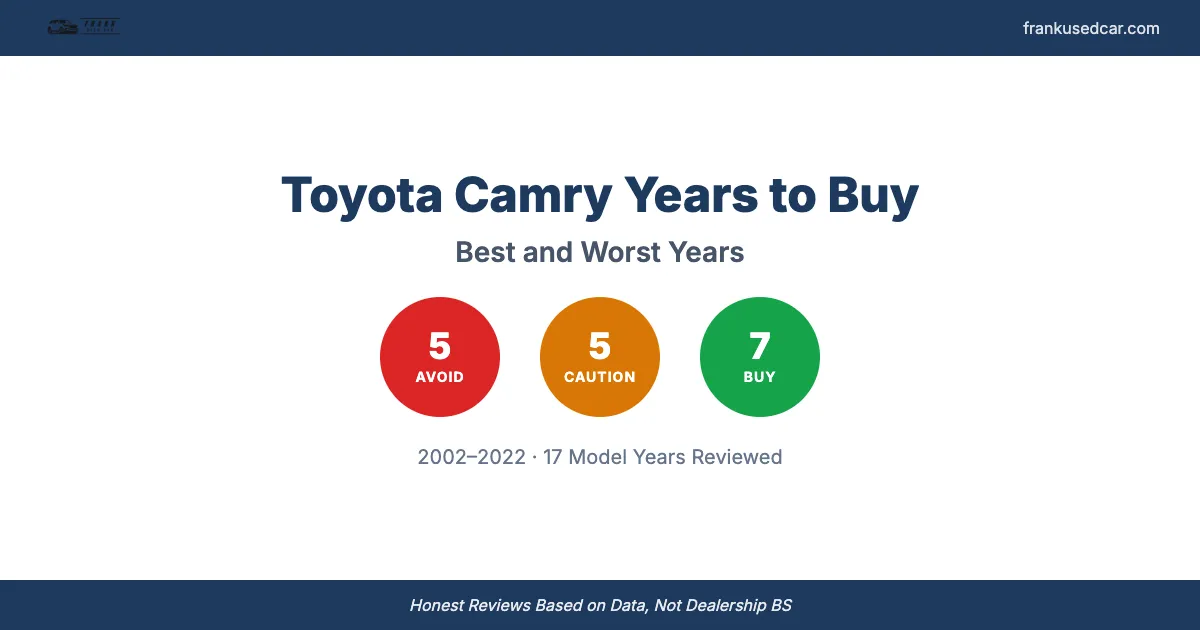
| Year | Frank’s Verdict | Key Issue | Risk Level |
|---|---|---|---|
| 2007 | AVOID | 2AZ-FE oil consumption + dashboard cracking | High |
| 2008 | AVOID | 2AZ-FE oil consumption + transmission shudder | High |
| 2009 | AVOID | 2AZ-FE oil consumption + VVT-i oil line leaks | High |
| 2010-2011 | CAUTION | Tail-end oil consumption (less severe) | Medium |
| 2012 | CAUTION | Dashboard melting/sticky surface (worst year) | Medium |
| 2013-2014 | BUY | Mid-Gen7, strong reliability | Low |
| 2015-2017 | BUY | Late Gen7, fully refined | Low |
| 2018 | CAUTION | First-year TNGA platform | Medium |
| 2019-2022 | BUY | Mature Gen8, excellent reliability | Low |
Which Toyota Camry Years Should You Avoid?
The 2007, 2008, and 2009 Toyota Camry are the three model years to avoid, based on NHTSA complaint density and the severity of the 2AZ-FE engine oil consumption defect.
The 2012 and 2018 Camry earn CAUTION ratings for less severe but documented issues.
Here’s the thing about Toyota — even their worst years are more reliable than most brands’ best years. But the 2007-2009 Camry’s oil consumption problem is real and expensive. Repair costs range from $2,000 to $5,000 depending on severity.
I’ve helped friends walk away from cheap-looking 2007-2009 Camry deals. The purchase price looks attractive until you factor in the engine repair bill. A 2013+ Toyota Camry costs slightly more upfront with none of these risks.
Let’s start with the worst offender — the 2007 Camry.
What Problems Does the 2007 Toyota Camry Have?
The 2007 Toyota Camry has the highest complaint count of any Camry model year, with excessive oil consumption in the 2AZ-FE 4-cylinder engine, dashboard cracking, and transmission hesitation reported at rates that surprise people who assume all Toyotas are bulletproof.
This was the first year of the Gen6 redesign. Toyota introduced a larger body and new features, but the 2AZ-FE engine’s piston ring design created a serious oil burning defect. Oil consumption typically begins between 40,000 and 80,000 miles.
The 2007 Camry burns through 1 quart of oil every 1,200-2,000 miles. That burn rate accelerates as mileage increases. Dashboard cracking from sun exposure adds another expensive repair to the list.
I see 2007 Toyota Camry listings at $6,000-$8,000 with 100,000 miles. At that mileage, the 2AZ-FE oil consumption is almost guaranteed. A 2013 Camry costs $2,000 more with none of these problems.
- Oil consumption: 2AZ-FE burns 1 qt per 1,200-2,000 miles starting at 40,000-80,000 miles
- Dashboard cracking: Sun exposure degrades dash material, $1,500-$2,500 to replace
- Transmission hesitation: Harsh shifts reported at 30,000-60,000 miles
- Brake pulsation: Vibration complaints at 25,000-40,000 miles
Frank’s Verdict: AVOID The 2007 Camry’s oil consumption issue tarnishes Toyota’s reputation for a reason. The 2013+ Gen7 models are better in every way.
Why Does the 2007 Camry Burn Oil?
The 2007 Toyota Camry burns oil because the 2AZ-FE 4-cylinder engine has undersized piston ring oil return holes that allow oil to pass into the combustion chamber, a design flaw Toyota later acknowledged with a class action settlement.
The piston rings cannot properly scrape oil from the cylinder walls. Oil seeps past the rings and burns during combustion. Blue exhaust smoke is the most visible symptom of this Toyota Camry oil consumption defect.
Toyota’s response confirmed the severity. The class action settlement covered 2007-2009 Camry owners, and Toyota extended warranties for affected vehicles. Piston ring replacement costs $2,000-$3,500. A full engine rebuild runs $3,500-$5,000.
The 2AR-FE engine in the Gen7 Toyota Camry (2012+) uses a completely different piston ring design. That engine largely eliminated the oil consumption problem.
Does the 2007 Camry Have Dashboard Problems?
Yes, the 2007 Toyota Camry has a well-documented dashboard cracking and melting problem caused by sun exposure degrading the dashboard material, with Toyota offering a limited warranty extension for affected vehicles.
Heat and UV radiation break down the dashboard surface material. Cracks spread across the dash, and in hot climates, the surface becomes sticky and deformed. This Toyota Camry dashboard issue affects 2007-2011 models.
Replacement cost runs $1,500-$2,500 for a new dashboard. Toyota’s warranty extension helped some owners, but coverage was limited by mileage and age. I’ve seen 2007 Camry dashboards that look like melted plastic in Arizona and Texas.
What Problems Does the 2008 Toyota Camry Have?
The 2008 Toyota Camry continues the same 2AZ-FE oil consumption defect as the 2007 and adds transmission shudder complaints that make it the second year to avoid in the Gen6 lineup.
Oil consumption in the 2008 Camry typically starts between 35,000 and 75,000 miles. The same piston ring design flaw causes the same oil burning pattern. Transmission shudder during acceleration adds a second expensive problem.
The 2008 Toyota Camry also introduces ABS actuator pump noise at 60,000+ miles. This noise is loud enough to alarm owners on cold starts. Power steering pump leaks appear at 80,000+ miles.
The 2008 is essentially the same car as the 2007 with the same problems. If you’re avoiding the 2007 Toyota Camry, there’s no reason to consider the 2008 either.
- Oil consumption: 2AZ-FE defect, onset at 35,000-75,000 miles
- Transmission shudder: During acceleration, reported at 40,000-70,000 miles, $2,500-$4,500 rebuild
- ABS actuator noise: Pump noise on cold start at 60,000+ miles, $1,000-$2,000 to fix
- Power steering leak: At 80,000+ miles, $400-$800 repair
Frank’s Verdict: AVOID Same oil-burning engine as the 2007, plus transmission shudder. Skip the entire 2007-2009 range.
The 2009 is the last year of this problematic stretch.
What Problems Does the 2009 Toyota Camry Have?
The 2009 Toyota Camry is the last year with the 2AZ-FE oil consumption problem, though complaints are slightly less severe than 2007-2008, and adds metallic rattling noise complaints and VVT-i oil line leaks.
Toyota improved the piston rings slightly for the 2009 model year. Oil consumption onset pushes later, typically 50,000-90,000 miles. The fundamental design flaw remained, but fewer owners report extreme burn rates.
VVT-i oil line leaks appear at 60,000-100,000 miles on the 2009 Toyota Camry. This is a separate issue from the piston ring oil consumption. Repair cost for VVT-i lines runs $200-$500.
The 2009 is the least bad of the three avoid years. I’d still skip it — the 2010+ models finally addressed the worst of the 2AZ-FE oil consumption issues.
- Oil consumption: Improved but still present, onset at 50,000-90,000 miles
- VVT-i oil line leaks: At 60,000-100,000 miles, $200-$500 repair
- Metallic rattling: At idle, reported across multiple 2009 Camry units
- Dashboard stickiness: Same material degradation as 2007-2008
Frank’s Verdict: AVOID Better than the 2007-2008 but still carries the 2AZ-FE oil consumption risk. The 2010+ models finally addressed this.
The 2012 Camry brought a new generation but also new concerns.
What Problems Does the 2012 Toyota Camry Have?
The 2012 Toyota Camry was the first year of the Gen7 redesign and had the worst dashboard melting/sticky surface problem of any Camry model year, along with some initial quality issues typical of first-year models.
The Gen7 Toyota Camry switched to the 2AR-FE engine. Oil consumption problems largely disappeared. The dashboard material, though, introduced a new defect — surfaces degrade into a sticky, melting mess.
The 2012 Camry dashboard issue is more annoying than dangerous, but it’s expensive to fix. Toyota’s warranty extension didn’t cover everyone. Factor $1,500-$2,500 into your budget if the dashboard hasn’t been replaced.
Bluetooth connectivity issues and steering pull complaints round out the 2012 Toyota Camry’s problem list. Wind noise at highway speeds bothers some owners.
- Dashboard melting: Worst year for sticky/melting dash surface
- Bluetooth issues: Connectivity drops and pairing failures
- Steering pull: Drift complaints at highway speeds
- Wind noise: At highway speeds, noted by multiple owners
Frank’s Verdict: CAUTION The dashboard issue is the main concern. If it’s been replaced under warranty, the 2012 can be a solid buy. Check the dash surface before you sign anything.
The 2018 Camry brought another new generation.
What Problems Does the 2018 Toyota Camry Have?
The 2018 Toyota Camry was the first year on Toyota’s TNGA platform (Gen8) and introduced minor first-year issues including wind noise at highway speeds and infotainment learning curve complaints, though overall reliability remained strong.
Toyota’s TNGA platform turned out to be excellent. The Dynamic Force engine in the 2018 Camry delivers better fuel economy and performance than the outgoing Gen7. First-year growing pains were minor.
The 2018 Toyota Camry’s issues don’t compare to the 2007-2009 oil consumption disaster. Wind noise and infotainment quirks were fixed under warranty for most owners. No systemic mechanical defects plague this model year.
If you can find a 2019 Toyota Camry for similar money, that’s the smarter play. The 2019 refined everything the 2018 introduced. But the 2018 is not a dealbreaker — it’s a minor caution.
Frank’s Verdict: CAUTION First-year TNGA growing pains, nothing serious. The 2019+ models are slightly safer bets.
These individual year problems feed into larger patterns across the Toyota Camry lineup.
What Are the Most Common Toyota Camry Problems?
The most common Toyota Camry problems across all model years are 2AZ-FE oil consumption, dashboard cracking/melting, transmission hesitation, and ABS actuator noise — though the Camry has fewer systemic problems than almost any competitor.
| Problem | Severity | Estimated Cost | Affected Years |
|---|---|---|---|
| Oil Consumption (2AZ-FE) | SERIOUS | $2,000-$5,000 | 2007-2009 |
| Dashboard Cracking/Melting | MODERATE | $1,500-$2,500 | 2007-2014 |
| Transmission Hesitation/Shudder | SERIOUS | $2,500-$4,500 | 2007-2008 |
| ABS Actuator Noise | MODERATE | $1,000-$2,000 | 2008-2010 |
The Toyota Camry’s “common problems” list is shorter than most cars’ highlights. When problems do appear, they cluster in specific years. The Gen7 (2012-2017) and Gen8 (2018+) Camry models have dramatically fewer complaints.
Toyota Camry years to avoid share these problems at the highest rates. The Gen6 2007-2009 stretch is where nearly every serious issue concentrates.
Is Toyota Camry Oil Consumption Serious?
Toyota Camry oil consumption is serious in 2007-2009 models with the 2AZ-FE engine, where the piston ring design flaw can lead to $2,000-$3,500 in repair costs and potential engine failure if oil levels aren’t monitored regularly.
Toyota settled a class action over this issue — that tells you everything about how widespread it was. Unchecked oil consumption leads to low oil levels, which causes bearing damage and eventual engine seizure.
The 2AR-FE engine in the Gen7 Toyota Camry (2012+) largely eliminated the problem. Oil consumption complaints drop by over 90% in post-2011 model years. The 2AZ-FE is the culprit, not the Camry nameplate.
Does the Camry Have Transmission Problems?
Toyota Camry transmission problems are limited primarily to 2007-2008 models with shudder during acceleration and 2002 models with surging, costing $2,500-$4,500 for a rebuild — Gen7 and Gen8 Camrys have significantly fewer transmission complaints.
The 2007-2008 Toyota Camry transmission shudder occurs during acceleration at 40,000-70,000 miles. The torque converter is the typical failure point. This is not a Camry-wide issue — it’s isolated to two model years.
Gen7 (2012-2017) and Gen8 (2018+) Toyota Camry models have some of the lowest transmission complaint rates in the midsize sedan segment.
Does the Camry Have Dashboard Issues?
Yes, the Toyota Camry has documented dashboard cracking in 2007-2011 models and dashboard melting/sticky surface in 2012-2014 models, with Toyota offering limited warranty extensions for both issues.
Two different dashboard problems affect two different generations. The Gen6 Toyota Camry (2007-2011) suffers from UV-induced cracking. The Gen7 Camry (2012-2014) has a surface material that degrades into sticky residue.
Toyota’s warranty extensions covered some owners for both issues. Replacement cost runs $1,500-$2,500 regardless of which generation’s dashboard problem you’re dealing with.
How Reliable Is the Toyota Camry by Year?
The Toyota Camry reliability is exceptional in Gen7 (2013-2017) and Gen8 (2019+) models, but the Gen6 years from 2007-2009 drag down the nameplate’s otherwise stellar track record with the 2AZ-FE oil consumption defect.
| Year(s) | Generation | Frank’s Rating | Key Strength | Key Risk |
|---|---|---|---|---|
| 2002-2006 | Gen5 | 7/10 | Solid V6 option | 2002 transmission surging |
| 2007 | Gen6 | 3/10 | Comfortable ride | Oil consumption + dashboard |
| 2008 | Gen6 | 3/10 | V6 remains strong | Oil consumption + transmission |
| 2009 | Gen6 | 4/10 | Slight improvement | Oil consumption + VVT-i leaks |
| 2010-2011 | Gen6 | 6/10 | Oil issue reduced | Tail-end 2AZ-FE risk |
| 2012 | Gen7 | 6/10 | New 2AR-FE engine | Dashboard melting |
| 2013-2014 | Gen7 | 8/10 | Proven platform | Minimal |
| 2015-2017 | Gen7 | 9/10 | Fully refined | Minimal |
| 2018 | Gen8 | 7/10 | TNGA platform | First-year quirks |
| 2019-2022 | Gen8 | 9/10 | Dynamic Force engine | Minimal |
The Toyota Camry is the most reliable midsize sedan you can buy — period. Reliability isn’t binary, though. The 2007-2009 models prove that even Toyota can have a bad run.
Toyota Camry reliability by year shows a clear pattern: avoid first-year redesigns and the entire 2007-2009 stretch. Mid-cycle and late-cycle Camry models earn the reputation Toyota is famous for.
Has the Toyota Camry Been Recalled?
The Toyota Camry has been subject to several NHTSA recalls, with the most notable being the 2009-2011 floor mat/unintended acceleration recall that affected millions of Toyota vehicles and the oil consumption class action settlement covering 2007-2009 models.
| Recall ID | Year(s) | Date Issued | Issue | Fix |
|---|---|---|---|---|
| 09V388000 | 2007-2010 | Oct 2009 | Floor mat traps accelerator pedal | Pedal modification + mat replacement |
| 10V017000 | 2007-2010 | Jan 2010 | Accelerator pedal friction lever sticks | Reinforcement bar installation |
| 15V689000 | 2007, 2009 | Oct 2015 | Power window switch overheat/fire risk | Switch inspection and replacement |
| 12V491000 | 2007-2009 | Oct 2012 | Power window switch malfunction/fire risk | Special grease application or replacement |
A Toyota Camry recall isn’t always bad news — it means Toyota acknowledged and fixed the problem for free. The accelerator pedal recalls were serious safety issues that Toyota addressed with dealer repairs.
Always check the NHTSA recall database before buying any used Toyota Camry. Enter the VIN to see if all recalls have been completed. Unresolved Toyota Camry recalls are free to fix at any dealer.
Now that you know what to avoid, here are the years worth buying.
What Are the Best Toyota Camry Years to Buy?
The best Toyota Camry years to buy used are the 2015, 2016, 2017, and 2019-2022 models — refined Gen7 and mature Gen8 vehicles with bulletproof reliability and significantly lower complaint rates than the 2007-2009 problem years.
If I were buying a used Toyota Camry today, I’d get the 2017. It’s the last year of Gen7 — fully refined, proven reliable, and prices have dropped enough to be a genuine bargain.
A 2017 Toyota Camry costs about the same as a 2009 with half the miles. The 2017 will last longer with fewer problems. That math makes the buying decision simple.
The 2019-2022 Toyota Camry models on the mature TNGA platform offer the newest tech with proven reliability. The hybrid option gets 52 MPG combined. For more Toyota buying advice, see our Toyota reliability guide.
- 2017 Camry: Frank’s TOP PICK — last Gen7, lowest complaint rate, best value
- 2016 Camry: Near-identical to 2017, slightly lower price
- 2015 Camry: Refreshed styling, same Gen7 reliability
- 2019 Camry: First refined Gen8, Dynamic Force engine
- 2020-2022 Camry: Mature Gen8, Toyota Safety Sense 2.5 standard
Is the 2017 Toyota Camry Worth Buying Used?
Yes, the 2017 Toyota Camry is one of the most reliable used sedans you can buy, offering the fully refined Gen7 platform with zero oil consumption concerns, proven transmission reliability, and some of the lowest complaint rates of any Camry model year.
The 2017 Camry represents six years of Gen7 refinement. Every early-production issue was resolved by this point. This Toyota Camry model year routinely reaches 250,000 miles with basic maintenance.
Is the 2020 Toyota Camry a Good Used Buy?
Yes, the 2020 Toyota Camry is a mature Gen8 model on the TNGA platform with the Dynamic Force engine, standard Toyota Safety Sense 2.5, and an available hybrid powertrain that gets 52 MPG combined.
The 2020 Toyota Camry fixed the minor first-year issues from the 2018. Standard safety features include adaptive cruise control, lane departure warning, and automatic emergency braking. The hybrid Toyota Camry version is the most fuel-efficient midsize sedan available.
Is the Toyota Camry a Reliable Sedan Overall?
Yes, the Toyota Camry is the most reliable midsize sedan you can buy. The Camry consistently ranks at or near the top of J.D. Power, Consumer Reports, and owner satisfaction surveys.
The 2007-2009 Toyota Camry oil consumption years prove no nameplate is perfect.
The Toyota Camry beats the Honda Accord on long-term reliability data. The Camry beats the Hyundai Sonata on resale value by a significant margin. Pick the right year and you’ll have a car that runs for 250,000 miles with basic maintenance.
Toyota Camry years to avoid represent a small fraction of the nameplate’s 40+ year production run. For comparison, check our guides on Honda Accord years to avoid and Hyundai Elantra years to avoid.
Toyota is the most reliable brand overall. Even the worst Camry years are better than most competitors’ good years. The data backs this up — the Toyota Camry has fewer NHTSA complaints per model year than any rival in the midsize sedan segment.
How Do You Inspect a Used Toyota Camry Before Buying?
Check these seven items before buying any used Toyota Camry to catch the most common and expensive problems documented by owners.
Check the oil level on the dipstick and look for blue exhaust smoke. Low oil between changes signals the 2AZ-FE consumption defect in 2007-2009 Toyota Camry models. Ask the seller when oil was last added.
Inspect the dashboard surface for cracking or stickiness. Run your hand across the dash. Tacky or cracked surfaces on 2007-2014 Toyota Camry models mean a $1,500-$2,500 replacement is coming.
Test the transmission in city driving for shudder or hesitation. Drive the 2007-2008 Toyota Camry through stop-and-go traffic. Shudder during acceleration from a stop indicates torque converter failure.
Listen for ABS actuator pump noise on cold start. Start the 2008-2010 Toyota Camry cold and listen for a buzzing or humming from under the hood. ABS actuator replacement runs $1,000-$2,000.
Check for metallic rattling at idle. The 2009 Toyota Camry is known for this noise. Rattling at idle can indicate VVT-i system issues or heat shield looseness.
Verify recall completion on the NHTSA website. Enter the Toyota Camry’s VIN to check for unresolved recalls. Free to fix at any Toyota dealer.
Request full service history with oil change intervals. Regular 5,000-mile oil changes on a 2007-2009 Toyota Camry indicate an owner who monitored the oil consumption issue. Gaps in service records are a warning sign.
For a complete pre-purchase walkthrough, see our used car buying guide.
Also see: Toyota Best & Worst Years
- camry years to avoid
- toyota camry problems
- toyota camry reliability
- 2007 toyota camry problems
- toyota camry oil consumption
- toyota camry best years
- toyota camry recall
- toyota camry transmission problems
- toyota camry dashboard melting
- worst toyota camry years
- toyota camry common problems
- toyota camry reliability by year
- years-to-avoid