Honda CR-V Years to Avoid and Best Years to Buy
The 2015, 2017, and 2018 Honda CR-V are the years to avoid. See Frank's verdict on every model year, repair costs, and the best CR-V to buy used.
The Honda CR-V is a compact SUV produced since 1997 that consistently ranks among America’s best-selling vehicles. The CR-V has earned its reputation through six generations of practical design and strong resale value.
Not every Honda CR-V model year is worth buying. Three model years have complaint rates high enough to avoid entirely.
The years to avoid are 2015, 2017, and 2018. NHTSA complaint data shows these CR-V models carry AC compressor failures, oil dilution from the 1.5-liter turbo engine, and vibration problems that cost $800 to $6,000 to fix.
The 2017 and 2018 Honda CR-V share an engine defect that lets gasoline mix with your oil. That single issue makes them the riskiest used CR-V purchases on the market today.
This guide covers which Honda CR-V years to avoid, the specific problems per model year, common CR-V issues across all generations, reliability ratings, recall history, and the best years to buy instead.
Honda is a strong second choice after Toyota for used SUV buyers. Watch for 1.5T turbo and CVT-equipped CR-V models — those are where the trouble concentrates.
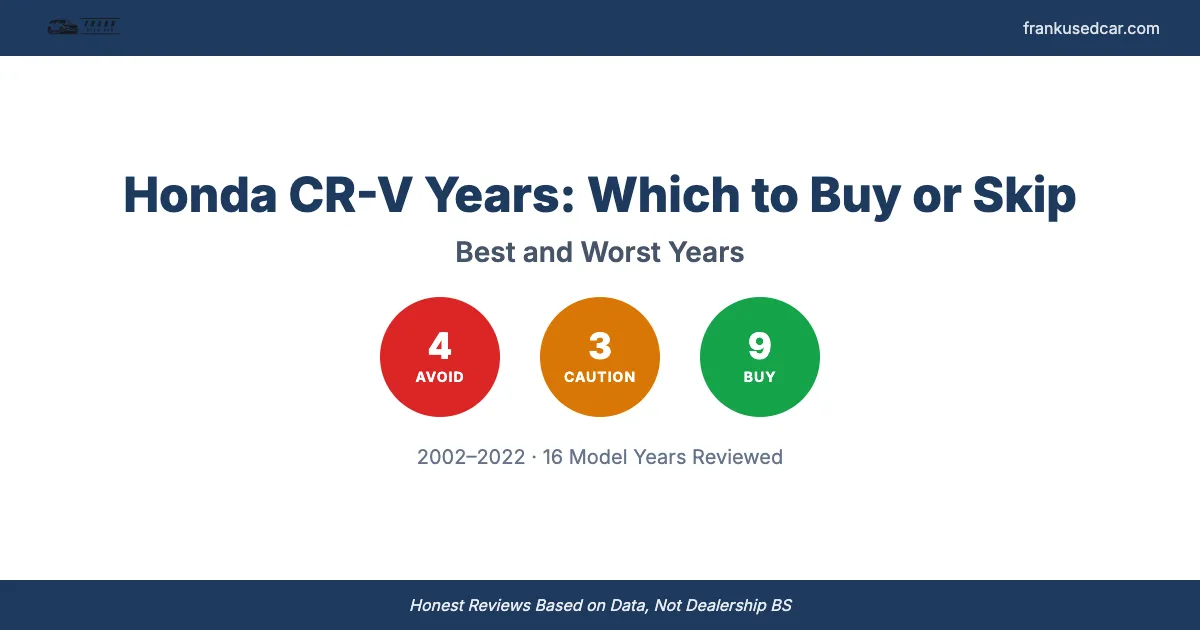
| Year | Frank’s Verdict | Key Issue | Risk Level |
|---|---|---|---|
| 1997-2001 | BUY | Gen1, minimal complaints | Low |
| 2002-2003 | CAUTION | AC compressor failures | Moderate |
| 2004-2006 | BUY | Late Gen2, proven and reliable | Low |
| 2007 | CAUTION | First-year Gen3, AC compressor | Moderate |
| 2008-2011 | BUY | Mature Gen3, K24Z bulletproof | Low |
| 2012 | CAUTION | First-year Gen4, vibration at idle | Moderate |
| 2013-2014 | BUY | Refined Gen4, most issues resolved | Low |
| 2015 | AVOID | AC compressor + vibration at idle | High |
| 2016 | BUY | Late Gen4, improved | Low |
| 2017 | AVOID | Oil dilution (1.5T turbo) | High |
| 2018 | AVOID | Oil dilution + battery drain | High |
| 2019 | CAUTION | Lingering oil dilution risk | Moderate |
| 2020-2022 | BUY | Oil dilution resolved, Honda Sensing | Low |
| 2023+ | BUY | Gen6 redesign, hybrid available | Low |
Which Honda CR-V Years Should You Avoid?
The 2015, 2017, and 2018 Honda CR-V are the three model years to avoid, based on NHTSA complaint density and severity of reported issues.
The 2015 CR-V earned its AVOID rating through AC compressor failures and persistent vibration at idle. Both problems appear at low mileage and cost $800 or more to fix.
The 2017 Honda CR-V introduced the 1.5-liter turbo engine and the oil dilution defect that defines it. Gasoline literally mixes with engine oil in cold weather.
The 2018 CR-V carries the same oil dilution problem plus battery drain complaints. Honda’s factory software update helped but did not eliminate the root cause.
Let’s start with the 2015 CR-V — the worst Gen4 model.
What Problems Does the 2015 Honda CR-V Have?
The 2015 Honda CR-V has the highest complaint count of any Gen4 model, with AC compressor failures, persistent vibration at idle from faulty engine mounts, and hesitation during acceleration reported at unusually high rates.
AC compressor failure strikes the 2015 CR-V between 30,000 and 60,000 miles. Replacement costs run $800 to $1,500 at independent shops.
The 2015 CR-V shakes at every red light. Honda knows about it — they issued a TSB — but the fix doesn’t always work.
Hesitation during acceleration appears between 20,000 and 50,000 miles on the 2015 CR-V. Owners describe the SUV lurching forward unpredictably from stops.
Not every 2015 CR-V has these issues. Complaint rates are significantly higher than the 2014 or 2016 models on the same Gen4 platform.
The 2014 Honda CR-V is a much better Gen4 choice at similar prices.
Frank’s Verdict: AVOID The vibration and AC problems make the 2015 CR-V a frustrating daily driver. The 2014 is a much better Gen4 choice.
Why Does the 2015 CR-V Vibrate at Idle?
The 2015 Honda CR-V vibrates at idle because the engine mounts fail to properly dampen the Earth Dreams 2.4L engine’s vibrations, a design weakness that Honda addressed with a TSB but never fully resolved.
The engine mounts on the 2015 CR-V degrade between 10,000 and 40,000 miles. That’s far earlier than the 100,000-mile lifespan you’d expect from Honda mounts.
Replacing the engine mounts on a 2015 CR-V costs $400 to $800. Some owners report the vibration returns within a year of the repair.
Honda’s TSB acknowledges the problem exists on the 2015 CR-V. The recommended fix — mount replacement — does not address the underlying engine harmonics issue.
What Problems Does the 2017 Honda CR-V Have?
The 2017 Honda CR-V introduced Honda’s 1.5-liter turbocharged engine, and with it came the oil dilution problem — gasoline literally mixes with the engine oil, raising oil levels and creating a fuel smell inside the cabin.
The 2017 CR-V was the first year of Gen5 with the L15B7 turbo engine. Oil dilution onset occurs between 5,000 and 30,000 miles on affected vehicles.
When your engine oil smells like gasoline, something is fundamentally wrong. Honda issued a software update, but the root cause is the engine design.
In cold climates, the 2017 CR-V’s 1.5T simply doesn’t get hot enough to burn off fuel contamination. The problem worsens with short commutes and temperatures below freezing.
Infotainment system lag and freezing affect the 2017 CR-V from new. Wind noise at highway speeds is another common complaint.
I’ve seen 2017 CR-V owners dump thousands into oil changes trying to manage the dilution problem. The math doesn’t work at that point.
Frank’s Verdict: AVOID The oil dilution problem is a design flaw, not a defect Honda can truly fix with software. If you live anywhere it gets cold, skip the 2017 CR-V.
What Causes Honda CR-V Oil Dilution?
Honda CR-V oil dilution happens because the 1.5-liter turbo engine (L15B7) doesn’t reach operating temperature fast enough in cold weather, allowing unburned fuel to pass the piston rings and mix with engine oil in the crankcase.
The L15B7 turbo runs a fuel-rich mixture during cold starts to protect the catalytic converter. That extra fuel washes past the piston rings before the CR-V engine warms up.
Honda’s ECU update raises idle RPM to heat the 1.5T engine faster. The update reduces oil dilution severity on the CR-V but doesn’t eliminate it in sub-freezing temperatures.
Severe oil dilution in the CR-V can accelerate bearing wear and reduce lubrication effectiveness. Engine replacement for oil dilution damage costs $4,000 to $6,000.
What Problems Does the 2018 Honda CR-V Have?
The 2018 Honda CR-V carries the same 1.5T oil dilution problem as the 2017, plus adds battery drain complaints and continued infotainment glitches.
Oil dilution on the 2018 CR-V was slightly improved through Honda’s factory-applied ECU software update. Onset shifted to 10,000 to 40,000 miles — later than the 2017 but still present.
Battery drain hits 2018 CR-V owners at various mileages. Dead batteries after sitting overnight is a recurring complaint on Gen5 forums.
The 2018 CR-V is marginally better than the 2017 because Honda applied the ECU update at the factory. “Marginally better” on a fundamental design issue isn’t enough for me to recommend it.
Fuel smell in the cabin persists in the 2018 CR-V during cold weather driving. Brake noise between 15,000 and 30,000 miles is another documented complaint.
Frank’s Verdict: AVOID Same oil dilution engine as the 2017, factory software update helps but doesn’t solve the root cause.
What Problems Does the 2002-2003 Honda CR-V Have?
The 2002 and 2003 Honda CR-V are early Gen2 models with a recurring AC compressor failure pattern that plagued many Honda vehicles from this era, plus catalytic converter failures at higher mileages.
AC compressor failure on the 2002-2003 CR-V occurs between 50,000 and 80,000 miles. Replacement runs $800 to $1,500 — the same Honda compressor weakness seen across multiple generations.
The 2003 CR-V adds catalytic converter failures at 80,000 to 120,000 miles. That repair costs $1,200 to $2,500 and can trigger check engine lights.
Door lock actuators fail on both the 2002 and 2003 CR-V after 60,000 miles. At $200 to $400 per actuator, it’s annoying but not a dealbreaker.
The 2002-2003 CR-V isn’t terrible — it’s mostly an AC compressor issue. A 2006 is a much safer Gen2 pick with fewer known problems.
Frank’s Verdict: CAUTION AC compressor failure is annoying and expensive ($800-$1,500). The 2006 is the better Gen2 choice.
What Problems Does the 2007 Honda CR-V Have?
The 2007 Honda CR-V was the first year of the Gen3 redesign on the RE platform, and it carried first-year teething issues including AC compressor failures at 40,000-70,000 miles and paint/clear coat problems.
The 2007 CR-V is where Honda switched to the K24Z engine. The platform itself is excellent — first-year production introduced the AC compressor issue that Honda sorted out by 2008.
Paint peeling and clear coat failure appear on the 2007 CR-V within the first five years. Door lock actuator failures carry over from the Gen2 platform.
I helped a friend shop for a Gen3 CR-V last year. Finding a clean 2008 or 2009 instead of a 2007 saved him the AC compressor gamble entirely.
Frank’s Verdict: CAUTION First-year Gen3 AC compressor risk. The 2008-2009 is the sweet spot for Gen3.
What Problems Does the 2012 Honda CR-V Have?
The 2012 Honda CR-V was the first year of the Gen4 on the RM platform, and it carried vibration at idle complaints and some AC compressor issues that were less severe than the 2015 model.
Vibration at idle on the 2012 CR-V appears between 10,000 and 30,000 miles. The same engine mount weakness that plagues the 2015 started here.
Battery drain and Bluetooth connectivity problems round out the 2012 CR-V’s complaint list. Neither is expensive to fix, but both are annoying.
The 2012 CR-V is the in-between year. Most issues were addressed by 2013. The 2014 Honda CR-V is the definitive Gen4 choice.
Frank’s Verdict: CAUTION First-year Gen4 growing pains. The 2014 is the Gen4 sweet spot.
What Problems Does the 2019 Honda CR-V Have?
The 2019 Honda CR-V is an early Gen5 model that still carries some oil dilution risk from the 1.5T engine, though the problem was significantly improved over the 2017-2018 models through Honda’s continued software and hardware refinements.
Most 2019 CR-V owners report no oil dilution at all. Some cold-climate drivers still notice elevated oil levels and faint fuel smell on the dipstick.
The 2019 CR-V is the bridge year between the problematic 2017-2018 and the largely resolved 2020. Honda applied incremental fixes but hadn’t yet made the hardware changes that solved it.
The 2020 Honda CR-V is the safer bet if the price difference is manageable. I’ve seen the gap between a 2019 and 2020 CR-V shrink to under $2,000 in many markets.
Frank’s Verdict: CAUTION Oil dilution risk is minor but still present. The 2020 is the Gen5 sweet spot.
What Are the Most Common Honda CR-V Problems?
The most common Honda CR-V problems across all generations are oil dilution in 1.5T turbo models, AC compressor failures across multiple generations, vibration at idle in Gen4, and battery drain — though severity depends entirely on which generation you buy.
| Problem | Severity | Estimated Cost | Affected Years |
|---|---|---|---|
| Oil dilution (1.5T) | SERIOUS | $1,000-$6,000 | 2017-2019 |
| AC compressor failure | MODERATE | $800-$1,500 | 2002-2003, 2007, 2012, 2015 |
| Vibration at idle (engine mounts) | MINOR | $400-$800 | 2012, 2015 |
| Battery drain | MINOR | $200-$400 | 2012, 2018 |
| Infotainment freezing | MINOR | $0-$1,800 | 2017-2018 |
| Catalytic converter failure | MODERATE | $1,200-$2,500 | 2002-2003 |
Oil dilution earns the SERIOUS label because unchecked cases lead to engine replacement. A $150 software update versus a $6,000 engine swap — that’s the range of outcomes on the same CR-V defect.
AC compressor failure is the Honda CR-V’s most persistent cross-generational weakness. Four different generations share the same failure pattern.
These problem patterns map directly onto the year-by-year reliability picture.
Is Honda CR-V Oil Dilution Dangerous?
Yes, Honda CR-V oil dilution can cause engine damage if left unchecked. When gasoline dilutes the engine oil, it reduces lubrication effectiveness and accelerates bearing wear inside the 1.5T engine.
Most CR-V owners catch oil dilution before catastrophic failure. The fuel smell on the dipstick is an early warning sign that’s hard to miss.
Checking your 2017-2018 CR-V’s oil level every 1,000 miles is essential. Oil that smells like gasoline or reads above the full mark on the dipstick needs immediate attention.
Honda recommends shorter oil change intervals for affected CR-V models. Every 3,000 miles instead of 7,500 miles reduces the risk of dilution damage.
Do Honda CR-Vs Have AC Compressor Problems?
Yes, AC compressor failure is the most persistent Honda CR-V problem, appearing in Gen2 (2002-2006), Gen3 (2007), Gen4 (2012, 2015), and even some Gen5 models. It’s a cross-generational Honda weakness.
The CR-V’s AC compressor replacement costs $800 to $1,500 regardless of generation. The part itself is the primary expense — labor runs about 2-3 hours.
Testing the AC at full blast for 10 minutes before buying any used CR-V is the single best screening test. Warm air from a CR-V’s vents after 10 minutes means the compressor is failing.
Does the CR-V Have Electrical Issues?
Honda CR-V electrical issues are relatively minor, with the most common being battery drain in 2012 and 2018 models and infotainment freezing/lag in 2017-2018 Gen5 models.
Battery replacement on the CR-V costs $200 to $400. The drain issue typically stems from parasitic draw rather than a defective battery.
Infotainment problems on the 2017-2018 CR-V range from free software updates to $1,000-$1,800 unit replacements. Most dealers handle the software fix under warranty.
CR-V electrical issues rarely strand you on the roadside. They’re annoyances, not safety risks — unlike oil dilution or AC failure.
How Reliable Is the Honda CR-V by Year?
Honda CR-V reliability varies by generation — Gen3 (2007-2011) with the K24Z engine and late Gen5 (2020-2022) earn the highest marks, while the 2015 Gen4 and 2017-2018 Gen5 are the clear weak spots.
| Year | Generation | Frank’s Rating (1-10) | Key Strength | Key Risk |
|---|---|---|---|---|
| 1997-2001 | Gen1 | 7 | Simple, durable B20 engine | Age-related wear |
| 2002-2003 | Gen2 | 6 | Spacious, practical | AC compressor |
| 2004-2006 | Gen2 | 8 | Refined, proven | Minimal |
| 2007 | Gen3 | 7 | K24Z engine debut | First-year AC issues |
| 2008-2011 | Gen3 | 9 | Bulletproof K24Z, low complaints | Minimal |
| 2012 | Gen4 | 7 | Larger interior, CVT | First-year vibration |
| 2013-2014 | Gen4 | 8 | Mature Gen4 platform | Minimal |
| 2015 | Gen4 | 4 | Interior space | AC + vibration |
| 2016 | Gen4 | 7 | Late Gen4, improved | Minor issues |
| 2017 | Gen5 | 3 | Honda Sensing available | Oil dilution |
| 2018 | Gen5 | 4 | Honda Sensing standard | Oil dilution + battery |
| 2019 | Gen5 | 6 | Improved 1.5T calibration | Lingering oil dilution |
| 2020-2022 | Gen5 | 9 | Oil dilution resolved, safety tech | Minimal |
| 2023+ | Gen6 | 8 | Hybrid option, redesigned | Too new for full data |
The Honda CR-V is Honda’s most important vehicle. When they get it right, it’s one of the best compact SUVs you can buy.
When they get it wrong, it’s a $25,000 headache. The 2017 CR-V proves that point.
Before buying any used CR-V, check the recall history. A completed recall means a free fix — an open recall means leverage in price negotiation.
Has the Honda CR-V Been Recalled?
The Honda CR-V has been subject to several NHTSA recalls and TSBs, with the most significant being the 2017-2018 oil dilution software update and recurring safety issues across multiple model years.
| Recall ID | Year(s) | Date Issued | Issue | Fix |
|---|---|---|---|---|
| 15V121000 | 2015 | March 2015 | Improperly torqued connecting rod bolts — engine power loss, oil leak, stall with fire risk | Dealer engine short block replacement |
| 17V442000 | 2017 | July 2017 | Fuel supply pipe may disconnect and leak fuel while driving | Dealer fuel supply pipe replacement |
| 18V663000 | 2017-2018 | Sept 2018 | Power steering torque sensor magnet dislodges, steering assist in wrong direction | Dealer steering gearbox replacement |
| 23V158000 | 2017-2020 | March 2023 | Front seat belt buckle may not latch properly | Dealer seat belt buckle replacement |
| 23V858000 | 2015, 2017 | Dec 2023 | Fuel pump inside fuel tank may fail, causing engine stall | Dealer fuel pump module replacement |
Source: NHTSA recall database, verified March 2026.
A recall isn’t always bad news — it means Honda acknowledged the problem and will fix it for free. Check any CR-V’s recall status through the NHTSA recall database before purchase.
The 2017 CR-V appears in three separate recalls. That volume of safety issues on a single model year reinforces the AVOID rating.
Now that you know what to avoid, here are the Honda CR-V years worth buying.
What Are the Best Honda CR-V Years to Buy?
The best Honda CR-V years to buy used are the 2020, 2021, 2008, 2009, and 2014 models. The 2020-2021 are mature Gen5 vehicles with the oil dilution issue largely resolved. The 2008-2009 Gen3 models have the bulletproof K24Z engine.
If I were buying a used CR-V today, I’d get the 2020. Honda fixed the oil dilution issue with hardware changes, Honda Sensing is standard, and prices sit in the $22,000-$26,000 range.
For budget buyers, the 2008-2009 Gen3 Honda CR-V is one of the best used SUVs under $10,000. The K24Z engine runs for 200,000+ miles with basic maintenance.
The 2014 CR-V is the Gen4 sweet spot at $12,000-$16,000. It avoids the 2015’s AC and vibration problems while offering the same interior space.
The 2010-2011 CR-V models deserve mention too. Late Gen3 vehicles share the same proven K24Z platform as the 2008-2009 with no new issues.
For more on Honda’s overall reliability track record, see our Honda reliability guide.
Is the 2020 Honda CR-V Worth Buying Used?
Yes, the 2020 Honda CR-V is the turning point for the Gen5 lineup. Honda applied hardware fixes to the oil dilution problem, standard Honda Sensing makes it one of the safest compact SUVs, and reliability complaints dropped sharply.
The 2020 CR-V earns a 9 out of 10 in Frank’s rating. That’s the same score as the legendary 2008-2011 Gen3 models.
Oil dilution complaints on the 2020 CR-V dropped to near zero. Honda’s hardware changes — not just software — addressed the 1.5T turbo’s cold-weather fuel contamination issue.
Is the 2009 Honda CR-V a Good Used Buy?
Yes, the 2009 Honda CR-V is the best budget option in the CR-V lineup. It’s a mature Gen3 model with the proven K24Z engine, minimal complaints, and prices often under $10,000 for clean examples.
The 2009 CR-V lacks modern safety tech like Honda Sensing and automatic emergency braking. That’s the trade-off for a sub-$10,000 price tag.
In 20 years of buying used cars, the Gen3 CR-V is one of the most reliable compact SUVs I’ve come across. The K24Z engine is Honda engineering at its best.
Is the Honda CR-V a Reliable Compact SUV Overall?
Yes, the Honda CR-V is a reliable compact SUV when you buy the right model year. The 2017-2018 oil dilution era and persistent AC compressor issues mean it’s not as consistently dependable as the Toyota RAV4.
The Toyota RAV4 doesn’t have a single generation-defining defect like the CR-V’s oil dilution problem. That gives the RAV4 the edge in overall reliability — see our Toyota RAV4 years to avoid guide for details.
The Subaru Forester offers superior AWD capability but has its own head gasket and CVT concerns. Our Subaru Forester years to avoid guide covers those issues.
The CR-V’s interior space and practicality are class-leading. If you pick the right year, it’s the best daily driver in its segment.
Honda is a strong second choice after Toyota for used compact SUVs. Watch for 1.5T and CVT-equipped CR-V models — those generations carry the highest risk.
How Do You Inspect a Used Honda CR-V Before Buying?
Check these seven items before buying any used Honda CR-V to avoid the most common and expensive problems reported by owners.
Pull the dipstick and smell the oil for gasoline. On 2017-2018 CR-V models, fuel-smelling oil confirms active oil dilution. Oil above the full mark is another warning sign.
Run the AC at full blast for 10 minutes. AC compressor failure affects CR-V models across all generations. Warm air after 10 minutes means the compressor is dying.
Idle for 5 minutes and feel for vibration through the steering wheel. The 2012 and 2015 CR-V models are prone to engine mount failure that causes noticeable shaking at idle.
Check battery voltage with a multimeter. A healthy CR-V battery reads 12.4-12.7 volts with the engine off. Below 12.2 volts on a 2012 or 2018 CR-V suggests parasitic drain.
Test Honda Sensing in traffic on Gen5 CR-V models (2017+). Adaptive cruise control and lane keeping should engage smoothly without false alerts.
Verify recall and TSB completion. Enter the CR-V’s VIN through the NHTSA recall database. Open recalls mean free repairs — and negotiating leverage.
Request oil change records with oil analysis if available. Consistent 3,000-mile oil changes on a 2017-2019 CR-V suggest the previous owner was managing oil dilution proactively.
For a complete pre-purchase inspection process that applies to any used vehicle, see our used car buying guide.
Also see: Honda Best & Worst Years
- honda cr-v oil dilution
- honda crv problems
- honda cr-v reliability
- 2017 honda crv problems
- honda crv best years
- 2015 honda crv problems
- honda crv recall
- honda crv ac compressor
- honda crv transmission problems
- honda crv common problems
- years-to-avoid