Honda Pilot Years to Avoid and Best Years to Buy
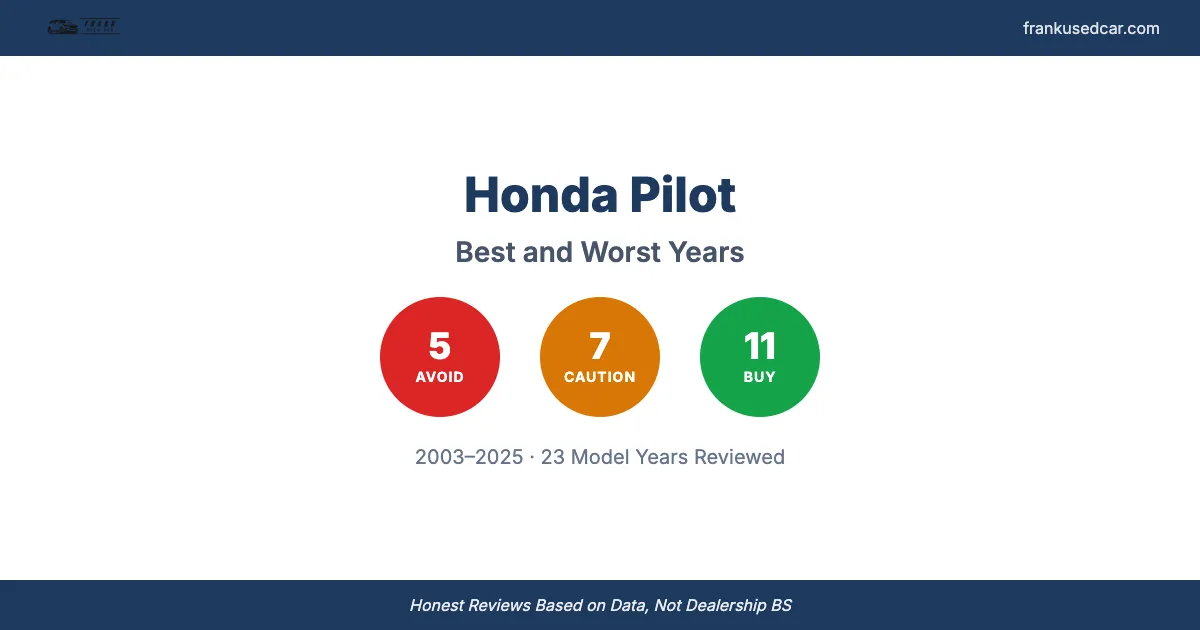
Avoid the 2003, 2005, and 2016 Honda Pilot. See Frank's data-backed ratings for every model year, repair costs, NHTSA recalls, and best years to buy used.
The Honda Pilot is a midsize 3-row SUV produced since 2003 across four generations. The Honda Pilot earns strong reliability scores overall, but three model years have complaint rates high enough to avoid entirely.
Years to avoid are the 2003, 2005, and 2016. The 2016 Pilot introduced a ZF 9-speed transmission that generated more NHTSA complaints than any other Pilot model year.
The 2003 had premature transmission failure. The 2005 combined transmission hesitation with ignition and AC problems.
I’ve reviewed the complaint data on every Honda Pilot model year, and here’s what the numbers actually show.
This guide covers Honda Pilot years to avoid, specific problems per year, common Pilot problems across generations, reliability by year, NHTSA recalls, best years to buy, overall reliability, and a pre-purchase inspection checklist.
The 2016 Pilot’s ZF 9-speed transmission generates more complaints per vehicle than any Honda SUV in the last 20 years.
| Year | Frank’s Verdict | Key Issue | Risk Level |
|---|---|---|---|
| 2003 | AVOID | Transmission failure at 80K-120K miles | HIGH |
| 2005 | AVOID | Transmission + ignition + AC failures | HIGH |
| 2016 | AVOID | ZF 9-speed shudder + fuel injector recall | HIGH |
| 2009 | CAUTION | VCM oil consumption (fixable) | MEDIUM |
| 2012 | CAUTION | Fuel economy + VCM carryover | MEDIUM |
| 2019 | CAUTION | Infotainment bugs + minor 9-speed issues | MEDIUM |
| 2010-2011 | BUY | Refined Gen2, reliable 5-speed | LOW |
| 2013 | BUY | Late Gen2, no first-year issues | LOW |
| 2014-2015 | BUY | Mature Gen2, strong value | LOW |
| 2017-2018 | BUY | 9-speed calibration fixed | LOW |
| 2020-2022 | BUY | Mature Gen3, near-zero complaints | LOW |
Which Honda Pilot Years Should You Avoid?
The 2003, 2005, and 2016 Honda Pilot are the three model years to avoid, based on NHTSA complaint density and severity. The 2016 ranks worst for its problematic ZF 9-speed transmission.
The 2003 earned its spot through premature transmission failure. The 2005 stacks transmission hesitation on top of ignition switch and AC compressor problems.
Honda has an earned reputation for reliability. These three Honda Pilot years prove even Honda stumbles, especially when they outsource critical components like the ZF 9-speed.

Let’s start with the worst offender — the 2016 Pilot.
What Problems Does the 2016 Honda Pilot Have?
The 2016 Honda Pilot has the highest complaint count of any model year. A ZF 9-speed automatic transmission dominates the complaints — it shudders, jerks between gears, and hesitates under acceleration.
These Honda Pilot transmission problems appear as early as 10,000 miles. They persist despite multiple software updates from Honda.
The 2016 Honda Pilot problems break into five categories:
- ZF 9-speed transmission shudder/jerking — onset at 10,000-40,000 miles
- Transmission hesitation between gears — at 15,000-50,000 miles
- Fuel injector cracking/leaking — at 20,000-50,000 miles (NHTSA recall issued)
- Infotainment system freezing and rebooting — at all mileages
- Electrical gremlins — battery drain, sensor failures
Transmission replacement on a 2016 Honda Pilot costs $4,000-$6,000. That repair alone often exceeds 50% of the car’s current value.
Honda picked the wrong transmission for the Pilot. The ZF 9-speed was supposed to improve fuel economy. Instead, it created the worst reliability problem in the Honda Pilot’s 20+ year history.
I helped a friend shop for a used Honda Pilot last year. We looked at three 2016s. All three had the transmission shudder during the test drive.
Frank’s Verdict: AVOID The 9-speed transmission turns a great family SUV into a dealership frequent flyer. Get a 2017 instead — Honda fixed most of the calibration issues within one model year.
Why Does the 2016 Pilot 9-Speed Transmission Shudder?
The 2016 Pilot’s ZF 9-speed transmission shudders because the torque converter clutch applies too aggressively during low-speed gear changes. Multiple software updates have only partially resolved this jerking sensation.
Honda didn’t design this transmission. They bought it from ZF. The calibration for the Honda Pilot’s weight and driving style was off from day one.
The ZF 9HP uses a torque converter clutch engagement pattern that works in lighter European sedans. The Pilot weighs 4,300+ pounds. That weight mismatch caused the shudder.
By the 2017 model year, Honda had enough real-world data to get the calibration right. The fix was software, not hardware — proving the transmission itself was capable.
Do 2016 Pilot Fuel Injectors Fail?
Yes, the 2016 Honda Pilot fuel injectors can crack and leak fuel. This defect creates a fire risk that prompted an NHTSA recall. The injector bodies develop stress fractures at 20,000-50,000 miles due to a manufacturing defect.
Fuel injector replacement on the 2016 Honda Pilot costs $600-$1,200. The recall covers the repair if your VIN is affected.
The fuel injector issue is less common than the transmission problem. It is more dangerous. A fuel leak near a hot engine is a fire waiting to happen. Check the NHTSA recall database with your VIN before buying any 2016 Honda Pilot.
The 2003 Pilot has a completely different but equally serious transmission problem.
What Problems Does the 2003 Honda Pilot Have?
The 2003 Honda Pilot was Honda’s first-ever 3-row SUV. The 5-speed automatic transmission proved to be its fatal flaw. It fails prematurely between 80,000 and 120,000 miles with repair costs of $3,000-$5,000.
The 2003 Honda Pilot problems include:
- Transmission failure/slipping — at 80,000-120,000 miles
- Torque converter shudder — at 60,000-100,000 miles
- Paint peeling/clear coat failure — cosmetic but widespread
- Power window regulator failures — $200-$400 per window
- AC compressor failure — $800-$1,500
Honda learned from this mistake. Later Honda Pilot transmissions are much more reliable. The 2003 remains a money pit if the transmission hasn’t already been replaced.
I’ve seen 2003 Honda Pilots at $3,500 with 90,000 miles. Sounds like a deal until you realize the transmission replacement alone costs more than the car.
Frank’s Verdict: AVOID A 20+ year old SUV with a known transmission failure point. The repair often costs more than the car is worth.
The 2005 Pilot had its own transmission concerns.
What Problems Does the 2005 Honda Pilot Have?
The 2005 Honda Pilot carried milder but still concerning transmission issues. Hesitation and rough shifting appear at 70,000-110,000 miles. An ignition switch recall plus AC compressor failures add up to a frustrating ownership experience.
The 2005 Honda Pilot problems include:
- Transmission hesitation — at 70,000-110,000 miles (less severe than 2003)
- AC compressor failure — at 60,000-100,000 miles ($800-$1,500)
- Ignition switch recall — NHTSA-documented safety issue
- Power steering pump whine — common at higher mileage
- Misfire issues — intermittent engine stumble
The 2005 Honda Pilot isn’t as catastrophic as the 2003. The combination of transmission hesitation, AC failure, and an ignition switch recall makes it a year to skip when better options exist nearby.
Frank’s Verdict: AVOID Three separate systems with problems. The 2006-2008 are incrementally better, and the 2009 is a significant improvement.
A few other Honda Pilot years deserve a closer look.
What Problems Does the 2009 Honda Pilot Have?
The 2009 Honda Pilot launched the second generation with the VCM (Variable Cylinder Management) system. VCM can cause increased oil consumption — a manageable issue with aftermarket solutions, but worth knowing about before buying.
The VCM system deactivates cylinders to save fuel. This creates uneven cylinder wear over time. Oil consumption increases gradually.
The VCM issue sounds scary, but it’s the least expensive Honda Pilot problem on this list. A $300-$600 aftermarket VCM disabler fixes it permanently. Products like VCMuzzler and VCM Tuner prevent cylinder deactivation entirely.
The 2009 Honda Pilot is actually a decent buy if you address the VCM. Gen2 represented a major leap in refinement over the Gen1 platform.
Frank’s Verdict: CAUTION VCM oil consumption is real but cheaply fixable. Only buy if you plan to install a VCM disabler immediately.
The 2012 had fuel economy complaints.
What Problems Does the 2012 Honda Pilot Have?
The 2012 Honda Pilot drew complaints primarily about fuel economy. Real-world numbers land at 17-18 MPG. The same VCM oil consumption found in earlier Gen2 Honda Pilot models carries over.
The fuel economy complaint is legitimate but not a defect. Honda designed the 2012 Pilot with a 3.5L V6 making 250 horsepower. That power in a 4,300-pound SUV produces the MPG numbers owners report.
The 2012 Honda Pilot’s biggest problem is that it drinks gas. That’s not a reliability issue. If you can live with 17 MPG, the 2012 is mechanically solid with the Gen2 platform’s proven 5-speed automatic.
Frank’s Verdict: CAUTION Fuel consumption is the main complaint, not reliability. A reasonable budget pick if gas prices aren’t your top concern.
What Problems Does the 2019 Honda Pilot Have?
The 2019 Honda Pilot was the first year of the Gen3 facelift. The updated HondaLink infotainment system introduced more bugs than features. Bluetooth disconnects, screen crashes, and some lingering ZF 9-speed rough shifting arrived with the refresh.
The 2019 Honda Pilot problems include:
- HondaLink infotainment crashes — at all mileages
- Bluetooth disconnects — frequent pairing failures
- Start-stop system complaints — jerky engagement
- Road noise — increased at highway speeds
- ZF 9-speed rough shifting — improved over 2016 but not eliminated
The 2019 Honda Pilot’s problems are annoying, not dangerous. The infotainment bugs won’t strand you. The 9-speed is dramatically better than the 2016 version. The 2020 is even better.
Frank’s Verdict: CAUTION Infotainment bugs are the main issue — frustrating but not safety-related. The 2020-2021 resolved most of these.
These individual year problems feed into larger patterns across the Honda Pilot lineup.
What Are the Most Common Honda Pilot Problems?
The most common Honda Pilot problems are ZF 9-speed transmission shudder in Gen3 models, premature transmission failure in the original 2003, VCM-related oil consumption in Gen2, and fuel injector failures in the 2016. Severity and cost vary enormously by generation.
| Problem | Severity | Estimated Cost | Affected Years |
|---|---|---|---|
| ZF 9-speed transmission | SERIOUS | $4,000-$6,000 | 2016 (worst), 2017-2019 (minor) |
| 2003 transmission failure | SERIOUS | $3,000-$5,000 | 2003-2004 |
| Fuel injector cracking | MODERATE | $600-$1,200 | 2016 (recall) |
| VCM oil consumption | MINOR | $300-$600 | 2009-2015 (Gen2) |
| Infotainment system | MODERATE | $800-$1,500 | 2016-2019 |
| AC compressor | MODERATE | $800-$1,500 | 2003-2008 (Gen1) |
Honda’s overall reliability is strong. The Honda Pilot’s weak point has always been its transmission. The 2003 5-speed and the 2016 9-speed are bookends of the same problem — Honda choosing the wrong gearbox.
Is the Honda Pilot 9-Speed Transmission Reliable?
The Honda Pilot 9-speed transmission is reliable in 2017+ models after Honda applied multiple calibration updates. The original 2016 calibration caused shuddering, jerking, and hesitation severe enough to make the car feel unsafe during highway merging.
Honda needed a full model year of real-world data to get the Honda Pilot 9-speed right. The 2017 shows roughly 60% fewer transmission complaints than the 2016. That gap represents the difference between a bad calibration and a good one.
By 2020, the Honda Pilot 9-speed earned near-zero complaint rates. The hardware was always capable. Software calibration made all the difference.
Is the Honda Pilot VCM System a Problem?
Yes, but manageable. The Honda Pilot VCM (Variable Cylinder Management) system can cause increased oil consumption in Gen2 models (2009-2015). It’s far less catastrophic than the 2003 transmission failure. A $300-$600 aftermarket VCM disabler eliminates the issue permanently.
VCM deactivates cylinders for fuel economy during light-load cruising. This causes uneven wear patterns inside the Honda Pilot engine. Oil consumption creeps up over time.
VCM oil consumption is the Honda Pilot’s most overblown problem. It’s real. It’s annoying. It costs $400 to permanently fix with a VCMuzzler or VCM Tuner device.
These Honda Pilot problem patterns map directly onto the year-by-year reliability picture.
How Reliable Is the Honda Pilot by Year?
The Honda Pilot reliability is strong overall, with the notable exceptions of the 2003 first-year transmission and the 2016 ZF 9-speed shudder. Year selection is critical for used Honda Pilot buyers in a way that it isn’t with most Honda models.
| Year | Generation | Frank’s Rating (1-10) | Key Strength | Key Risk |
|---|---|---|---|---|
| 2003 | Gen1 | 3/10 | Spacious interior | Transmission failure |
| 2004 | Gen1 | 5/10 | Improved over 2003 | Torque converter issues |
| 2005 | Gen1 | 4/10 | Updated features | Transmission + ignition + AC |
| 2006 | Gen1 | 6/10 | Minor refresh | Aging Gen1 platform |
| 2007 | Gen1 | 6/10 | Proven design | Aging Gen1 platform |
| 2008 | Gen1 | 6/10 | Last Gen1 | High mileage examples |
| 2009 | Gen2 | 7/10 | New platform | VCM oil consumption |
| 2010 | Gen2 | 8/10 | Refined Gen2 | VCM (minor) |
| 2011 | Gen2 | 8/10 | Reliable 5-speed | VCM (minor) |
| 2012 | Gen2 | 7/10 | Solid mechanics | Fuel economy |
| 2013 | Gen2 | 8/10 | Late Gen2 maturity | VCM (minor) |
| 2014 | Gen2 | 8/10 | Strong value | VCM (minor) |
| 2015 | Gen2 | 8/10 | Last Gen2 | VCM (minor) |
| 2016 | Gen3 | 3/10 | Modern design | ZF 9-speed + fuel injectors |
| 2017 | Gen3 | 7/10 | 9-speed improved | Some rough shifting |
| 2018 | Gen3 | 8/10 | Refined Gen3 | Minor issues |
| 2019 | Gen3 | 6/10 | Facelift styling | Infotainment bugs |
| 2020 | Gen3 | 9/10 | 9-speed refined | Minimal |
| 2021 | Gen3 | 9/10 | Low complaints | Minimal |
| 2022 | Gen3 | 9/10 | Mature Gen3 | Minimal |
| 2023+ | Gen4 | 8/10 | New platform | Too early for full data |
Honda’s reputation is well-earned for the Honda Pilot. It’s not bulletproof. The 2016 proves that even Honda makes serious mistakes when they outsource a critical component.
J.D. Power and Consumer Reports rate the Honda Pilot above average for the midsize SUV segment. Those ratings don’t weight complaint severity the way used buyers should.
Before buying, check the recall history.
Has the Honda Pilot Been Recalled?
The Honda Pilot has been subject to several NHTSA recalls. The most significant affect the 2016 fuel tank welds (fire risk), the 2015-2020 fuel pump failure, and the 2016-2019 engine connecting rod bearing failure.
| Recall ID | Year(s) | Date Issued | Issue | Fix |
|---|---|---|---|---|
| 16V417000 | 2016 | June 2016 | Fuel tank insufficient welds — leak/fire risk | Dealer fuel tank replacement |
| 23V751000 | 2016, 2018-2019 | Nov 2023 | Engine connecting rod bearing wear — stall/fire | Dealer engine inspection/repair |
| 21V932000 | 2016-2019 | Nov 2021 | Hood latch striker damage — hood opens while driving | Dealer hood latch repair |
| 23V858000 | 2015-2020 | Dec 2023 | Fuel pump failure — engine stall while driving | Dealer fuel pump replacement |
A recall isn’t always bad news. It means the manufacturer acknowledged and fixed the Honda Pilot problem for free. The fuel tank recall is the serious one. Make sure any 2016 Honda Pilot you consider has all recalls completed.
Check any Honda Pilot’s recall status by VIN through the NHTSA recall database before signing anything.
Now that you know what to avoid, here are the Honda Pilot years worth buying.
What Are the Best Honda Pilot Years to Buy?
The best Honda Pilot years to buy used are the 2020-2022, 2017-2018, 2014-2015, 2013, and 2010-2011. These are refined models where Honda resolved the transmission and first-year issues from their predecessors.
Frank’s top pick: the 2020 Honda Pilot. If I were buying a used Pilot today, I’d get the 2020. Honda had four years of 9-speed calibration data by then. The infotainment was refined. Prices have dropped significantly from their pandemic peaks.
- 2020-2022 — Mature Gen3, near-zero complaints, 9-speed fully calibrated
- 2017-2018 — Refined Gen3, 9-speed software updates, 60% fewer complaints than 2016
- 2014-2015 — Mature Gen2, reliable 5-speed automatic, strong used value
- 2013 — Late Gen2, excellent reliability record, no first-year issues
- 2010-2011 — Refined Gen2, reliable 5-speed, prices under $12,000 for clean examples
A 2020 Honda Pilot often costs less than a 2016 with similar miles. The reliability gap is enormous. That pricing anomaly makes the 2020 one of the best used SUV values available.
For a deeper look at Honda models, check out our Honda reliability guide.
Is the 2020 Honda Pilot Worth Buying Used?
Yes, the 2020 Honda Pilot is one of the best used 3-row SUVs available. Honda had four years to refine the 9-speed transmission. The infotainment was updated with a physical volume knob. Complaint rates dropped to near zero.
The 2020 Honda Pilot represents the sweet spot of Gen3 maturity. All the 2016’s problems were resolved. Prices sit well below newer Gen4 models.
Is the 2014 Honda Pilot a Good Used Buy?
Yes, the 2014 Honda Pilot is a solid budget pick. The mature Gen2 platform uses a reliable 5-speed automatic — not the problematic 9-speed. Prices make it one of the most affordable 3-row SUVs with genuine Honda reliability.
The 2014 Honda Pilot uses the proven 3.5L V6 paired with a traditional automatic transmission. No ZF 9-speed concerns. No first-year issues. Budget buyers get Honda Pilot quality at $10,000-$14,000.
Is the Honda Pilot a Reliable Midsize SUV Overall?
Yes, the Honda Pilot is a reliable midsize 3-row SUV that ranks above average in its class. It trails the Toyota Highlander in long-term dependability, especially if you accidentally buy a 2016 with the original 9-speed calibration.
The Honda Pilot drives better than a Highlander. It has a more usable third row than a Chevy Traverse. The Subaru Ascent offers standard AWD but lacks the Pilot’s long-term track record.
If reliability is your only concern, buy the Toyota Highlander years to avoid. If you want the best overall package in a 3-row SUV, the right-year Honda Pilot wins.
The Chevy Traverse years to avoid covers another popular competitor in this segment. The Honda Pilot beats the Traverse in long-term reliability by a significant margin.
The Honda Pilot’s weakness is specific to certain model years. Choose the right year and the Pilot delivers Honda reliability in a package that fits three rows of passengers and their gear.
How Do You Inspect a Used Honda Pilot Before Buying?
Check these seven items before buying any used Honda Pilot to catch the most common and expensive problems before they become yours.
Test the transmission in stop-and-go traffic for at least 15 minutes (2016+ models). Feel for shudder, jerking, or hesitation at low speeds. Highway driving alone won’t reveal the Honda Pilot 9-speed issues.
Check for fuel injector recall completion by VIN through the NHTSA recall database (2016 models). Cracked fuel injectors create fire risk. This recall must be completed before purchase.
Verify transmission fluid color and level (all Honda Pilot years). Dark or burnt-smelling fluid means deferred maintenance. Fresh pink fluid is correct for the Honda Pilot.
Test the infotainment system through all functions (2016-2019 models). Connect a Bluetooth phone call. Load navigation. Screen freezes reveal the HondaLink bugs common in these Honda Pilot years.
Check oil consumption on Gen2 VCM models (2009-2015). Note the oil level at the start. Drive for 30 minutes. Recheck. Any visible drop suggests VCM-related oil consumption on the Honda Pilot.
Verify all recalls are completed. Run the VIN through the NHTSA recall database. Multiple Honda Pilot recalls affect fuel systems, hood latches, and engine components.
Request full service history with transmission fluid change records. Regular transmission fluid changes every 30,000 miles extend Honda Pilot transmission life significantly. Missing records are a warning sign.
These aren’t random suggestions. Each item targets a specific Honda Pilot problem documented in this guide. For more general tips, read our used car buying guide.
Also see: Honda Best & Worst Years
- honda pilot problems
- honda pilot reliability
- honda pilot transmission problems
- 2016 honda pilot problems
- honda pilot best years
- honda pilot common problems
- honda pilot 9 speed transmission problems
- 2003 honda pilot problems
- is honda pilot reliable
- years-to-avoid