Best and Worst Honda CR-V Years: Which to Buy or Skip
Honda CR-V best and worst years ranked by reliability. Turbo vs NA generations, oil dilution years, and safest picks. Frank's data-driven guide.
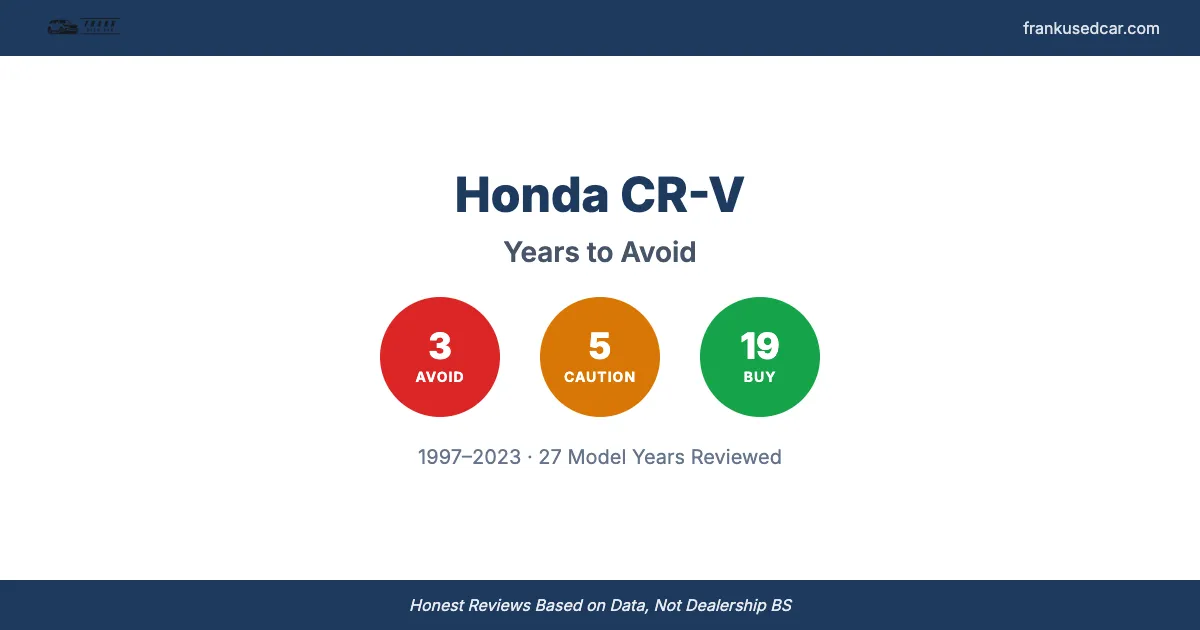
The Honda CR-V is one of the most reliable compact SUVs ever made —but three model years have a design flaw that puts gasoline in your engine oil, and buying the wrong year turns a $15,000 bargain into a $15,000 headache. The best Honda CR-V years are the 2015, 2009, 2011, 2016, and 2020. The worst are the 2002, 2017, 2018, and 2019.
Honda has built the CR-V across six generations since 1997. The right model year saves thousands in repair bills. The wrong one puts you in the shop for oil dilution damage that can cost $3,000 or more.
I’ve been recommending the CR-V to friends and family for 20 years —but only specific model years. Here’s which ones are actually worth your money.
The 2015 CR-V has near-zero NHTSA complaints and a 2.4L engine that runs for 250,000+ miles. The 2017 has 4x the complaint rate and an oil dilution problem that can destroy the engine. This guide covers Frank’s top pick, the best years by generation, years to avoid, reliability ratings, value analysis, and what to check before buying.
| Year | Frank’s Verdict | Key Strength or Issue |
|---|---|---|
| 2015 | BUY —TOP PICK | Mature Gen4, K24 engine, Honda Sensing available |
| 2009 | BUY | Best Gen3, proven K24Z, budget king |
| 2011 | BUY | Last Gen3, fully mature, under $13K |
| 2016 | BUY | Last NA engine year, low complaints |
| 2020 | BUY | Best Gen5, oil dilution fixed |
| 2021 | BUY | Continued improvement, above sweet spot |
| 2014 | BUY | Mid-cycle Gen4 refresh, solid |
| 2010 | BUY | Gen3, reliable K24Z |
| 2008 | BUY | Gen3 maturing, stable |
| 2022 | CAUTION | Last Gen5, turbo complexity remains |
| 2012 | CAUTION | First Gen4, vibration TSB |
| 2007 | CAUTION | First Gen3, A/C issues |
| 2019 | AVOID | Oil dilution + A/C + infotainment |
| 2018 | AVOID | Oil dilution continues, gas smell |
| 2017 | AVOID | Oil dilution crisis, 4x complaints |
| 2002 | AVOID | A/C compressor failures, vibration |
Why Is the 2015 CR-V Frank’s Top Pick?
The 2015 Honda CR-V is Frank’s number one pick because it combines the proven 2.4L K24 engine, Honda Sensing availability, and mature Gen4 reliability at $15,000-$18,000 used —the best value-to-reliability ratio across all Honda CR-V best and worst years.
The 2015 sits in the fourth year of the Gen4 platform. Every early issue has been resolved by this point. The vibration problem from 2012 is gone. The CVT has proven itself reliable over four model years.
Honda Sensing arrived on the 2015 Touring trim. That means collision mitigation, adaptive cruise control, lane keep assist, and road departure mitigation —all on a compact SUV with a naturally aspirated engine.
No turbo. No oil dilution risk. The K24W engine in the 2015 CR-V belongs to the same K24 family that powered the CR-V from 2002 to 2016. Fifteen years of proven reliability.
I helped a friend buy a 2015 CR-V Touring last year with 72,000 miles. She paid $16,500. RepairPal estimates $407 per year in maintenance. That’s $245 below the $652 industry average for compact SUVs.
For $3,000 less than a 2017, you get better reliability. That math is hard to argue with.
Frank’s Verdict: BUY —TOP PICK The 2015 CR-V is the single best used CR-V you can buy. Naturally aspirated engine, Honda Sensing, proven CVT, depreciation sweet spot pricing.
What Are the Best Third-Generation CR-V Years? (2007-2011)
The best Gen3 Honda CR-V years are the 2009, 2010, and 2011, which run the bulletproof K24Z i-VTEC engine with a proven 5-speed automatic transmission —making these the most reliable CR-V models ever produced and a key part of the Honda CR-V best and worst years discussion.
The Gen3 CR-V launched in 2007 with a complete redesign. Larger interior. Better ride quality. The K24Z engine delivered 166 horsepower and routinely lasted 250,000+ miles.
The 2007 first model year had minor A/C compressor issues. By 2008, Honda had resolved them. The 2009 through 2011 models sit in the sweet spot —fully mature, zero major design flaws.
| Year | Frank’s Rating | Verdict | Notes |
|---|---|---|---|
| 2007 | 6/10 | CAUTION | First Gen3, A/C issues |
| 2008 | 8/10 | BUY | Gen3 maturing, reliable |
| 2009 | 9/10 | BUY | Excellent, proven platform |
| 2010 | 9/10 | BUY | Same as 2009, minor updates |
| 2011 | 9/10 | BUY | Last Gen3, fully mature |
The Gen3 used a traditional 5-speed automatic —not a CVT. Torque converter automatics are the most proven transmission design in the industry. No belt slippage concerns. No CVT anxiety.
Used pricing sits at $8,000-$13,000 with 100,000-160,000 miles. That’s budget-friendly territory for one of the most reliable compact SUVs on the road.
Is the 2009 Honda CR-V a Good Used Buy?
Yes, the 2009 Honda CR-V is one of the most reliable compact SUVs ever made —a fully mature Gen3 with the K24Z engine, a 5-speed automatic, and NHTSA complaint rates so low they barely register.
The 2009 CR-V is my budget pick. At $8,000-$12,000 with 110,000-150,000 miles, you get proven reliability at the lowest entry point in the CR-V lineup.
Standard features include stability control and side-curtain airbags. No backup camera —that arrived with Gen4 in 2012.
I’ve seen 2009 CR-Vs roll through inspections at 180,000 miles with nothing but brake pads and fluid changes on the service record. The K24Z engine is that reliable.
Between the 2009 and 2011, pick whichever has better maintenance records and fewer miles. Both are equally reliable. The 2011 sometimes costs $1,000-$2,000 more just because it’s two years newer.
Is the 2011 Honda CR-V Worth Buying?
Yes, the 2011 Honda CR-V is the last Gen3 model year —a fully mature platform with zero major design flaws, the reliable K24Z engine, and prices that make it one of the best compact SUVs you can buy for under $13,000.
Last Gen3 year means every Gen3 issue has been resolved. It’s essentially identical to the 2009-2010 with minor trim updates.
Standard features: stability control, side-curtain airbags. No backup camera. If a rearview camera matters to you, step up to the 2012+ Gen4.
If the 2009 has lower miles and better records, save the money. The 2011’s only advantage is being two years newer on paper.
What Are the Best Fourth-Generation CR-V Years? (2012-2016)
The best Gen4 Honda CR-V years are the 2014, 2015, and 2016, which kept the proven 2.4L K24 engine, introduced Honda’s reliable CVT, and added modern safety features —making the 2015 Frank’s overall top pick for the entire Honda CR-V best and worst years lineup.
Gen4 brought a major redesign in 2012. Lighter body. Better fuel economy —28-29 MPG combined versus 22-23 in Gen3. And Honda switched to a CVT.
The CR-V switched to a CVT in 2012 and people panicked. “CVTs are unreliable!” they said, thinking of Nissan’s Jatco units. Honda’s CVT uses a different design —steel chain, not rubber belt —and it’s proven to last 200,000+ miles with regular fluid changes.
The 2012 first model year had a vibration issue at highway speeds. Honda fixed it via TSB. By 2013, the problem was resolved. The 2014+ models are mature and excellent.
| Year | Frank’s Rating | Verdict | Notes |
|---|---|---|---|
| 2012 | 6/10 | CAUTION | First Gen4, vibration TSB |
| 2013 | 7/10 | NEUTRAL | Vibration fixed, improving |
| 2014 | 8/10 | BUY | Mid-cycle refresh, solid |
| 2015 | 9/10 | BUY | TOP PICK —Honda Sensing |
| 2016 | 9/10 | BUY | Last Gen4, last NA engine |
The engine: 2.4L K24W (Earth Dreams). Same K24 family as Gen3, updated for better efficiency. This was the last generation with a naturally aspirated engine before Honda switched to the problematic 1.5L turbo.
The 2015-2016 CR-V hits the depreciation sweet spot right now. Enough depreciation to be affordable. Modern enough to feel current. And the last years with the NA engine before Honda switched to turbo.
Honda Sensing became available from 2015 on the Touring trim —collision mitigation, adaptive cruise, and lane keep assist. The first CR-V generation with driver assistance technology.
Is the 2015 Honda CR-V a Good Used Buy?
Yes —the 2015 Honda CR-V is Frank’s TOP PICK across all CR-V generations. It combines the proven 2.4L K24 engine with Honda Sensing availability, mature Gen4 reliability, and used prices in the $15,000-$18,000 range.
The 2015 is where Gen4 became genuinely great. The vibration issue from 2012 is long gone. The CVT has proven itself reliable. Honda Sensing arrived. And you get all of this with a naturally aspirated engine that doesn’t put gasoline in your oil.
Backup camera is standard on the 2015 (mandated in 2014+). Combined fuel economy runs 28-29 MPG.
For $3,000 less than a 2017, you get better reliability. That math is hard to argue with across all Honda CR-V best and worst years.
What Are the Best Fifth-Generation CR-V Years? (2017-2022)
The best Gen5 Honda CR-V year is the 2020, which resolved the oil dilution problems that plagued the 2017-2019 models through improved engine calibration and software updates —though even the best Gen5 year still carries the turbo engine that caused the crisis.
Gen5 brought a complete redesign with the 1.5L L15B turbo engine. More power. Slightly better fuel economy at 29-30 MPG combined. And the defining Honda CR-V best and worst years problem: oil dilution.
Oil dilution is exactly what it sounds like. Gasoline gets past the piston rings into the crankcase, diluting the engine oil. In cold climates, short trips don’t let the engine get hot enough to evaporate the fuel. The oil level rises. The gas smell enters the cabin. Left unchecked, it destroys the engine.
The 2017-2019 models were worst affected. Honda issued a service bulletin —not a full recall —with a software update and revised oil change intervals. That tells you how seriously they took it.
| Year | Frank’s Rating | Verdict | Notes |
|---|---|---|---|
| 2017 | 3/10 | AVOID | Oil dilution crisis, 4x complaints |
| 2018 | 4/10 | AVOID | Oil dilution continues, 3x complaints |
| 2019 | 4/10 | AVOID | Oil dilution + A/C + infotainment |
| 2020 | 8/10 | BUY | Oil dilution improved, best Gen5 |
| 2021 | 8/10 | BUY | Continued improvement |
| 2022 | 7/10 | CAUTION | Last Gen5, turbo complexity |
The 2020 CR-V often costs $2,000-$3,000 LESS than the 2019 with fewer miles at dealers. It’s significantly more reliable. That’s the used car market being irrational, and buyers should take advantage.
Is the 2020 Honda CR-V Worth Buying Used?
Yes, the 2020 Honda CR-V is the best Gen5 model year. Honda’s improved engine calibration and software updates significantly reduced the oil dilution complaints that affected 2017-2019 models. The 2020 is the first Gen5 year worth recommending.
Fourth Gen5 year. Honda had three years to address the oil dilution problem and finally got it under control. Improved cold-start calibration reduces fuel wash-down past piston rings.
NHTSA complaint density drops from HIGH for 2017-2019 to LOW for 2020. Honda Sensing comes standard —collision mitigation, adaptive cruise, lane keep assist.
I wouldn’t recommend any 2017-2019 CR-V to anyone. The 2020 is the first Gen5 year I’d put my name behind. Honda fixed the calibration, the complaints dropped, and the rest of the car —the interior, the space, the safety tech —is genuinely excellent.
Pricing runs $24,000-$28,000 with 30,000-60,000 miles. Still turbo though. The 2020 still has the 1.5L turbo. The oil dilution risk is reduced, not eliminated. If you live in Minnesota and drive 3-mile commutes in January, the 2015 with the 2.4L is still a safer bet. The 2020 is for buyers who want Gen5 features and drive enough highway miles to keep the engine hot.
Is the CR-V Hybrid Worth Buying Used?
Yes, the Honda CR-V Hybrid is worth buying used —the 2020-2022 models deliver 40 MPG combined with Honda’s proven hybrid drivetrain, and the $2,000-$4,000 used price premium pays for itself in fuel savings within 18-24 months at average driving.
The CR-V Hybrid became available in the US starting with the 2020 model year. The hybrid drivetrain uses a 2.0L Atkinson-cycle engine plus two electric motors with an eCVT —similar in concept to Toyota’s proven hybrid system.
Here’s the key advantage. The CR-V Hybrid uses a 2.0L naturally aspirated engine —NOT the 1.5L turbo. No oil dilution risk. If the turbo oil dilution issue is your biggest concern about Gen5, the Hybrid eliminates it entirely.
Fuel savings math: 40 MPG versus 30 MPG gas equals roughly $800 per year saved at $3.50 per gallon and 12,000 miles annually. The $2,000-$4,000 premium pays back in 2.5-5 years. If gas hits $4.50, payback drops to under 2 years.
All-wheel drive is standard on the Hybrid. The 2020-2021 CR-V Hybrid models are the best used Honda CR-V best and worst years picks for buyers who want Gen5 without the turbo risk.
If you’re cross-shopping a 2020 CR-V gas at $25,000 and a 2020 CR-V Hybrid at $28,000, take the Hybrid. Better fuel economy. Naturally aspirated engine with no oil dilution risk. Standard AWD. The $3,000 premium is one of the easiest decisions in the used compact SUV market.
Which Honda CR-V Years Should You Avoid?
The 2002, 2017, 2018, and 2019 Honda CR-V are the four model years to avoid —the 2002 for A/C compressor failures, and the 2017-2019 for the oil dilution crisis that can destroy the 1.5L turbo engine across the Honda CR-V best and worst years spectrum.
| Year | Frank’s Verdict | Key Issue | Risk Level |
|---|---|---|---|
| 2002 | AVOID | A/C compressor failure, vibration | HIGH |
| 2017 | AVOID | Oil dilution crisis, 4x complaints | CRITICAL |
| 2018 | AVOID | Oil dilution, gas smell in cabin | CRITICAL |
| 2019 | AVOID | Oil dilution + A/C + infotainment | HIGH |
| 2007 | CAUTION | First Gen3, A/C issues | MODERATE |
| 2012 | CAUTION | First Gen4, vibration TSB | MODERATE |
| 2022 | CAUTION | Last Gen5, turbo complexity | MODERATE |
Oil dilution means gasoline seeps past the piston rings into your engine oil. In cold climates with short trips, the engine never gets hot enough to burn it off. The oil level rises above the full mark. You smell gasoline in the cabin. Left unchecked, it thins the oil to the point where it can’t protect the engine.
Honda issued a service bulletin —not a recall —with a software update and revised oil change intervals. That tells you how seriously they took it.
The pattern is clear: avoid first-year models of any new CR-V generation. The 2007 (Gen3 launch), 2012 (Gen4 launch), and 2017 (Gen5 launch) all had first-year teething problems. But the 2017-2019 weren’t just teething problems. They were a fundamental engine design issue that took Honda three model years to adequately address.
For the full breakdown of what goes wrong in each of these years —oil dilution mechanics, A/C compressor failures, infotainment glitches —read the complete Honda CR-V years to avoid guide.
How Reliable Is the CR-V by Year?
Honda CR-V reliability varies dramatically by era —the 2009-2011 Gen3 and 2014-2016 Gen4 models earn 8-9/10 ratings with the proven K24 engine, while the 2017-2019 Gen5 turbo years score 3-4/10 based on NHTSA complaint density and the severity of the oil dilution problem across all Honda CR-V best and worst years.
RepairPal rates the CR-V 4.5 out of 5.0 with an average annual repair cost of $407 —the lowest in the compact SUV segment. But that’s a brand-level average. The 2009 and the 2017 are both Honda CR-Vs. One costs $200 per year in repairs. The other can cost $3,000+ for an engine-related oil dilution fix. Averages hide the truth.
| Year | Generation | Frank’s Rating | Key Strength | Key Risk |
|---|---|---|---|---|
| 2002 | Gen2 | 4/10 | Spacious interior | A/C compressor failure |
| 2003 | Gen2 | 6/10 | A/C improved | Lingering compressor issues |
| 2005 | Gen2 | 7/10 | Mature Gen2 | Age-related wear |
| 2006 | Gen2 | 7/10 | Last Gen2 | Age-related wear |
| 2007 | Gen3 | 6/10 | New platform | First-year A/C issues |
| 2008 | Gen3 | 8/10 | Gen3 maturing | Minor concerns |
| 2009 | Gen3 | 9/10 | Excellent reliability | None significant |
| 2010 | Gen3 | 9/10 | Same as 2009 | None significant |
| 2011 | Gen3 | 9/10 | Last Gen3, fully mature | No backup camera |
| 2012 | Gen4 | 6/10 | CVT intro, better MPG | Vibration at highway speed |
| 2013 | Gen4 | 7/10 | Vibration fixed | Still maturing |
| 2014 | Gen4 | 8/10 | Mid-cycle refresh | Minor complaints |
| 2015 | Gen4 | 9/10 | TOP PICK, Honda Sensing | None significant |
| 2016 | Gen4 | 9/10 | Last NA engine year | None significant |
| 2017 | Gen5 | 3/10 | More power, space | Oil dilution crisis |
| 2018 | Gen5 | 4/10 | Honda Sensing standard | Oil dilution, gas smell |
| 2019 | Gen5 | 4/10 | Feature-rich | Oil dilution + A/C + glitches |
| 2020 | Gen5 | 8/10 | Oil dilution fixed | Still turbo engine |
| 2021 | Gen5 | 8/10 | Continued improvement | Above depreciation sweet spot |
| 2022 | Gen5 | 7/10 | Last Gen5 | Turbo complexity |
J.D. Power gives the CR-V high marks overall, but they weight customer satisfaction equally with mechanical reliability. My rating focuses on one thing: how likely is this car to cost you money in repairs.
Every CR-V with the 2.4L K24 engine (2002-2016) scores 6-9/10 on my scale. Every CR-V with the 1.5L turbo (2017-2019) scores 3-4/10. The engine swap in 2017 is the single biggest inflection point in CR-V reliability history.
What Is the Best Used CR-V for the Money?
The best used CR-V for the money depends on your budget —the 2009-2011 wins under $13,000, the 2014-2016 wins at $14,000-$19,000, and the 2020 wins at $24,000-$28,000, with each tier offering the best reliability-to-price ratio across Honda CR-V best and worst years.
| Budget Tier | Recommended Year | Price Range | Mileage | Why |
|---|---|---|---|---|
| Budget | 2009-2011 | $8,000-$13,000 | 100K-160K | Gen3 K24Z, proven 5-speed auto |
| Mid-Range | 2014-2016 | $14,000-$19,000 | 60K-100K | Gen4 K24W, CVT, Honda Sensing |
| Premium | 2020 | $24,000-$28,000 | 30K-60K | Gen5 turbo fixed, full safety suite |
A $10,000 CR-V with $407 per year in repairs costs $11,221 over three years. A $16,000 CR-V with the same repair cost is $17,221. The cheaper car wins on total cost —but only if you pick the right model year.
A $10,000 2017 CR-V with $3,000+ in oil dilution repairs costs MORE than a $16,000 2015. The wrong year erases the price advantage completely.
Keep 15% of your budget in reserve for first-year repairs. A $16,000 budget means $13,600 for the car and $2,400 in the repair fund.
The 2014-2016 CR-V might be the single best used compact SUV value in the entire market right now. Naturally aspirated engine. Proven CVT. Honda Sensing available. Prices between $14,000 and $19,000. Name another compact SUV with a 4.5/5.0 RepairPal score at that price point. You can’t.
Which CR-V Generation Is Most Reliable?
The Gen3 CR-V (2007-2011) is the most reliable generation overall with the lowest complaint rates per unit sold and the proven K24 engine, followed closely by the Gen4 (2012-2016), while the Gen5 (2017-2022) is split between the worst and best Honda CR-V best and worst years.
| Rank | Generation | Years | Engine | Transmission | Key Strength | Key Weakness |
|---|---|---|---|---|---|---|
| 1 | Gen3 | 2007-2011 | 2.4L K24Z | 5-speed auto | Lowest complaints | No modern safety tech |
| 2 | Gen4 | 2012-2016 | 2.4L K24W | CVT | Last NA, Honda Sensing | 2012 vibration issue |
| 3 | Gen5 (2020+) | 2020-2022 | 1.5L turbo | CVT | Modern features, fixed oil | Turbo complexity |
| 4 | Gen2 | 2002-2006 | 2.4L K24A1 | 4/5-speed auto | Spacious, reliable | A/C compressor (2002) |
| 5 | Gen5 (early) | 2017-2019 | 1.5L turbo | CVT | Power, efficiency | Oil dilution crisis |
The ranking changes dramatically within Gen5. Count only the 2020-2022 models and Gen5 ranks second behind Gen3. Count 2017-2019 and it drops to dead last. That’s how much the oil dilution issue distorts the generation’s reputation.
The K24 engine ran in the CR-V from 2002 to 2016 —15 model years. One of the most proven four-cylinder engines in Honda’s history. When Honda replaced it with the 1.5L turbo in 2017, they traded 15 years of proven reliability for 10 extra horsepower and 1 MPG. The market spoke: owners hated it.
Honda’s CVT (2012+) is NOT a Nissan CVT. Nissan’s Jatco units are belt-driven and fail at 80,000-100,000 miles. Honda’s CVT uses a different internal design and routinely lasts 200,000+ miles with fluid changes every 30,000-40,000 miles. Don’t let CVT anxiety steer you away from a 2014-2016 CR-V.
How Does the CR-V Compare to Other Compact SUVs?
The Honda CR-V beats the Toyota RAV4, Mazda CX-5, Subaru Forester, and Nissan Rogue in annual repair cost at $407 per year and has the highest RepairPal score in the compact SUV segment at 4.5/5.0 —though the RAV4 wins on hybrid value and the CX-5 wins on driving dynamics across all Honda CR-V best and worst years competitors.
| Model | RepairPal Score | Annual Repair Cost | Best Used Years | Worst Years |
|---|---|---|---|---|
| Honda CR-V | 4.5/5.0 | $407/yr | 2015, 2009-2011, 2020 | 2017-2019, 2002 |
| Toyota RAV4 | 4.0/5.0 | $429/yr | 2021, 2020, 2015-2016 | 2006-2008, 2013, 2019 |
| Mazda CX-5 | 4.0/5.0 | $447/yr | 2019-2022, 2016-2017 | 2013-2014 |
| Subaru Forester | 3.5/5.0 | $467/yr | 2019-2021, 2016-2018 | 2011-2013 |
| Nissan Rogue | 4.0/5.0 | $467/yr | 2021-2022 | 2013-2017 |
Even the CR-V’s bad years are better than most competitors’ average years. A 2019 CR-V with oil dilution complaints is still more reliable overall than a 2015 Nissan Rogue with CVT failures costing $3,000-$5,000 to replace.
The CR-V has a lower annual repair cost ($407 versus $429) and a higher RepairPal score (4.5 versus 4.0) than the RAV4. The RAV4 wins on hybrid availability and Toyota’s overall brand reliability perception. Both are excellent. The CR-V edges out the RAV4 on pure repair cost data.
For full reliability rankings on the RAV4, read the Toyota RAV4 best and worst years guide. For Honda brand-level guidance, see the used Honda buying guide.
The CX-5 is underrated. Skyactiv engines are excellent and repair costs sit at $447 per year. The Forester offers standard AWD but higher maintenance costs. The Rogue’s Nissan CVT makes it the riskiest pick in this segment —avoid the 2013-2017 models entirely.
What Should You Check Before Buying a Used CR-V?
Check these seven items before buying any used Honda CR-V —each targets a specific problem documented in this guide that varies by generation and model year across the Honda CR-V best and worst years.
Check the oil dipstick cold before starting. If the oil level is ABOVE the full mark or smells like gasoline, walk away. This targets oil dilution on 2017-2022 turbo models.
Verify NHTSA recall completion by VIN. The 2017-2018 fuel pump recall (18V845000) and 2019-2020 airbag sensor recall (20V064000) must show complete.
Test drive for 20+ minutes including highway. Feel for vibration at 60-70 MPH (2007, 2012 models) and CVT hesitation (2012+ models).
Scan ECM with OBD-II scanner. Any misfire codes (P0300-P0304) on turbo models are a dealbreaker. Engine damage may already be underway.
Run the A/C at full cold for 10 minutes. Listen for compressor noise or cycling. This targets 2002-2006 and 2019+ A/C compressor failures costing $800-$1,500.
Check CVT fluid condition on 2012+ models. Dark or burnt-smelling fluid means deferred maintenance. CVT fluid should be changed every 30,000-40,000 miles.
Request complete service history with oil change intervals. Turbo models (2017+) need oil changes every 5,000 miles maximum —not the 7,500 Honda recommends.
These aren’t random suggestions. Each item maps to a specific CR-V problem pattern I’ve documented by generation. A 2015 CR-V needs items 3, 6, and 7. A 2018 needs items 1, 2, 3, 4, and 7. A 2009 needs items 3 and 7 —that’s it.
The inspection list tells you which generation you’re dealing with. For a broader pre-purchase framework, read the used car buying guide.
Also see: Honda Years to Avoid
- best honda crv years
- worst honda crv years
- crv reliability by year
- best-and-worst-years