Honda Pilot Best and Worst Years: Which Model Years Are Worth Buying?
Frank ranks every Honda Pilot model year from 2003-2024. The 2021 is his #1 pick. Avoid the 2003 and 2016. Data-backed verdicts with repair costs and VCM guidance.
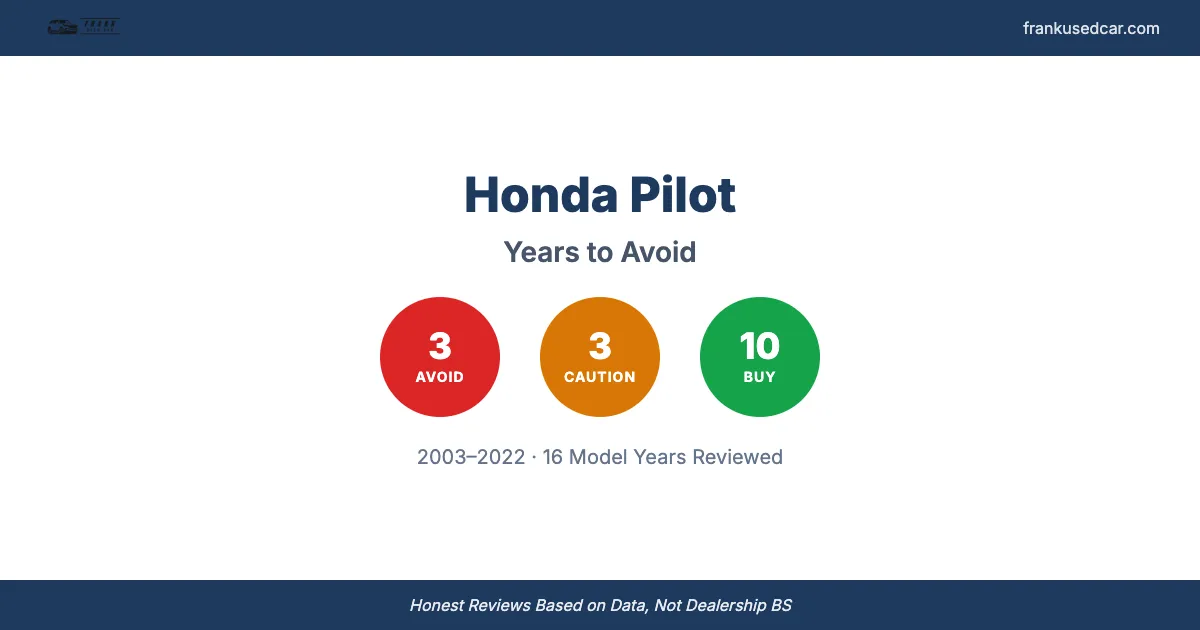
The Honda Pilot spans four generations of 3-row midsize SUV. Best years: 2021, 2020, 2019, 2014-2015, 2012-2013. Worst years: 2003, 2016, 2004, 2005, 2009.
The right Honda Pilot model year saves thousands in repair bills. The wrong one drains $3,500-$5,000 on a transmission rebuild or $1,500-$3,000 on piston ring damage from VCM oil consumption.
I’ve bought, inspected, or helped friends buy over 50 used cars in 20 years — and the Pilot is one of the most requested family SUVs. The 2021 has near-zero NHTSA complaints. The 2003 has 738. The 2016 has 1,472. Year selection is everything.
| Year | Frank’s Verdict | Key Strength or Issue |
|---|---|---|
| 2021 | BUY — TOP PICK | Mature Gen3, near-zero complaints, Honda Sensing standard |
| 2020 | BUY | Near-zero complaints, depreciation sweet spot |
| 2019 | BUY | Mid-cycle refresh, Honda Sensing all trims |
| 2015 | BUY | Last Gen2, maximum maturity, extended warranty |
| 2014 | BUY | Depreciation sweet spot, proven J35Z4 V6 |
| 2013 | BUY | Late Gen2, strong reliability |
| 2012 | BUY | Mature Gen2, backup camera standard |
| 2018 | BUY | Gen3 improving, engine bearing recall to verify |
| 2017 | BUY | 9-speed updated, much improved over 2016 |
| 2010 | BUY | VCM refined, mature Gen2 |
| 2022 | BUY | Last Gen3, above depreciation sweet spot |
| 2006-2008 | CAUTION | Late Gen1, improved but aging |
| 2011 | CAUTION | Electrical/brake complaints above average |
| 2023-2025 | CAUTION | Gen4, still proving itself |
| 2016 | AVOID | 1,472 complaints, 9-speed + injectors + infotainment |
| 2009 | AVOID | First Gen2, VCM oil consumption introduced |
| 2005 | AVOID | Torque converter + ignition + AC triple failure |
| 2004 | AVOID | Transmission recall 04V176000, electrical |
| 2003 | AVOID | 738 complaints, transmission failure, 14 recalls |
Why Is the 2021 Pilot Frank’s Top Pick?
The 2021 Honda Pilot is the best used Pilot you can buy. Near-zero NHTSA complaints. Honda Sensing standard on every trim. A 9-speed ZF transmission that finally works after 5+ years of software updates.
Compare the 2021 to the 2016. That first Gen3 year logged 1,472 NHTSA complaints. The 2021 barely registers. Same generation. Completely different ownership experience.
Honda Sensing includes collision mitigation braking, adaptive cruise control, lane keeping assist, and road departure mitigation. No trim gambling — every 2021 Pilot gets the full suite. That matters when you’re hauling three rows of passengers.
The 2016 launched with a ZF 9-speed that shuddered, jerked, and hesitated. Honda pushed five years of software calibrations. By 2021, the hardware remained the same but the software was rewritten. The shudder is gone. The hesitation between 2nd and 3rd gear is gone.
A 2021 Pilot EX-L with 30,000 miles lists around $26,000-$31,000. A new Pilot starts above $40,000. That’s $9,000-$14,000 in savings for a Pilot with proven reliability data behind it.
I recommended a 2021 to my cousin last fall. She found an EX-L with 28,000 miles for $27,500. Six months later — zero issues. The data backed it up. The ownership confirmed it.
Frank’s Verdict: BUY — TOP PICK The 2021 Honda Pilot is the single best used Pilot available. Mature Gen3 platform, near-zero complaints, Honda Sensing standard, and a 9-speed transmission Honda spent five years perfecting. Worth every penny at $26,000-$31,000.
The 2021 leads Gen3. Gen2 offers the best budget options in the entire Pilot lineup.
What Are the Best Gen2 Honda Pilot Years? (2009-2015)
The best Gen2 Honda Pilot years are the 2012, 2013, 2014, and 2015. The proven J35Z4 V6 can reach 250,000+ miles — but every Gen2 buyer needs to budget $300-$600 for a VCM disabler.
Gen2 introduced unibody construction and a refined ride. It also brought VCM — Variable Cylinder Management. VCM shuts down 1-3 cylinders during light throttle. Closed valves create vacuum, pulling oil past piston rings into the combustion chamber.
Oil consumption on affected Gen2 Pilots runs 1 quart per 2,000-3,000 miles. Left unchecked, it fouls spark plugs, kills catalytic converters ($1,500-$2,500), and accelerates engine mount wear.
The fix is cheap. An aftermarket VCMTuner or S-VCM Controller costs $300-$600 installed. You lose 1-2 MPG on the highway. You gain an engine that runs past 250,000 miles without burning oil. Every Gen2 buyer should install one within the first week of ownership.
| Year | Frank’s Rating | Verdict | Notes |
|---|---|---|---|
| 2009 | 5/10 | AVOID | First Gen2, VCM oil consumption worst, paint peeling |
| 2010 | 8/10 | BUY | VCM refined, mature platform |
| 2011 | 6/10 | CAUTION | Electrical/brake complaints above average |
| 2012 | 8/10 | BUY | Mature Gen2, backup camera standard |
| 2013 | 8/10 | BUY | Late Gen2, strong reliability |
| 2014 | 8/10 | BUY | Depreciation sweet spot begins |
| 2015 | 8/10 | BUY | Last Gen2, maximum maturity |
Honda settled a class action in 2013 over VCM oil consumption affecting 1.6 million vehicles. Extended warranty coverage for 2013-2015 Pilot VCM-related issues arrived in June 2025. Known problem. Known fix.
A 2014-2015 Pilot with 80,000-130,000 miles runs $10,000-$16,000. Add $400 for a VCM disabler. That’s a 3-row SUV seating 8 for under $17,000 total.
A VCM disabler isn’t optional on a Gen2 Pilot — it’s part of the purchase price. The $400 saves $3,000-$6,000 in downstream damage. Best insurance policy in used cars.
Is the 2012 Honda Pilot a Good Used Buy?
Yes. The 2012 Honda Pilot is a strong mid-budget buy. Mature Gen2 platform. Standard backup camera. The J35Z4 V6 reaches 250,000 miles with a VCM disabler installed.
At $9,000-$14,000 with 90,000-150,000 miles, the 2012 is one of the most affordable 3-row SUVs with real reliability behind it.
I helped a friend buy a 2012 Pilot with 110,000 miles for $11,000. We installed a VCM disabler the same week. Three years and 45,000 miles later — zero major repairs. The disabler is the key. Without it, oil consumption starts by 80,000-120,000 miles.
Is the 2014 Honda Pilot Worth Buying?
Yes. The 2014 Honda Pilot hits the depreciation sweet spot at $10,000-$16,000. Late Gen2 maturity. Honda’s extended warranty covers VCM-related issues on 2013-2015 models.
Between a 2012 at $11,000 and a 2014 at $14,000, the 2014 gets lower mileage and potential warranty coverage. That $3,000 buys peace of mind. A solid pick for families who need space without the Gen3 price tag.
The 2014 also avoids the paint peeling that plagued early Gen2 models. Body and mechanical maturity in one package.
What Are the Best Gen3 Honda Pilot Years? (2016-2022)
The best Gen3 Honda Pilot years are the 2019, 2020, and 2021. These fixed the disastrous 2016 launch year. The 2020-2021 models have near-zero complaint rates — the most refined Pilots Honda has built.
Gen3 brought a complete redesign. Direct-injection 3.5L V6 (J35Y6, 280 hp). Two transmission options: 6-speed auto on LX/EX trims, ZF 9-speed on EX-L and above.
The 2016 was a catastrophe. NHTSA logged 1,472 complaints. The 9-speed shuddered so badly that owners called it possessed. Fuel injectors cracked. The infotainment system froze mid-drive. Honda spent five years pushing software updates.
| Year | Frank’s Rating | Verdict | Notes |
|---|---|---|---|
| 2016 | 2/10 | AVOID | 1,472 complaints, 9-speed + injectors + infotainment |
| 2017 | 7/10 | BUY | 9-speed updated, much improved |
| 2018 | 7/10 | BUY | Continued improvement, engine bearing concern |
| 2019 | 8/10 | BUY | Mid-cycle refresh, Honda Sensing standard |
| 2020 | 9/10 | BUY | Mature Gen3, near-zero complaints |
| 2021 | 9/10 | BUY | TOP PICK — best all-around used Pilot |
| 2022 | 9/10 | BUY | Last Gen3, above depreciation sweet spot |
Engine bearing recall 23V751000 affects 2016 and 2018-2019 models. Connecting rod bearing wear can cause engine seizure. Always verify by VIN before buying those years.
The 2016 Pilot is one of the worst first-year models I’ve seen from any Japanese manufacturer. By 2020, the same platform delivers a completely different experience. From dealbreaker to top pick in four years.
Gen3 lower trims (LX, EX) got a 6-speed auto — no 9-speed drama. Want the 9-speed features of EX-L and above? Buy 2019 or later.
Is the 2019 Honda Pilot a Good Used Buy?
Yes. The 2019 Honda Pilot is the mid-cycle refresh. Honda Sensing standard on all trims. Updated infotainment. The 9-speed received three years of software refinement since the troubled 2016 launch.
FIXD rates the 2019 Pilot 10/10 for reliability. Minor HondaLink bugs persist, but mechanically sound across the board. Three years of software updates made a real difference. The shudder is gone.
Pricing runs $20,000-$26,000 with 40,000-80,000 miles. A solid pick for buyers who want modern safety tech at a reasonable price.
Is the 2020 Honda Pilot Worth Buying Used?
Yes. The 2020 Honda Pilot has near-zero NHTSA complaints, the fully refined 9-speed, and it’s entering the depreciation sweet spot at $23,000-$28,000.
Every 2016 launch issue is resolved by 2020. Reliable 3-row seating. Modern safety tech. Proven platform.
I’ve recommended more 2020 Pilots than any other model year. The only question: pick the 2020 or stretch for the 2021? They’re mechanically identical. The 2021 sometimes costs $2,000-$3,000 more. If the 2020 has the miles and records you want, save the money.
What Are the Best Gen4 Honda Pilot Years? (2023-Present)
The Gen4 Honda Pilot launched with a new 10-speed automatic and TrailSport off-road trim. It’s promising — but too new and too expensive to recommend over the proven 2020-2021 Gen3.
Gen4 rides on a new platform. The 10-speed replaces the 9-speed. The V6 bumps to 285 hp. TrailSport adds steel skid plates and all-terrain tires.
Early reliability data is limited. Brake pedal recall 25V031000 on 2023-2025 models is concerning. The pivot pin wasn’t properly secured — the brake pedal could become inoperative.
| Year | Frank’s Rating | Verdict | Notes |
|---|---|---|---|
| 2023 | — | CAUTION | First Gen4, brake pedal recall |
| 2024 | — | CAUTION | Second year, limited owner data |
| 2025 | — | CAUTION | Too new for used market |
This is exactly the situation where I tell buyers to wait. New platform. New transmission. First-year quality still being proven. The 2023 brake pedal recall isn’t catastrophic, but it’s the kind of issue that makes me cautious.
Want Gen4? Wait for the 2025 or 2026 to hit the used market with 2-3 years of data. A 2021 at $26,000-$31,000 beats a 2023 at $32,000-$38,000 with less reliability evidence.
Which Honda Pilot Years Should You Avoid?
Five Honda Pilot model years should be avoided entirely. Each has complaint rates 2-5x higher than surrounding years. Repair bills can exceed the car’s value.
| Year | Frank’s Verdict | Key Issue | Risk Level |
|---|---|---|---|
| 2003 | AVOID | 738 complaints, transmission failure, 14 recalls | CRITICAL |
| 2004 | AVOID | Transmission recall 04V176000, electrical | HIGH |
| 2005 | AVOID | Torque converter + ignition + AC triple failure | HIGH |
| 2016 | AVOID | 1,472 complaints, 9-speed + injectors + infotainment | CRITICAL |
| 2009 | AVOID | First Gen2, VCM oil consumption introduced | HIGH |
The 2003 was Honda’s first 3-row SUV. The 5-speed automatic suffered second gear heat buildup. Gear teeth chipped at 80,000-120,000 miles. Transmission rebuilds run $3,500-$5,000. NHTSA logged 738 complaints and 14 recalls.
Gen1 (2003-2008) is largely outdated for most buyers. The 2006-2008 improved significantly, but at 130,000-200,000 miles and $5,000-$9,000, they’re budget-only options. The 2003-2005 are dealbreakers.
The pattern is clear. Avoid first-year models of any Pilot generation. The 2003 (Gen1 launch), 2009 (Gen2 launch), and 2016 (Gen3 launch) all had problems Honda fixed within 1-3 years.
For the full breakdown of what fails in each avoid year — transmission failure, VCM oil consumption, 9-speed shudder — read the complete Honda Pilot years to avoid guide.
How Reliable Is the Honda Pilot by Year?
Honda Pilot reliability swings wildly by model year. The 2020-2022 earn 9/10. The 2003 and 2016 score 2/10. RepairPal’s brand-level average masks these extremes.
RepairPal rates the Pilot 3.5 out of 5.0 — 13th of 26 midsize SUVs — at $542 per year versus the $652 industry average. Averages are meaningless without model year context.
| Year | Generation | Frank’s Rating | Key Strength | Key Risk |
|---|---|---|---|---|
| 2003 | Gen1 | 2/10 | First 3-row Honda SUV | Transmission failure, 738 complaints |
| 2004 | Gen1 | 4/10 | Improved over 2003 | Transmission recall, electrical |
| 2005 | Gen1 | 4/10 | Minor updates | Torque converter + ignition + AC |
| 2006 | Gen1 | 7/10 | Significantly improved | Paint/clear coat |
| 2007 | Gen1 | 7/10 | Clean year | Paint concern only |
| 2008 | Gen1 | 7/10 | Last Gen1, solid | Aging platform |
| 2009 | Gen2 | 5/10 | Unibody redesign | First Gen2, VCM introduced |
| 2010 | Gen2 | 8/10 | VCM refined | VCM (manageable with disabler) |
| 2011 | Gen2 | 6/10 | Mid-Gen2 | Electrical/brake complaints |
| 2012 | Gen2 | 8/10 | Backup camera standard | VCM (manageable with disabler) |
| 2013 | Gen2 | 8/10 | Late Gen2 maturity | VCM (manageable with disabler) |
| 2014 | Gen2 | 8/10 | Depreciation sweet spot | VCM (manageable with disabler) |
| 2015 | Gen2 | 8/10 | Last Gen2, maximum maturity | VCM (manageable with disabler) |
| 2016 | Gen3 | 2/10 | Full redesign, 280 hp | 1,472 complaints, 9-speed disaster |
| 2017 | Gen3 | 7/10 | 9-speed updated | Some transmission concerns |
| 2018 | Gen3 | 7/10 | Continued improvement | Engine bearing recall |
| 2019 | Gen3 | 8/10 | Honda Sensing standard | Minor infotainment bugs |
| 2020 | Gen3 | 9/10 | Near-zero complaints | None significant |
| 2021 | Gen3 | 9/10 | TOP PICK, mature Gen3 | None significant |
| 2022 | Gen3 | 9/10 | Last Gen3 | Above depreciation sweet spot |
The 2003 with 738 complaints and $3,500-$5,000 transmission rebuilds is not the same car as the 2021 with near-zero complaints. My ratings weight one thing: how likely this car is to cost you money.
Consumer Reports surveys owners. J.D. Power tracks initial quality. I cross-reference NHTSA complaint density, RepairPal cost data, and 20 years of watching these SUVs come through inspections.
What Is the Best Used Honda Pilot for the Money?
The best used Honda Pilot depends on your budget. Three tiers cover every buyer.
| Budget Tier | Recommended Year | Price Range | Mileage | Why |
|---|---|---|---|---|
| Budget | 2012-2013 | $9,000-$14,000 | 90K-150K | Gen2 J35Z4, add VCM disabler ($400) |
| Mid-Range | 2014-2015 | $10,000-$16,000 | 80K-130K | Depreciation sweet spot, extended warranty |
| Premium | 2020-2021 | $23,000-$31,000 | 20K-50K | Near-zero complaints, entering sweet spot |
Every Gen2 purchase needs $400 budgeted for a VCM disabler. Not optional. Part of the purchase price. The $400 saves $3,000-$6,000 in downstream damage. I tell every Gen2 buyer the same thing: the disabler cost is baked into your purchase price.
A $12,000 2014 Pilot with $542 per year in repairs costs $13,626 over three years. A $12,000 2009 with VCM oil consumption and $1,500-$3,000 in piston ring repairs costs more than the 2014 with a $400 disabler.
Keep 15% of your budget in reserve for first-year repairs. A $15,000 budget means $12,750 for the car and $2,250 in the repair fund.
AWD adds $1,000-$2,000 on the used market. The Gen3+ i-VTM4 torque vectoring system is genuinely capable — better than most competitors. Worth it for northern climates.
The mid-range tier delivers the most value right now. A 2014-2015 Pilot at 100,000 miles with a VCM disabler and clean records is a 3-row SUV seating 8 for under $17,000. The numbers don’t lie.
Which Honda Pilot Generation Is Most Reliable?
Gen3 (2019-2022) ranks first for reliability. Gen2 (2012-2015) ranks second. Gen1 (2003-2005) ranks last.
| Rank | Generation | Years | Engine | Transmission | Reliability |
|---|---|---|---|---|---|
| 1 | Gen3 (late) | 2019-2022 | J35Y6 (280 hp) | 6-speed / 9-speed ZF | Excellent |
| 2 | Gen2 (late) | 2012-2015 | J35Z4 (250 hp) | 5-speed auto | Strong (with VCM disabler) |
| 3 | Gen3 (early) | 2017-2018 | J35Y6 (280 hp) | 6-speed / 9-speed ZF | Good |
| 4 | Gen2 (early) | 2009-2011 | J35Z4 (250 hp) | 5-speed auto | Mixed |
| 5 | Gen1 (late) | 2006-2008 | J35A6 (255 hp) | 5-speed auto | Decent |
| 6 | Gen4 | 2023+ | J35Y6 (285 hp) | 10-speed auto | Insufficient data |
| 7 | Gen1 (early) | 2003-2005 | J35A4 (240 hp) | 5-speed auto | Poor |
The ranking shifts based on which years you include. Gen3 is #1 with 2019-2022 but drops to last counting the 2016. Gen2 is solid across the board with a VCM disabler. Year selection within each generation matters more than the generation itself.
Mid-generation years are always more reliable than launch years. I’ve seen it on the Pilot, the CR-V, the RAV4, the Explorer. First model year of any redesign is a gamble. Third or fourth year is where the engineering matures.
The Pilot uses the J-series V6 across all four generations — not the turbocharged 1.5L four-cylinder that caused oil dilution in the CR-V. The engine isn’t the Pilot’s weak point. Transmissions and VCM are what separate the best years from the worst. Pick the right year and the right generation sub-era, and the Pilot is one of the most dependable family SUVs on the road.
How Does the Honda Pilot Compare to Other 3-Row SUVs?
The Honda Pilot holds its own against every 3-row competitor. The Highlander wins on RepairPal scores. The Pilot wins on Gen2 budget pricing.
| Model | RepairPal Score | Annual Repair Bill | Best Used Years | Worst Years |
|---|---|---|---|---|
| Honda Pilot | 3.5/5.0 | $542/yr | 2021, 2020, 2019, 2014-2015 | 2003, 2016, 2004, 2009 |
| Toyota Highlander | 4.0/5.0 | $489/yr | 2019, 2016, 2021, 2010 | 2001-2003, 2008, 2014-2015 |
| Chevrolet Traverse | 3.5/5.0 | $656/yr | 2020-2022 | 2009-2011, 2018 |
| Ford Explorer | 3.5/5.0 | $732/yr | 2019, 2017-2018 | 2020, 2002-2005 |
| Subaru Ascent | N/A | ~$617/yr (est.) | 2022-2023 | 2019 (first year) |
| Hyundai Palisade | N/A | ~$500/yr (est.) | 2022-2023 | 2020 (first year) |
The Highlander wins on paper — 4.0 versus 3.5 RepairPal, $489 per year versus $542. In the $10,000-$16,000 used market, the Pilot Gen2 offers more passenger space and a lower entry price than equivalent Highlanders.
The Explorer costs $732 per year to maintain — $190 more than the Pilot. The Traverse sits at $656. Both are significantly more expensive long-term.
The Palisade and Ascent are too new for mature used data. Both had first-year issues. The 2019 Ascent launched with recalls. The 2020 Palisade carried first-year risk.
I’ve tracked the Pilot and Highlander across 15+ model years. The Highlander is the safer average pick. The Pilot is the better value pick under $16,000. Both are solid — different sweet spots. For full Highlander analysis, read the best and worst Toyota Highlander years guide. For brand-level Honda analysis, see the used Honda buying guide.
What Should You Check Before Buying a Used Honda Pilot?
Check these six items before buying any used Honda Pilot. Each targets a generation-specific problem documented in this guide.
Check NHTSA recall status by VIN. Verify fuel pump recall 23V858000 on 2015-2021 models. Verify brake pedal recall 25V031000 on 2023-2025 models. Unrepaired recalls are a dealbreaker.
Check oil level cold on any Gen2 (2009-2015). Oil consumption of 1 quart per 3,000 miles signals VCM damage. Ask if a VCM disabler is installed. No disabler means budget $300-$600 immediately.
Test the 9-speed through all gears in stop-and-go traffic on Gen3 EX-L and above (2016-2022). Feel for shudder between 2nd-3rd and 3rd-4th gears. Lurching means software updates haven’t been applied — or the transmission needs work.
Scan for engine bearing recall 23V751000 on 2016 and 2018-2019 models. Connecting rod bearing wear can cause engine seizure. Verify by VIN that the recall is complete.
Test infotainment responsiveness on 2016-2019 models. Freezing, rebooting, or unresponsive touchscreen means a replacement at $800-$1,500.
Request complete service history with oil change intervals. Maintenance matters more than mileage — especially for Gen2 VCM engines. Regular changes every 5,000 miles are critical.
These aren’t random suggestions. Each item maps to a specific failure pattern by generation. A 2021 needs items 1 and 6. A 2014 needs items 1, 2, and 6. A 2016 needs all six.
For a broader pre-purchase framework covering any make or model, read the used car buying guide.
Also see: Honda Years to Avoid
- best honda pilot years
- worst honda pilot years
- honda pilot reliability by year
- most reliable honda pilot year
- best used honda pilot
- best-and-worst-years