Subaru Outback Years to Avoid and Best Years to Buy
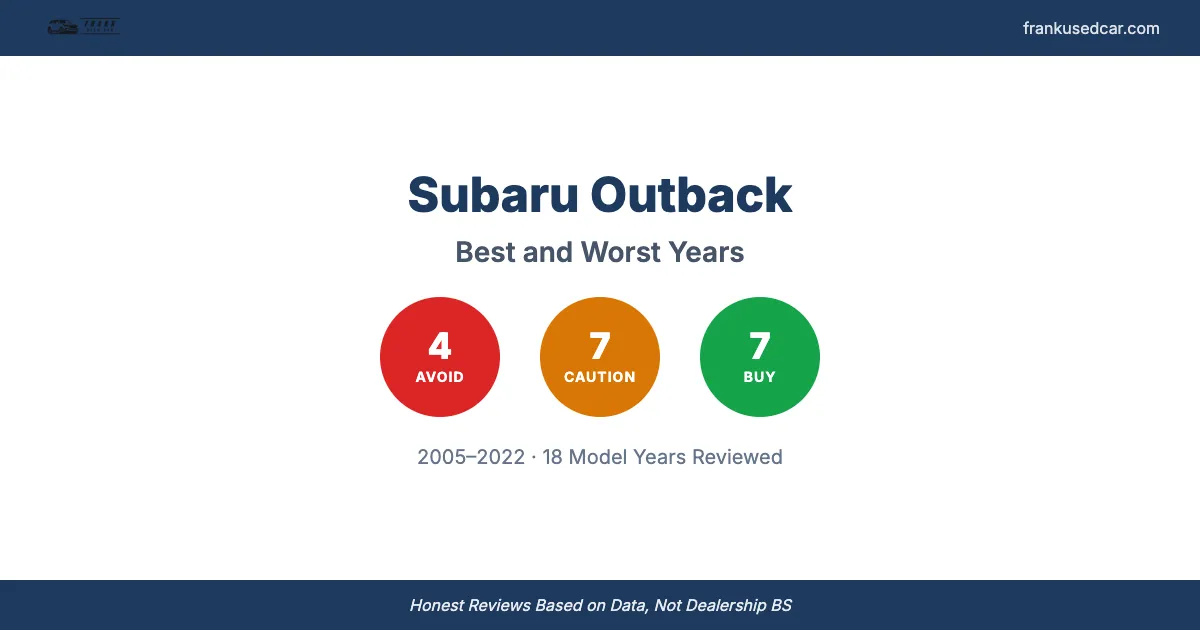
Subaru Outback years to avoid include 2005, 2013, and 2014. Learn which model years have head gasket failures, CVT problems, and which years are safe to buy.
The Subaru Outback is an all-wheel-drive crossover wagon produced since 1995 that earns loyal owners for its AWD capability. The Outback delivers confident traction in snow and dirt — but not every model year is worth buying.
I’ve reviewed the NHTSA complaint data on every Outback model year, and here’s what the numbers actually show.
The years to avoid split into two eras of problems: head gasket failures in pre-2010 EJ25 engines and CVT transmission failures in post-2010 models.
2013 and 2014 have the highest complaint rates of any Subaru Outback model year, primarily due to CVT failures and excessive oil consumption from the FB25 engine. The 2005 rounds out the worst years with its notorious EJ25 head gasket problem.
The best years to buy — 2017, 2018, and 2019 — show dramatically lower complaint rates and refined CVT calibration.
| Year | Verdict | Top Problem | Repair Cost |
|---|---|---|---|
| 2005 | AVOID | Head gasket failure (EJ25) | $2,000–$3,000 |
| 2007–2008 | BUY | Improved head gasket design | — |
| 2010 | CAUTION | Head gasket + early CVT | $2,000–$5,000 |
| 2011–2012 | CAUTION | Oil consumption + CVT concerns | $3,000–$5,000 |
| 2013 | AVOID | CVT failure + oil consumption | $3,500–$5,000 |
| 2014 | AVOID | CVT failure + oil consumption | $3,500–$5,000 |
| 2015 | CAUTION | First-year Gen5 CVT hesitation | $200–$5,000 |
| 2016 | CAUTION | CVT shudder + windshield cracks | $400–$5,000 |
| 2017–2019 | BUY | Refined Gen5, low complaints | — |
| 2020 | CAUTION | First-year Gen6 infotainment | $200–$500 |
| 2021–2022 | BUY | Mature Gen6, lowest complaints | — |
Which Subaru Outback Years Should You Avoid?
The 2013, 2014, and 2005 Subaru Outback are the three model years to avoid, based on NHTSA complaint density and severity of reported CVT and engine issues.
The 2013 and 2014 share the same FB25 engine with piston ring defects that burn oil at alarming rates. Both years also use early Lineartronic CVT transmissions prone to shudder and outright failure.
The 2005 belongs to the older EJ25 head gasket era. Repair costs on that engine regularly exceed the vehicle’s resale value.
The Outback’s problems split into two eras — head gaskets before 2010, and CVTs after 2010. Knowing which engine and transmission your year has is everything.
Let’s start with the worst offender — the 2013 Outback.
What Problems Does the 2013 Subaru Outback Have?
The 2013 Subaru Outback has the highest complaint count of any model year. CVT transmission failures, excessive oil consumption from the 2.5L FB25 engine, and engine stalling dominate the reports.
Oil consumption hits 1 quart per 1,000–1,500 miles in affected vehicles. Problems surface between 30,000 and 60,000 miles — well before most owners expect major repairs.
CVT failures cluster around 40,000 miles. Subaru issued a warranty extension for oil consumption — that tells you how widespread this problem is.
Not every 2013 has these issues. But complaint rates are significantly higher than 2017 and newer models.
I see dealers list these at $10,000 and up. With CVT replacement costs at $3,500–$5,000, the repair risk can exceed the car’s value.
Frank’s Verdict: AVOID — The 2013 Outback is the worst year to buy. The CVT and oil consumption combo is a wallet-drainer. Save your money for a 2017 or newer.
Does the 2013 Outback Have CVT Transmission Problems?
Yes. The 2013 Subaru Outback has documented CVT transmission problems including shudder, hesitation, and complete failure. Replacement costs run $3,500–$5,000.
Subaru’s Lineartronic CVT uses a chain-driven system that develops bearing wear and valve body issues over time. Failures concentrate between 40,000 and 80,000 miles.
Subaru extended the CVT warranty to 10 years and 100,000 miles on some models. When a manufacturer extends a warranty that far, they know there’s a systemic problem.
Why Does the 2013 Outback Burn Oil?
The 2013 Subaru Outback burns oil because the FB25 2.5-liter engine has piston ring design issues. Oil passes into the combustion chamber at rates of 1 quart per 1,000–1,500 miles.
The piston ring gap and oil control ring design allow excessive oil passage. Subaru issued a TSB and eventually extended the warranty for this defect.
Burning 1 quart every 1,000 miles is not normal — it is a design flaw. Subaru’s own threshold was 1 quart per 1,200 miles, and many 2013 models exceeded even that.
What Problems Does the 2014 Subaru Outback Have?
The 2014 Subaru Outback continued the 2013’s worst problems — excessive oil consumption from the FB25 engine and CVT transmission complaints. This makes it the second year to avoid in the Outback lineup.
The 2014 is essentially the same car as the 2013 with the same problems. Subaru did not fix the oil consumption issue until later model years.
NHTSA complaints for the 2014 mirror the 2013 pattern: oil burning, CVT shudder, and transmission hesitation at similar mileage points.
Frank’s Verdict: AVOID — Same oil-burning engine, same CVT risk. The 2014 is not any better than the 2013. Skip both.
The 2014 Outback continued many of the same problems. Going further back, the 2005 Outback had a completely different but equally expensive problem.
What Problems Does the 2005 Subaru Outback Have?
The 2005 Subaru Outback suffers from the EJ25 engine’s most notorious problem — head gasket failure. Repairs cost $2,000–$3,000 and typically strike between 80,000 and 120,000 miles.
The head gasket issue is the defining Subaru problem of the 2000s era. The EJ25 boxer engine uses a horizontally opposed design where coolant leaks externally from the gaskets.
At current mileage levels, most 2005 Outbacks have either had the gaskets replaced or are overdue. The repair bill often exceeds the vehicle’s market value.
Frank’s Verdict: AVOID — The head gasket repair costs more than many 2005 Outbacks are worth. Only buy if head gaskets have already been replaced with documentation.
Are Subaru Head Gasket Failures Really That Common?
Yes. Subaru EJ25 head gasket failure is one of the most well-documented engine problems in automotive history. It affects 2000–2009 Outback models with repair costs of $2,000–$3,000.
The horizontally opposed design creates uneven cooling across the cylinder heads. Gasket material degrades over time, leading to external coolant leaks.
Every independent Subaru mechanic I’ve talked to considers head gasket replacement an inevitability on EJ25 engines, not a possibility. Failure typically occurs between 80,000 and 120,000 miles.
What Problems Does the 2010 Subaru Outback Have?
The 2010 Subaru Outback sits at the crossroads of Subaru’s two biggest problems. It was one of the last EJ25 years with head gasket risk and an early CVT adoption year with transmission growing pains.
Head gasket failures appear between 80,000 and 100,000 miles on the 2.5L engine. Early CVT units show hesitation under acceleration at higher mileage.
The 2010 is a caution year because it could hit you from either direction. Head gaskets if you get the 2.5L, or CVT issues if you rack up miles.
Frank’s Verdict: CAUTION — Not the worst Outback, but you’re betting on which problem doesn’t hit you first. I’d rather buy a 2017 for similar money.
What Problems Does the 2015 Subaru Outback Have?
The 2015 Subaru Outback was the first year of the Gen5 redesign. It brought CVT hesitation complaints, infotainment glitches, and some continuing oil consumption concerns from the FB25 engine.
First-year redesigns are always a gamble. The 2015 Outback improved in many areas but the CVT calibration was not fully sorted until 2016–2017.
CVT hesitation during acceleration shows up as early as 20,000 miles in NHTSA complaints. The infotainment system freezes and reboots without warning.
Frank’s Verdict: CAUTION — Better than the 2013–2014, but first-year risk is real. The 2017–2019 models are safer bets in the Gen5 range.
What Problems Does the 2020 Subaru Outback Have?
The 2020 Subaru Outback launched the Gen6 with a massive 11.6-inch tablet screen and available turbo engine. Some owners reported infotainment freezing, CVT judder, and turbo-related hesitation.
The new infotainment system had growing pains. Screen freezes required hard resets, and Bluetooth connectivity dropped intermittently.
The 2020 is not bad enough to avoid outright. As a first-year Gen6, it carries more risk than 2021–2022 models with refined software.
Frank’s Verdict: CAUTION — The new infotainment system had growing pains. If you want Gen6 features, the 2021 or 2022 is the smarter pick.
What Are the Most Common Subaru Outback Problems?
The most common Subaru Outback problems across all model years split into two eras. Head gasket failures dominate pre-2010 models. CVT transmission issues dominate post-2010 models. Oil consumption bridges both generations.
| Problem | Severity | Affected Years | Repair Cost |
|---|---|---|---|
| Head gasket failure (EJ25) | SERIOUS | 2000–2009 | $2,000–$3,000 |
| CVT transmission failure | SERIOUS | 2010–2016 | $3,500–$5,000 |
| Oil consumption (FB25) | SERIOUS | 2013–2015 | $3,000–$5,000 |
| Windshield cracking | MINOR | All generations | $400–$900 |
Are Subaru Outback CVT Problems Serious?
Subaru Outback CVT problems range from minor shudder costing $200–$500 to recalibrate, to catastrophic transmission failure requiring $3,500–$5,000 replacement. The 2013–2015 models are most affected.
Subaru extended the CVT warranty on some models to 10 years and 100,000 miles. When a manufacturer extends a warranty that far, they know there is a problem.
Minor CVT shudder can sometimes be resolved with a software update. Complete failure requires full transmission replacement — there is no rebuilding a CVT.
What Engine Problems Do Subaru Outbacks Have?
Subaru Outback engine problems include head gasket failure in 2000–2009 EJ25 models costing $2,000–$3,000. The 2013–2015 FB25 models suffer excessive oil consumption that can require a $3,000–$5,000 short block replacement.
The EJ25 head gasket problem stems from the horizontally opposed cylinder layout. Uneven thermal expansion stresses the gasket material over time.
The FB25 oil consumption problem stems from undersized piston ring gaps. Subaru redesigned the rings in later production years, reducing complaint rates significantly by 2016.
Does the Subaru Outback Have Electrical Issues?
Yes. The Subaru Outback has documented electrical issues primarily in 2013–2015 models. Battery drain, infotainment freezing, and Bluetooth connectivity failures are the top complaints.
Electrical problems are less severe than head gasket or CVT failures. They rarely strand you or cost thousands to fix.
The 2015 and 2020 models added new infotainment systems that needed software updates to resolve freezing and lag issues.
How Reliable Is the Subaru Outback by Year?
Subaru Outback reliability varies dramatically by generation. Late Gen5 models (2017–2019) and mature Gen6 models (2021–2022) are the most reliable. The 2013–2014 models are the least reliable due to CVT and oil consumption problems.
Consumer Reports rates the Outback well overall. But they average across years. The difference between a 2013 and a 2018 Outback is enormous.
| Generation | Years | Frank’s Rating | Key Strength | Key Risk |
|---|---|---|---|---|
| Gen2 | 2000–2004 | 4/10 | Proven AWD | EJ25 head gaskets |
| Gen3 | 2005–2009 | 5/10 | Improved gasket design | Head gaskets still possible |
| Gen4 | 2010–2014 | 3/10 | New platform | CVT + oil consumption |
| Gen5 Early | 2015–2016 | 6/10 | Global Platform (2017) | First-year CVT calibration |
| Gen5 Late | 2017–2019 | 8/10 | Refined CVT, EyeSight | Windshield cracking |
| Gen6 Early | 2020 | 7/10 | Turbo option, big screen | Infotainment bugs |
| Gen6 Late | 2021–2022 | 9/10 | Lowest complaints | Limited used inventory |
The Subaru Outback reliability story depends entirely on which year you pick. A 2018 is a different ownership experience than a 2013.
Has the Subaru Outback Been Recalled?
The Subaru Outback has been subject to multiple NHTSA recalls. The most significant affect CVT transmission software, Takata airbag inflators, and engine-related issues across multiple model years.
| Recall ID | Year(s) | Date | Issue |
|---|---|---|---|
| 13V194000 | 2013 | May 2013 | Steering column shafts may disengage, causing loss of steering |
| 18V626000 | 2010–2014 | Sept 2018 | Electronic parking brake may not engage, allowing rollaway |
| 16V694000 | 2010–2014 | Sept 2016 | Wiper motor may overheat and melt, causing fire risk |
| 19V297000 | 2005–2014 | April 2019 | Ignition switch may fail, shutting off engine while driving |
A recall is not always bad news — it means the manufacturer acknowledged and fixed the problem for free. What matters is whether the recall work was actually completed on the specific car you are looking at.
Check any Outback’s recall status at the NHTSA recall database before buying. Outstanding recalls are free to fix at any Subaru dealer.
What Are the Best Subaru Outback Years to Buy?
The best Subaru Outback years to buy used are the 2017, 2018, and 2019 models. These are mature Gen5 vehicles with improved CVT calibration, standard EyeSight safety, and significantly lower complaint rates than 2013–2015 models.
If I were buying a used Outback today, I’d get the 2018. The CVT is dialed in, EyeSight is standard, and prices have dropped enough to be a genuine bargain.
For the price of a good 2014 Outback, you can often find a 2017. The difference in reliability is dramatic.
The 2021 and 2022 are strong picks if you want Gen6 features. The refined infotainment and available turbo engine make them worth the premium.
The 2007 and 2008 Gen3 models are budget alternatives. Post-2004 head gasket improvements make them more reliable than earlier EJ25 years. Check out our Subaru reliability guide for detailed model comparisons.
Is the 2018 Subaru Outback Worth Buying Used?
Yes. The 2018 Subaru Outback is one of the best used all-wheel-drive wagons you can buy. It offers refined CVT calibration, standard EyeSight driver assistance, and a sharp drop in owner complaints compared to earlier models.
The 2018 sits in the sweet spot of depreciation and reliability. Prices are reasonable and the mechanical kinks from 2013–2015 are long resolved.
Is the 2021 Subaru Outback a Good Used Buy?
Yes. The 2021 Subaru Outback builds on the Gen6 redesign with refined infotainment, available turbo power, and the lowest complaint rates of any Outback generation.
The 2021 fixed the 2020’s infotainment growing pains. Software updates resolved screen freezing and Bluetooth dropout issues.
Is the Subaru Outback a Reliable Car Overall?
Yes, the Subaru Outback is a reliable all-wheel-drive crossover that ranks above average in its class — when you pick the right year. It is not at Toyota RAV4 levels of bulletproof dependability, especially in 2010–2015 models.
The Outback’s AWD system is legitimately better than most competitors in snow and off-pavement driving. If you pick the right year, reliability is solid.
If you pick the wrong year, you are looking at $3,000–$5,000 repairs. The gap between good and bad Outback years is wider than most vehicles.
The Subaru Outback competes with the Toyota RAV4 and the Subaru Forester in the compact AWD segment. The Outback offers more cargo space and wagon proportions that the RAV4 cannot match.
Subaru’s stance: great AWD, but head gaskets in older models and CVTs in newer ones are real concerns. Budget for maintenance and pick the right year.
How Do You Inspect a Used Subaru Outback Before Buying?
Check these seven items before buying any used Subaru Outback to avoid the most common and expensive problems reported by owners.
- Check the oil level and look for blue exhaust smoke. Oil consumption affects 2013–2015 FB25 models. Low oil between changes signals piston ring problems.
- Test the CVT for shudder during acceleration from a stop. Drive the car in stop-and-go traffic. Any vibration or hesitation points to CVT wear on 2010 and newer models.
- Inspect for external coolant leaks at the head gaskets. Look for crusty residue where the engine block meets the cylinder heads on pre-2010 EJ25 engines.
- Check the windshield for cracks. Outback windshields crack easily across all generations. Replacement runs $400–$900.
- Test the infotainment system responsiveness. Tap through menus, test Bluetooth pairing, and check for screen lag on 2015 and newer models.
- Verify recall completion through the NHTSA recall database. Enter the VIN to check for outstanding recalls. Unfinished recall work is a red flag.
- Request full service history including CVT fluid changes. Regular CVT fluid changes at 30,000-mile intervals significantly extend transmission life.
These are not random suggestions. Each item targets a specific Outback problem documented above. A thorough used car buying guide covers additional inspection points that apply to any vehicle.
Also see: Subaru Best & Worst Years
- subaru outback reliability by year
- worst subaru outback years
- best subaru outback years
- subaru outback problems
- years-to-avoid