Subaru Outback Best and Worst Years: Which Model Years Are Worth Buying?
Frank ranks every Subaru Outback model year from best to worst. The 2017 is #1. Learn which years to buy, which to avoid, and the head gasket vs CVT truth.
The Subaru Outback is one of the few midsize SUVs with standard all-wheel drive on every trim — but the difference between the best and worst model years is the difference between a $16,000 adventure wagon and a $16,000 money pit. The Subaru Outback has spanned six generations since 1995, and the right model year gets you bulletproof AWD while the wrong one gets you a $3,000 head gasket bill or a $5,000 CVT replacement. Best years like the 2017-2018 and 2021 have near-zero NHTSA complaints while the 2013 has 5x the complaint rate of any other Outback year. This guide covers Frank’s top pick (2017), the best Gen3 years, best Gen5 years, best Gen6 years, years to avoid, the head gasket vs CVT era breakdown, reliability by year, best value picks, generation comparison, how the Outback stacks up against competitors, and a pre-purchase inspection checklist.
I’ve bought, inspected, or helped friends buy over 50 used cars in 20 years — and the Outback is one of the most requested. Here’s which years are actually worth your money.
| Year | Frank’s Verdict | Key Strength or Issue | Rating |
|---|---|---|---|
| 2021 | BUY | Lowest complaints in Outback history, fixed infotainment | 9/10 |
| 2022 | BUY | Same quality as 2021, above depreciation sweet spot | 9/10 |
| 2017 | BUY — TOP PICK | SGP platform, refined CVT, EyeSight available, sweet spot pricing | 8/10 |
| 2018 | BUY | Same mature Gen5 as 2017, minor updates | 8/10 |
| 2007 | BUY | Mature Gen3, no CVT, proven 4EAT automatic | 8/10 |
| 2008 | BUY | Identical to 2007, proven reliability | 8/10 |
| 2009 | BUY | Last Gen3, solid but aging platform | 7/10 |
| 2015 | CAUTION | First Gen5, CVT hesitation, infotainment glitches | 6/10 |
| 2016 | CAUTION | CVT shudder, windshield cracking | 6/10 |
| 2012 | CAUTION | FB25 transition, fewer head gasket reports | 6/10 |
| 2006 | CAUTION | Improving head gasket design | 6/10 |
| 2019 | CAUTION | High complaints — battery drain, windshield, infotainment | 5/10 |
| 2011 | CAUTION | Head gasket + early CVT concerns | 5/10 |
| 2020 | CAUTION | First Gen6, infotainment freezing, CVT judder | 5/10 |
| 2005 | AVOID | First Gen3, head gasket failures at 80K-120K | 4/10 |
| 2010 | AVOID | Worst of both eras — last head gasket + first CVT | 4/10 |
| 2014 | AVOID | Same oil consumption and CVT problems as 2013 | 3/10 |
| 2013 | AVOID | WORST YEAR — 5x complaints, oil consumption, CVT failures | 2/10 |
Why Is the 2017 Outback Frank’s Top Pick?
The 2017 Subaru Outback is Frank’s top pick because it’s the first Outback benefiting from the Subaru Global Platform with a refined CVT, available EyeSight driver assistance, and complaint rates that drop to near-zero after the troubled 2013-2016 stretch. By 2017, Subaru had 7 years of Lineartronic CVT production behind them. The 2017 CVT is a fundamentally different experience than the 2010-2014 units — smoother, more responsive, and far less likely to fail.
EyeSight driver assist is available on most trims — pre-collision braking, adaptive cruise control, lane departure warning, and lane keep assist. Standard AWD comes included on every Outback, where competitors charge $1,500-$2,000 extra for the same capability.
A 2017 Outback 2.5i Premium with 60,000 miles lists around $17,000-$19,000. That’s standard AWD, a refined CVT, and available EyeSight for roughly half the price of a new base Outback at $32,000+. The 2018 is equally strong — same platform, minor cosmetic updates. Between the 2017 and 2018, buy whichever has lower miles and better maintenance records.
I helped a friend buy a 2017 Outback with 55,000 miles for $18,500. Two years and 30,000 miles later, the only repairs were brake pads and a cabin air filter. Total maintenance cost: under $400. That’s the ownership experience you want from a used car.
The 2017 also offered the 3.6L H6 engine — the last generation to include it. The H6 paired with the CVT is smoother than the 2.5L and avoids the oil consumption concerns of the FB25. If you find a 2017 3.6R, it’s worth the slight fuel economy trade-off.
Frank’s Verdict: BUY — TOP PICK. The 2017 Subaru Outback is the best value in the lineup. Refined CVT, available EyeSight, standard AWD, proven platform — at $17,000-$19,000 with 60K miles, it’s a bargain for what you get.
The 2017-2018 are the best Gen5 picks — but older and newer generations have strong options too.
What Are the Best Gen3 Subaru Outback Years? (2005-2009)
The best Gen3 Subaru Outback years are the 2007 and 2008, which benefit from improved head gasket design after the 2004 fix and a proven 4EAT automatic transmission — no CVT concerns whatsoever. The 2005 launched the Gen3 redesign with persistent EJ25 head gasket failures at 80,000-120,000 miles, costing $2,000-$3,000 per repair. By 2007, complaint density dropped to low levels.
The Gen3 Outback uses a conventional 4EAT automatic — a traditional torque converter, not a CVT. For buyers who distrust the Lineartronic CVT, and I understand that skepticism, the 2007-2008 Outback is the newest Outback generation without one.
| Year | Verdict | Complaint Density | Transmission | Notes |
|---|---|---|---|---|
| 2005 | AVOID | HIGH (3x) | 4EAT Auto | First Gen3, head gasket at 80K-120K |
| 2006 | CAUTION | MODERATE (1.5x) | 4EAT Auto | Improving head gasket design |
| 2007 | BUY | LOW | 4EAT Auto | Mature Gen3, post-fix head gasket |
| 2008 | BUY | LOW | 4EAT Auto | Same proven reliability as 2007 |
| 2009 | BUY | LOW | 4EAT Auto | Last Gen3, solid but aging |
A 2007-2008 Outback with 130,000-180,000 miles runs $5,000-$8,000. Verify the head gasket was already replaced — if it was, the fix is typically permanent and the engine runs well for another 100,000+ miles. If not done, budget $1,500-$2,500 for the repair.
The 3.0L H6 engine available in Gen3 is silky smooth and avoids the head gasket issues of the 2.5L EJ25. If you find one, it’s worth the slight fuel economy penalty — 20 MPG combined vs 23 MPG for the four-cylinder.
Is the 2007 Subaru Outback a Good Used Buy?
Yes, the 2007 Subaru Outback is an excellent budget buy — it’s a mature Gen3 with low NHTSA complaint density, a proven 4EAT automatic, and post-fix head gasket design that resolved the chronic EJ25 failures of earlier models. At $5,000-$7,000 with 130,000-180,000 miles, it’s one of the cheapest AWD wagons you can buy with proven reliability.
I’ve seen 2007 Outbacks with 200,000+ miles still running strong — as long as the head gasket was done. Ask for receipts or look for fresh coolant hoses and a clean engine bay. Budget for timing belt replacement if not documented (every 105,000 miles, $500-$800 for the service).
Is the 2008 Subaru Outback Worth Buying?
Yes, the 2008 Subaru Outback is essentially identical to the 2007 with the same low complaint rates and proven drivetrain — buy whichever has better maintenance records and lower miles. The reliability difference between the 2007 and 2008 is negligible.
I’d pick the one with documented maintenance history and a receipt for head gasket work. The 2008 sometimes costs $500-$1,000 more than the 2007 for no meaningful improvement — save the money for your repair reserve.
What Are the Best Gen5 Subaru Outback Years? (2015-2019)
The best Gen5 Subaru Outback years are the 2017 and 2018, which moved to the Subaru Global Platform with refined CVT calibration and available EyeSight — making them Frank’s top picks for the entire Outback lineup. Gen5 introduced the SGP chassis starting with the 2017 model year, improving body rigidity, crash performance, and NVH levels.
The 2015 launched Gen5 with CVT hesitation under acceleration and infotainment glitches. The 2016 improved slightly but brought CVT shudder complaints and windshield cracking. By 2017, the CVT was genuinely refined. The 2019 added standard EyeSight but — despite that safety upgrade — became the most complained-about Outback per CarComplaints, with battery drain from the DCM telematics system, windshield cracking, and infotainment screen delamination.
| Year | Verdict | Complaint Density | EyeSight | Notes |
|---|---|---|---|---|
| 2015 | CAUTION | MODERATE (2x) | Available | First Gen5, CVT hesitation |
| 2016 | CAUTION | MODERATE (1.5x) | Available | CVT shudder, windshield cracking |
| 2017 | BUY — TOP PICK | LOW | Available | SGP platform, CVT refined |
| 2018 | BUY | LOW | Available | Same quality as 2017 |
| 2019 | CAUTION | HIGH (3x) | Standard | Battery drain, windshield, infotainment |
A 2017-2018 Outback 2.5i Premium with 50,000-90,000 miles runs $16,000-$21,000. Standard AWD is included — competitors charge $1,500-$2,000 extra for the same feature.
Gen5 was the last Outback with the H6 option. The 3.6L paired with the CVT is smoother than the 2.5L and avoids the oil consumption concerns. If you find a 2017-2018 3.6R, it’s worth the fuel economy trade-off — 23 MPG combined vs 28 MPG for the four-cylinder.
Is the 2017 Subaru Outback a Good Used Buy?
Yes, the 2017 Subaru Outback is Frank’s #1 pick — it combines the Subaru Global Platform with a refined CVT, available EyeSight, and the lowest complaint density of any Gen5 model year. The 2017 is where the Outback CVT became genuinely good. Not just “acceptable” — actually smooth and responsive. Seven years of CVT production made a measurable difference.
At $16,000-$19,000 with 60,000-90,000 miles, the 2017 sits at the depreciation sweet spot with standard AWD included. One critical note: verify the steering column recall (17V006000, “Do Not Drive” severity) is completed by VIN. Once confirmed clear, the 2017 is a confident buy.
Is the 2018 Subaru Outback Worth Buying Used?
Yes, the 2018 Subaru Outback offers the same mature Gen5 reliability as the 2017 with minor cosmetic updates — buy whichever has lower miles and a complete service history. The 2018 sometimes lists $500-$1,500 higher than the 2017 for no meaningful reliability difference. If the 2017 is cheaper, take it.
What Are the Best Gen6 Subaru Outback Years? (2020-Present)
The best Gen6 Subaru Outback years are the 2021 and 2022, which fixed the 2020’s infotainment freezing issues and offer the lowest complaint rates in Outback history — the 2021 earns a 9/10 from Frank. Gen6 brought an evolved SGP chassis, a massive 11.6-inch tablet-style infotainment screen, and the 2.4L FA24 turbo engine replacing the H6.
The 2020 was the problem child. The new 11.6-inch screen suffered random freezes, blank screens, and phantom touches. CVT judder returned during the first-year calibration. Turbo models had hesitation under light throttle. By 2021, software updates and revised hardware fixed every one of those issues.
| Year | Verdict | Complaint Density | Infotainment | Notes |
|---|---|---|---|---|
| 2020 | CAUTION | MODERATE (2x) | Freezing, bugs | First Gen6, first-year issues |
| 2021 | BUY | VERY LOW | Fixed | Lowest complaints in Outback history |
| 2022 | BUY | VERY LOW | Stable | Same quality, above depreciation sweet spot |
| 2023-2024 | BUY | LOW | Stable | Approaching new prices |
The 2.4L FA24 turbo replaced the H6 starting in 2020. It’s quicker and more fuel-efficient than the old 3.6L, but long-term reliability data is limited to 6 years. For budget-conscious buyers, the 2.5L FB25 base engine is the safer bet with a much longer track record.
A 2021 Outback with 20,000-50,000 miles runs $24,000-$28,000. Still above the depreciation sweet spot, but the near-zero complaint rate justifies the premium if your budget allows it.
Is the 2021 Subaru Outback a Good Used Buy?
Yes, the 2021 Subaru Outback earns a 9/10 from Frank — it has the lowest complaint rate in Outback history, a fixed infotainment system, standard EyeSight, and standard AWD at used prices starting to become reasonable. The 2020 infotainment was a disaster — random freezes, blank screens, phantom touches. The 2021 fixed it all with revised software and hardware. One model year apart, completely different ownership experience.
At $24,000-$28,000 with 20,000-50,000 miles, the 2021 costs more than the 2017 sweet spot — but you get standard EyeSight, the refined 11.6-inch screen, and the cleanest reliability record of any Outback ever made.
Which Subaru Outback Years Should You Avoid?
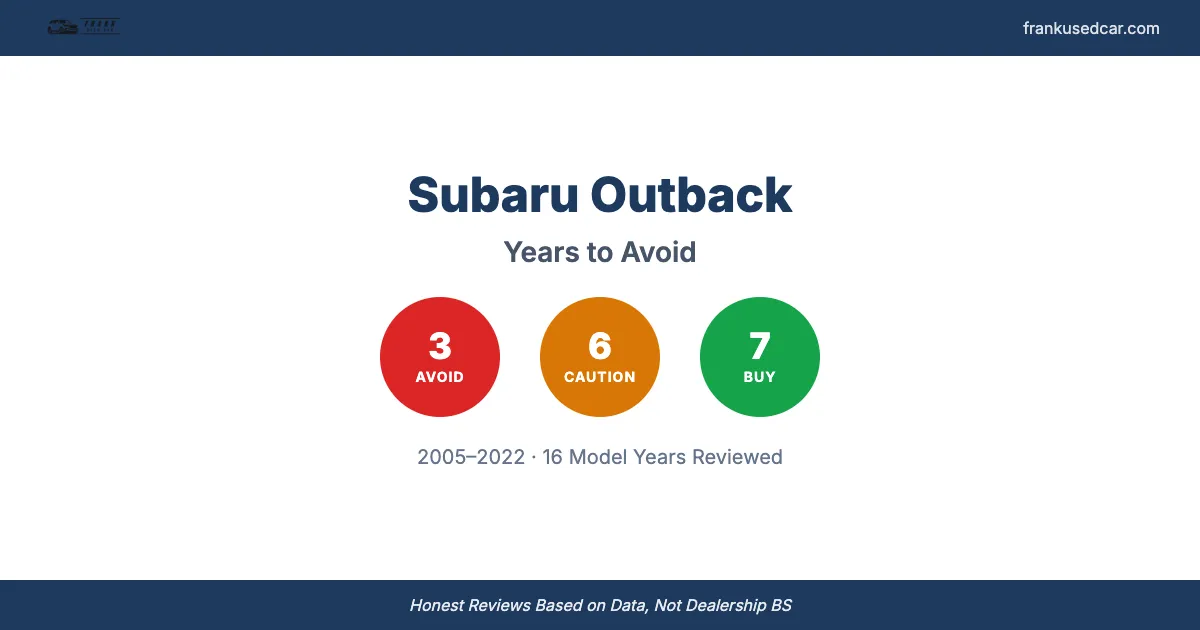
The 2013, 2014, 2005, 2010, and 2020 Subaru Outback are the five model years to avoid — the 2013 alone has 5x the complaint rate of any other Outback year, driven by catastrophic oil consumption and CVT failures.
| Year | Frank’s Verdict | Key Issue | Risk Level |
|---|---|---|---|
| 2013 | AVOID | WORST YEAR — oil consumption 1 qt/1,000 mi + CVT failures + stalling | EXTREME |
| 2014 | AVOID | Same FB25 oil consumption and CVT problems, no fix | EXTREME |
| 2005 | AVOID | First Gen3, EJ25 head gasket at 80K-120K, repair exceeds value | HIGH |
| 2010 | AVOID | Worst of both eras — last EJ25 head gaskets + first CVT | HIGH |
| 2020 | CAUTION | First Gen6, infotainment freezing, CVT judder | MODERATE |
The Outback has two distinct failure eras: head gaskets in older EJ25 engines (2000-2011) and CVT problems in newer models (2010-2016). CarComplaints.com ranks the 2013 Outback as a “Beware of the Clunker” vehicle — the highest severity rating they assign — driven by oil consumption and CVT failures that cost more than the car is worth. The 2010 sits at the crossroads of both eras — the last year with EJ25 head gasket risk and the first year with the CVT. That’s why I rate it a 4/10 despite being a newer car than the 2007-2008.
For the full breakdown of what goes wrong in each of these years — oil consumption rates, CVT shudder patterns, head gasket failure timelines — read the complete Subaru Outback years to avoid guide.
Head Gasket vs CVT: Two Eras of Subaru Outback Problems
The Subaru Outback has two distinct reliability eras — the head gasket era (2000-2011, EJ25 engine) and the CVT era (2010-present, Lineartronic transmission) — and understanding which era a model year falls in determines whether you budget $2,000 for a gasket or $5,000 for a transmission.
Era 1 — Head Gaskets (2000-2011): The EJ25 2.5-liter boxer engine develops external coolant leaks at the head gasket between 80,000-120,000 miles. The horizontal cylinder layout allows coolant to pool at gasket seams, deteriorating the composite gaskets Subaru used from the factory. Repair costs $1,500-$2,500 for both sides. When done with MLS (multi-layer steel) gaskets, the fix is permanent. The timing belt on the EJ25 is due every 105,000 miles — it’s an interference engine, so belt failure destroys the engine. Budget $500-$800 for this service.
If buying a 2005-2009 Outback, ask one question: has the head gasket been done? If yes, you’re good for another 100,000+ miles. If no, budget $2,000.
Era 2 — CVT + Oil Consumption (2010-present): The Lineartronic CVT replaced the traditional 4EAT automatic starting in 2010. Worst performance hit in 2013-2014, when the FB25 engine consumed oil at 1 quart per 1,000 miles and the CVT shuddered, hesitated, and failed. CVT replacement costs $3,000-$6,000. The transmission improved significantly by 2017 — seven years of production refinement made a real difference.
If buying a 2010-2016 Outback, get extended warranty coverage for the CVT. For 2017+ models, the CVT is more proven — but change the fluid every 30,000 miles, not the 60,000 miles Subaru recommends. Proactive fluid changes are the single best investment in CVT longevity.
The overlap zone: The 2010-2012 Outback sits in BOTH eras. The 2010 has the EJ25 head gasket risk AND the first-generation CVT. The 2011-2012 transitioned to the FB25 engine (eliminating head gaskets) but kept the early CVT. That’s why the entire Gen4 (2010-2014) is the weakest Outback generation.
| Era | Engine | Failure Mode | Repair Cost | Affected Years | Frank’s Advice |
|---|---|---|---|---|---|
| Head Gasket | EJ25 2.5L | External coolant leak at 80K-120K | $1,500-$2,500 | 2000-2011 | Ask if done. Budget $2,000 if not. |
| CVT | Lineartronic | Shudder, hesitation, premature failure | $3,000-$6,000 | 2010-2016 (worst) | Extended warranty. Fluid every 30K mi. |
| Oil Consumption | FB25 2.5L | 1 qt per 1,000 mi | $3,000-$5,000 (short block) | 2013-2014 | Avoid entirely. |
How Reliable Is the Subaru Outback by Year?
The Subaru Outback reliability varies dramatically by generation, with the 2021-2022 Gen6 and 2017-2018 Gen5 earning top marks while the 2013-2014 Gen4 score lowest — based on NHTSA complaint density and repair cost severity.
| Year | Gen | Frank’s Rating | Key Strength | Key Risk |
|---|---|---|---|---|
| 2005 | Gen3 | 4/10 | First Gen3 design | Head gasket at high mileage |
| 2006 | Gen3 | 6/10 | Improving design | Head gasket risk reducing |
| 2007 | Gen3 | 8/10 | Mature, no CVT | Timing belt maintenance |
| 2008 | Gen3 | 8/10 | Same proven reliability | Timing belt maintenance |
| 2009 | Gen3 | 7/10 | Last Gen3, solid | Aging platform |
| 2010 | Gen4 | 4/10 | Newer design | Head gasket + first CVT |
| 2011 | Gen4 | 5/10 | EJ25 still available | Head gasket + early CVT |
| 2012 | Gen4 | 6/10 | FB25 transition | Fewer head gaskets, CVT improving |
| 2013 | Gen4 | 2/10 | FB25 fuel economy | WORST — oil consumption + CVT + stalling |
| 2014 | Gen4 | 3/10 | Updated interior | Same FB25/CVT problems |
| 2015 | Gen5 | 6/10 | Gen5 design refresh | First-year CVT hesitation |
| 2016 | Gen5 | 6/10 | Improved over 2015 | CVT shudder, windshield |
| 2017 | Gen5 | 8/10 | TOP PICK — SGP, refined CVT | Verify steering column recall |
| 2018 | Gen5 | 8/10 | Same quality as 2017 | None significant |
| 2019 | Gen5 | 5/10 | EyeSight standard | Battery drain, windshield, infotainment |
| 2020 | Gen6 | 5/10 | New design, FA24 turbo | First-year infotainment freezing |
| 2021 | Gen6 | 9/10 | Lowest complaints ever | None significant |
| 2022 | Gen6 | 9/10 | Same as 2021 | Above depreciation sweet spot |
RepairPal rates the Subaru Outback 3.5 out of 5.0 with an average annual repair cost of $607 — below the $652 industry average but above the compact SUV segment leaders like the RAV4 ($429) and CR-V ($407). That ranks 10th out of 26 midsize SUVs. That’s a brand-level average across all years — the 2021 and the 2013 are completely different ownership experiences.
J.D. Power gives the Outback decent marks for initial quality, but their ratings don’t weight complaint severity. My rating focuses on one metric: how likely is this specific model year to cost you unexpected money?
What Is the Best Used Subaru Outback for the Money?
The best used Subaru Outback for the money depends on your budget — the 2007-2008 wins under $8,000, the 2017-2018 wins at $16,000-$21,000, and the 2021 wins at $24,000-$28,000, with each tier offering the best reliability-to-price ratio in its range.
| Budget Tier | Recommended Year | Price Range | Mileage | Key Advantage | Key Risk |
|---|---|---|---|---|---|
| Budget | 2007-2008 | $5,000-$8,000 | 130K-200K | No CVT, 4EAT proven, cheapest AWD wagon | EJ25 head gasket ($1,500-$2,500) |
| Mid-Range | 2017-2018 | $16,000-$21,000 | 50K-100K | Depreciation sweet spot, refined CVT, EyeSight | Verify steering recall |
| Premium | 2021 | $24,000-$28,000 | 20K-50K | Lowest complaints ever, standard EyeSight | Above sweet spot pricing |
Every Outback comes with standard AWD. Competitors charge $1,500-$2,000 for AWD as an option. A $17,000 Outback with AWD included is equivalent to an $18,500-$19,000 competitor with AWD added. Factor that into every price comparison.
Total cost of ownership matters more than sticker price. A $17,000 2017 Outback with $607 per year in repairs costs $18,821 over three years. A $7,000 2007 Outback with $607 per year is $8,821 — but budget an extra $2,000 if the head gasket hasn’t been done. A $10,000 2013 Outback with a $4,500 CVT failure costs $14,500+ in year one. The “cheap” 2013 becomes the most expensive option.
Keep 15% of your budget in reserve for first-year repairs. A $20,000 budget means $17,000 for the car and $3,000 in the repair fund. That repair fund is insurance against the unexpected — and on a used Subaru, it’s not optional.
Which Subaru Outback Generation Is Most Reliable?
The Gen6 Subaru Outback (2020-present) is the most reliable generation overall with the lowest complaint rates per unit sold, followed closely by the mature Gen5 years (2017-2018) and Gen3 (2007-2008), while the Gen4 (2010-2014) sits lowest — though every generation has at least one model year to avoid.
| Rank | Generation | Years | Engine | Transmission | Key Issue | Rating |
|---|---|---|---|---|---|---|
| 1 | Gen6 (2021+) | 2021-present | FB25/FA24T | CVT | None significant | 9/10 |
| 2 | Gen5 (late) | 2017-2018 | FB25/H6 | CVT | None significant | 8/10 |
| 3 | Gen3 (late) | 2007-2008 | EJ25/H6 | 4EAT Auto | Head gasket (one-time fix) | 8/10 |
| 4 | Gen5 (early) | 2015-2016 | FB25 | CVT | CVT hesitation, windshield | 6/10 |
| 5 | Gen4 | 2010-2014 | EJ25→FB25 | CVT | Head gasket + CVT + oil consumption | 3.5/10 |
The Gen4 (2010-2014) is the weakest Outback generation by a wide margin. It combined the transition from EJ25 to FB25 engines with first-generation CVT adoption. The 2013-2014 had oil consumption rates that consumed 1 quart every 1,000 miles — draining oil faster than some owners could check it.
Mid-generation years are always more reliable than launch years — that’s the single most important lesson in used car buying. The 2017 Outback is three times more reliable than the 2015 by complaint density. Same generation, completely different ownership experience.
How Does the Subaru Outback Compare to Other Midsize SUVs?
The Subaru Outback ranks below the Toyota RAV4, Honda CR-V, and Mazda CX-5 in long-term repair costs, but its standard AWD on every trim gives it a unique value advantage — no competitor includes AWD at no extra charge.
| Model | RepairPal | Annual Cost | Best Used Years | Worst Years | AWD Standard? |
|---|---|---|---|---|---|
| Subaru Outback | 3.5/5.0 | $607/yr | 2021, 2017-2018, 2007-2008 | 2013, 2014, 2005, 2010 | Yes — all trims |
| Toyota RAV4 | 4.0/5.0 | $429/yr | 2021, 2020, 2015-2016 | 2006-2008, 2013, 2019 | Optional |
| Honda CR-V | 4.5/5.0 | $407/yr | 2020-2021, 2015-2016 | 2011-2013, 2007 | Optional |
| Mazda CX-5 | 4.0/5.0 | $447/yr | 2019-2022, 2016-2017 | 2013-2014 | Optional |
| Ford Escape | 3.5/5.0 | $600/yr | 2020-2022 | 2013-2014 | Optional |
The Outback’s $607 per year repair cost is higher than the RAV4 ($429) and CR-V ($407). But add $1,500-$2,000 for AWD on those competitors and the total cost gap shrinks dramatically. The Outback also offers 8.7 inches of ground clearance vs 8.1 for the RAV4 and 7.8 for the CR-V — real clearance for gravel roads and light trails.
If you need AWD year-round — snow states, gravel roads, camping access — the Outback’s standard AWD and wagon body make it the most practical choice in the segment. If you live in a mild climate where AWD is optional, the RAV4 or CX-5 is cheaper to own long-term by $150-$200 per year.
The Subaru Impreza best and worst years guide covers Subaru’s compact option — the Impreza shares the same EJ25 and FB engine platforms with many of the same reliability patterns. The full used Subaru buying guide covers every current Subaru model.
What Should You Check Before Buying a Used Subaru Outback?
Check these seven items before buying any used Subaru Outback — each targets a specific problem documented in this guide that varies by generation and engine era.
Check head gasket status on 2005-2011 models. Look for dried coolant residue around the cylinder heads. Ask for replacement receipts. If done with MLS gaskets, the fix is permanent. If not done on a car with 80,000+ miles, budget $1,500-$2,500 and negotiate accordingly.
Test CVT through all driving modes on 2010+ models. Accelerate from a stop and feel for hesitation or shudder. Drive 20+ minutes and check for judder at highway speed. A smooth CVT at 5 minutes can reveal problems at 15 minutes when transmission fluid heats up. A failing CVT costs $3,000-$6,000.
Check oil level on 2013-2014 models COLD before the test drive. If it’s a quart low sitting on the dealer lot, oil consumption is active. Walk away. A short block replacement costs $3,000-$5,000 — more than many of these cars are worth.
Verify NHTSA recall completion by VIN. Especially recall 17V006000 on 2016-2017 models — the “Do Not Drive” steering column recall where improper machining could cause total loss of steering. This is not optional. Check before driving the car.
Test infotainment responsiveness on 2020+ models. Navigate through menus, test the backup camera, toggle between screens. Watch for freezing, lag, or phantom touches on the 11.6-inch tablet screen. The 2020 had persistent screen bugs that the 2021 fixed.
Inspect CVT fluid color on 2010+ models. Pull the dipstick or check at the dealer — fluid should be clear pink or light red. Dark brown or burnt-smelling fluid means deferred maintenance. Change CVT fluid every 30,000 miles, not the 60,000 Subaru recommends.
Request complete service history with CVT fluid changes and timing belt intervals. Maintenance records matter more than mileage on a Subaru. A 150,000-mile Outback with complete records is a better buy than a 90,000-mile Outback with no history. Gaps in service suggest deferred maintenance that accelerates wear on boxer engines and CVTs.
These aren’t random suggestions. Each item maps to a specific Outback problem pattern by generation. A 2021 needs items 2, 5, and 7. A 2007 needs items 1, 6, and 7. A 2013 needs items 3 and nothing else — because the answer is “don’t buy it.”
A thorough used car buying guide covers the universal checks that apply to every car — title history, accident reports, and financing strategies.
Also see: Subaru Years to Avoid