Nissan Rogue Years to Avoid (And Best Years to Buy)
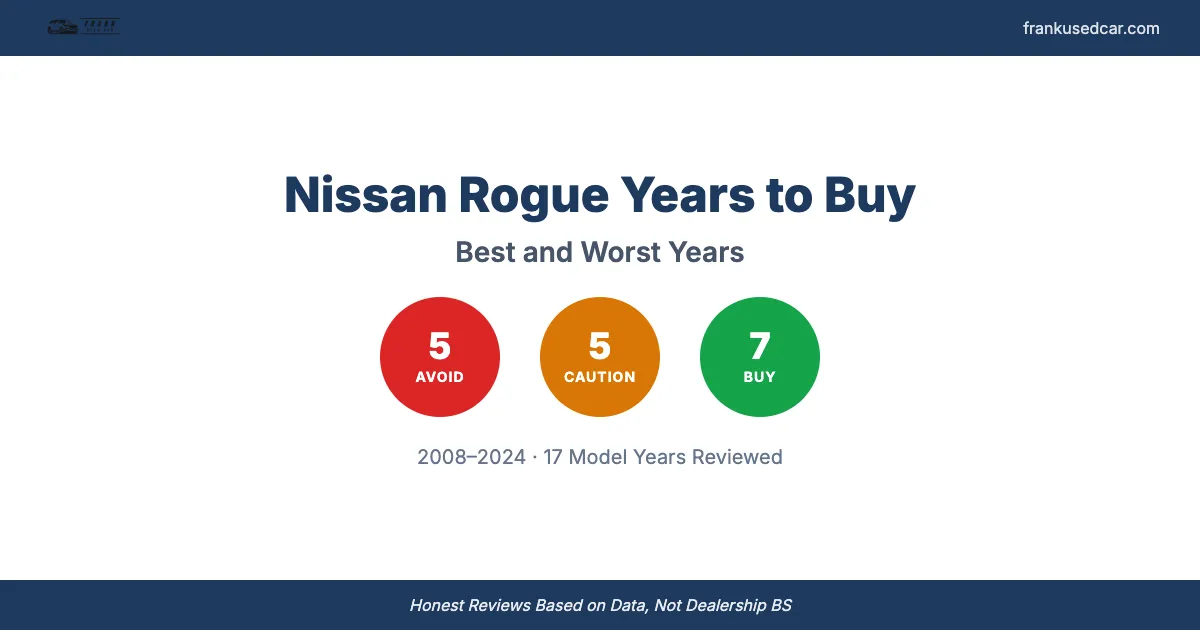
The 2008, 2013, 2014, and 2015 Nissan Rogue have the worst CVT failures. See Frank's year-by-year ratings and find the best Rogue to buy used.
The Nissan Rogue is a compact crossover SUV produced since 2008 across three generations — one of Nissan’s best-selling vehicles and a consistent top-5 SUV in America. Not every Nissan Rogue model year is worth buying used. The Jatco CVT transmission creates a reliability divide that makes year selection more critical for the Rogue than for any other compact SUV on the market.
I’ve reviewed the NHTSA complaint data on every Nissan Rogue model year, and the CVT is the story of this car — for better and worse. Four model years — 2008, 2013, 2014, and 2015 — have CVT failure rates high enough to avoid entirely, with replacement costs running $3,500-$5,000. The 2017 and 2021 earn a CAUTION rating as first-year refresh and first-year generation models. The 2018-2020 and 2022+ Nissan Rogue years represent the mature, refined CVT calibrations where this crossover becomes a genuine value compared to the RAV4 and CR-V.
Below is Frank’s year-by-year verdict for every Nissan Rogue generation.
| Year | Frank’s Verdict | Key Issue | Risk Level |
|---|---|---|---|
| 2008 | AVOID | First-year CVT failure + oil consumption | HIGH |
| 2009 | BUY (budget) | Improved calibration, lower complaints | LOW |
| 2010 | BUY (budget) | Refined Gen1, solid track record | LOW |
| 2011 | BUY (budget) | Consistent Gen1 performer | LOW |
| 2012 | BUY (budget) | Last good Gen1 year | LOW |
| 2013 | AVOID | Highest Gen1 complaint count, CVT judder | HIGH |
| 2014 | AVOID | First Gen2, inherited CVT failures + AC compressor | HIGH |
| 2015 | AVOID | CVT failure + phantom braking | HIGH |
| 2016 | BUY | Improved Gen2, lower complaint density | LOW-MEDIUM |
| 2017 | CAUTION | First refresh year, CVT calibration adjustments | MEDIUM |
| 2018 | BUY | Mature Gen2, ProPilot Assist added | LOW |
| 2019 | BUY (top pick) | Most refined Gen2 CVT, best value | LOW |
| 2020 | BUY | Final Gen2, proven reliability | LOW |
| 2021 | CAUTION | First Gen3, new platform teething | MEDIUM |
| 2022+ | BUY | Refined Gen3, redesigned CVT | LOW |
Which Nissan Rogue Years Should You Avoid?
The 2008, 2013, 2014, and 2015 Nissan Rogue are the four model years to avoid, based on NHTSA complaint density and the severity of CVT transmission failures that cost $3,500-$5,000 to repair. Each of these years sits at the beginning or end of a generation — exactly where reliability problems concentrate.
The CVT is the Nissan Rogue’s Achilles’ heel. When it works, the Rogue is a smooth, fuel-efficient crossover. When it fails, you’re looking at a $4,000 repair bill on a car that might be worth $8,000.
The 2008 was the first Rogue ever built. The 2013 was the last Gen1 with the highest complaint count. The 2014 launched Gen2 with a “revised” CVT that still failed. The 2015 added phantom braking from a faulty forward emergency braking system on top of the CVT problems.
Let’s start with the first Nissan Rogue ever made — the 2008.
What Problems Does the 2008 Nissan Rogue Have?
The 2008 Nissan Rogue was the first model year ever produced, and it arrived with an underpowered 2.5L engine, an early Jatco CVT that fails between 60,000 and 100,000 miles, and excessive oil consumption that compounds the transmission problems.
The 2008 Rogue was Nissan’s answer to the RAV4 and CR-V. The answer wasn’t good enough.
Top problems — 2008 Nissan Rogue:
- CVT transmission failure (shuddering, complete failure) — 60,000-100,000 miles
- Excessive oil consumption — 40,000-80,000 miles
- Engine stalling at idle and low speed — 50,000-90,000 miles
- Power steering pump failure
- Cracked exhaust manifold
I see 2008 Nissan Rogue listings at $4,000-$6,000 with 90,000 miles. That sounds affordable until the CVT fails at 95,000 and costs $4,000 to replace. The math doesn’t work.
Frank’s Verdict: AVOID — First-year model with first-generation CVT. The transmission alone makes this a skip. Add oil consumption and you’ve got a car that costs more to fix than it’s worth.
The 2013 had even more complaints despite being five years newer.
What Problems Does the 2013 Nissan Rogue Have?
The 2013 Nissan Rogue has the highest complaint count of any Gen1 model year, with CVT failures, transmission judder, and AC compressor issues occurring at rates that make it the worst of the original generation.
Six years of production and the Gen1 CVT was still failing at 50,000 miles. By 2013, the pattern was unmistakable — Nissan never resolved the fundamental Jatco CVT weakness during the entire first generation of the Rogue.
Top problems — 2013 Nissan Rogue:
- CVT transmission failure — 50,000-90,000 miles
- CVT judder and whining — 40,000-70,000 miles
- AC compressor failure — 30,000-60,000 miles
- Sunroof rattling and leaking
- Premature tire wear
The 2013 proves that the Gen1 Nissan Rogue CVT never got fully reliable. Last-year-of-generation models accumulate every unresolved problem from the entire production run.
Frank’s Verdict: AVOID — Highest complaint rate of any Gen1 Rogue. The CVT judder alone tells you this transmission was never properly sorted. Six years wasn’t enough for Nissan to fix it.
The Gen2 redesign in 2014 should have fixed the CVT — it didn’t.
What Problems Does the 2014 Nissan Rogue Have?
The 2014 Nissan Rogue was the first year of the second generation, and despite a complete platform redesign, the Jatco CVT continued to fail — with transmission shuddering, slipping, and complete failure reported at 40,000-80,000 miles, plus AC compressor seizure and engine stalling.
Nissan called it a “revised” CVT for the 2014 Rogue. The failure rates suggest the revisions didn’t address the fundamental design weakness. New body, same transmission problem.
Top problems — 2014 Nissan Rogue:
- CVT transmission failure (shuddering, slipping, complete failure) — 40,000-80,000 miles
- AC compressor seizure — 30,000-60,000 miles ($800-$1,500)
- Engine stalling at idle — 20,000-50,000 miles
- Excessive brake wear — 20,000-40,000 miles
- Sunroof leaking
The 2014 also triggered NHTSA recall 16V149000 for a fuel pump that could fail due to improper nickel plating, causing engine stall. Recall 14V218000 addressed an incorrect steering column bolt that could loosen and fall out.
Frank’s Verdict: AVOID — First-year Gen2 with the same CVT curse. The new platform looks great, but the transmission will ruin your ownership experience and your wallet.
The 2015 continued the same pattern.
What Problems Does the 2015 Nissan Rogue Have?
The 2015 Nissan Rogue continued the 2014’s CVT failures with transmission whining, shuddering, and complete failure at 45,000-90,000 miles, plus AC compressor issues and forward emergency braking false activations that caused phantom braking at highway speeds.
The forward emergency braking false activation is the scariest problem on this list. Imagine driving 65 mph and the Nissan Rogue suddenly slams the brakes for no reason. That happened to multiple 2015 Rogue owners — a safety system creating dangerous situations.
Top problems — 2015 Nissan Rogue:
- CVT transmission failure — 45,000-90,000 miles
- CVT whining and shuddering — 30,000-70,000 miles
- AC compressor failure — 35,000-65,000 miles
- Engine stalling — 25,000-50,000 miles
- Forward emergency braking false activations — phantom braking at highway speed
The 2015 Rogue gives you two dealbreakers instead of one. The CVT drains your bank account. The phantom braking endangers your safety.
Frank’s Verdict: AVOID — CVT failures plus phantom braking. The 2015 Rogue has reliability problems and a safety system that creates dangerous situations. Double dealbreaker.
Why Do Nissan Rogue CVTs Fail?
Nissan Rogue CVTs fail because the Jatco-manufactured continuously variable transmission uses a steel belt and pulley system that overheats under load, causing the belt to slip, the pulleys to wear unevenly, and the entire unit to lose its ability to transfer power to the wheels.
Jatco is a Nissan subsidiary — this is an in-house problem, not a supplier issue. The CVT uses no traditional gears. It relies entirely on friction between a steel belt and two cone-shaped pulleys. When the friction surface wears from overheating — caused by towing, hills, or aggressive driving — the Nissan Rogue CVT shudders, then fails.
CVT repair costs:
| Repair | Cost |
|---|---|
| CVT replacement | $3,500-$5,000 |
| CVT rebuild | $2,500-$4,000 |
Unlike a traditional automatic transmission where a worn clutch pack costs $1,200 to fix, a worn CVT usually means full replacement. There’s no partial fix for a slipping belt.
Nissan extended the CVT warranty on some Nissan Rogue models to 10 years/120,000 miles. Check with a Nissan dealer using your VIN before paying out of pocket.
A couple of other Nissan Rogue years deserve closer examination.
What Problems Does the 2017 Nissan Rogue Have?
The 2017 Nissan Rogue was the first year of the Gen2 refresh, and while CVT reliability improved significantly over 2014-2015, some early production units still had CVT calibration issues and the safety tech required software updates to eliminate false alerts.
The 2017 is dramatically better than the 2014-2015 Nissan Rogue. Most CVT issues were resolved. The refresh brought updated styling and improved tech — but first-refresh-year risk means the 2018-2020 are safer bets.
Remaining concerns — 2017 Nissan Rogue:
- CVT calibration adjustments on early production units
- Safety sensor calibration requiring dealer software updates
- ProPilot Assist not yet available (added for 2018)
Frank’s Verdict: CAUTION — Major improvement over 2014-2015, but the 2018 is where the CVT reliability really settled down. Worth considering only if the price is right and service records are clean.
The 2021 brought an entirely new platform.
What Problems Does the 2021 Nissan Rogue Have?
The 2021 Nissan Rogue launched the third generation on an entirely new platform with a redesigned CVT, and like most first-year models, it carried some early teething issues including infotainment bugs, sensor malfunctions, and occasional drivetrain calibration complaints.
The new CMF-C/D platform gave the 2021 Nissan Rogue a VC-Turbo engine option and a CVT design that addresses the overheating issues that killed earlier units. Early reliability reports are positive — but first-year risk is first-year risk.
Early concerns — 2021 Nissan Rogue:
- Infotainment system bugs and freezing
- Parking sensor and blind spot monitor malfunctions
- Drivetrain calibration complaints on early production units
- NHTSA recall 23V093000 for jackknife ignition key collapse
Frank’s Verdict: CAUTION — Promising first-year Gen3, but let someone else be the test driver. The 2022+ is where the new platform proves itself.
These year-specific Nissan Rogue problems feed into larger CVT-focused patterns.
What Are the Most Common Nissan Rogue Problems?
The most common Nissan Rogue problems center on the Jatco CVT transmission — failure, shuddering, whining, and overheating — followed by AC compressor seizure, engine stalling, and forward emergency braking false activations, with severity depending almost entirely on model year and generation.
The CVT is the defining issue of the Nissan Rogue. Every other problem on this list is a normal car repair. The CVT failure is the one that totals the car.
| Problem | Severity | Cost | Worst Years |
|---|---|---|---|
| CVT transmission failure | SERIOUS | $3,500-$5,000 | 2008, 2013, 2014, 2015 |
| CVT shudder/whining | MODERATE | $500-$1,500 | 2013, 2014, 2015 |
| AC compressor seizure | MODERATE | $800-$1,500 | 2014, 2015 |
| Engine stalling | MODERATE | $500-$1,500 | 2008, 2014, 2015 |
| Oil consumption | SERIOUS | $2,000-$3,500 | 2008 |
| Forward emergency braking false activation | MODERATE (safety hazard) | $200-$500 | 2015+ |
Are Nissan Rogue CVT Problems Serious?
Yes, Nissan Rogue CVT problems are serious. CVT failure is the number one complaint across all Nissan Rogue model years, with replacement costs of $3,500-$5,000 that often exceed half the vehicle’s resale value.
The severity varies by generation. Gen1 (2008-2013) has the worst failure rates. Gen2 early years (2014-2015) remain high. Gen2 mature years (2018-2020) show significant improvement. Gen3 (2021+) uses a redesigned CVT with positive early reliability data.
Nissan extended the CVT warranty to 10 years/120,000 miles on some Nissan Rogue models. Always check if your specific VIN is covered before paying out of pocket.
Does the Nissan Rogue Have AC Compressor Problems?
Yes, the Nissan Rogue has documented AC compressor failure primarily in 2014-2015 models, where the compressor seizes between 30,000 and 60,000 miles — an $800-$1,500 repair.
The seized compressor takes out the drive belt, compounding the repair cost. When both the CVT and AC compressor fail in the same ownership period — which happens in the 2014-2015 Nissan Rogue more often than you’d expect — the combined repair bill exceeds the car’s value.
Does the Nissan Rogue Have Engine Problems?
Yes, the Nissan Rogue has engine problems including stalling at idle in 2008 and 2014-2015 models, excessive oil consumption in the 2008 requiring piston ring replacement ($2,000-$3,500), and occasional fuel system complaints.
The engine issues are real but secondary. Fix the stalling for $500-$1,500 and the Nissan Rogue runs fine. The CVT is what ends these cars, not the engine.
These problem patterns map directly onto the year-by-year reliability picture.
How Reliable Is the Nissan Rogue by Year?
Nissan Rogue reliability is the most generation-dependent of any compact SUV — Gen1 late years and Gen2 early years score among the worst in the class, while Gen2 mature years (2018-2020) and Gen3 (2022+) have closed much of the gap with Japanese competitors.
| Year | Generation | Frank’s Rating (1-10) | Key Strength | Key Risk |
|---|---|---|---|---|
| 2008 | Gen1 | 3/10 | Low price | CVT + oil consumption |
| 2009 | Gen1 | 6/10 | Improved CVT calibration | Age |
| 2010-2012 | Gen1 | 7/10 | Proven Gen1 sweet spot | Age, parts availability |
| 2013 | Gen1 | 3/10 | Low price | Highest Gen1 complaint count |
| 2014 | Gen2 | 3/10 | New platform, more space | CVT + AC compressor |
| 2015 | Gen2 | 3/10 | Updated safety tech | CVT + phantom braking |
| 2016 | Gen2 | 6/10 | Improved CVT calibration | Some residual CVT risk |
| 2017 | Gen2 refresh | 6/10 | Refreshed design | First-refresh teething |
| 2018 | Gen2 | 8/10 | ProPilot Assist, mature CVT | Normal wear items |
| 2019 | Gen2 | 8/10 | Best value Gen2 | Normal wear items |
| 2020 | Gen2 | 8/10 | Final Gen2, proven | Normal wear items |
| 2021 | Gen3 | 6/10 | New platform, VC-Turbo | First-year risk |
| 2022+ | Gen3 | 8/10 | Refined Gen3, new CVT | Higher price |
The Nissan Rogue reliability reputation is dragged down by the 2013-2015 CVT disaster. Looking only at 2018+, the Rogue competes well with the CR-V and Forester. The key is knowing which years to avoid.
Before buying, check the recall history and CVT warranty status.
Has the Nissan Rogue Been Recalled?
The Nissan Rogue has been subject to several NHTSA recalls, with the most significant affecting the 2008-2014 electrical harness, the 2014-2016 electrical connector corrosion, the 2014 fuel pump and steering column, and the 2014-2020 jackknife ignition key.
| Recall ID | Year(s) | Date Issued | Issue | Fix |
|---|---|---|---|---|
| 15V032000 | 2008-2013, 2014 | Jan 2015 | Electrical short from water/salt intrusion — fire risk | Harness inspection + waterproof seal |
| 22V024000 | 2014-2016 | Jan 2022 | Under-dash connector corrosion — battery drain + fire risk | Connector replacement + lithium grease |
| 16V149000 | 2014 | Mar 2016 | Fuel pump failure from improper nickel plating — engine stall | Fuel pump replacement |
| 14V218000 | 2014 | Apr 2014 | Steering column bolt may loosen — loss of steering | Bolt inspection + repair |
| 23V093000 | 2014-2020 | Feb 2023 | Jackknife key collapse while driving — disables airbags | Key spacer installation |
Source: NHTSA recall database, verified .
The CVT extended warranty is separate from these recalls. Nissan didn’t formally recall the CVT — they extended the warranty. That means if the Nissan Rogue CVT fails within 10 years/120,000 miles and you’re the original owner, Nissan may cover the repair. Coverage varies by VIN, and used buyers may not qualify. Always check with a Nissan dealer before assuming you’re covered.
Now that you know what to avoid, here are the Nissan Rogue years worth buying.
What Are the Best Nissan Rogue Years to Buy?
The best Nissan Rogue years to buy used are the 2018-2020, 2022+, and 2010-2012 — models where the CVT had either been refined through years of calibration or completely redesigned for a new generation. For a deeper dive across the full lineup, see our Nissan reliability guide.
Frank’s Top Pick: 2019 Nissan Rogue. If I were buying a used Rogue today, I’d get the 2019. It’s the mature Gen2 with ProPilot Assist, the most-refined Jatco CVT calibration, and prices have dropped enough to be a genuine value compared to a RAV4 or CR-V.
Budget pick: 2010-2012 Nissan Rogue. The Gen1 sweet spot. The CVT had been calibrated for two years and complaint rates are significantly lower than the 2008 or 2013. At 14-16 years old, a pre-purchase inspection is essential — but the price is right.
New-gen pick: 2022+ Nissan Rogue. The Gen3 is promising with a redesigned CVT and the VC-Turbo engine option. Prices are still high, but the new platform addresses the fundamental overheating problems of earlier CVTs.
Price-value reality: A 2019 Nissan Rogue costs $5,000-$8,000 less than a comparable RAV4. If the CVT has been reliable for 60,000+ miles, it’s likely to stay reliable. That discount is real savings — not deferred repair costs.
Is the 2019 Nissan Rogue Worth Buying Used?
Yes, the 2019 Nissan Rogue is one of the best values in the used compact SUV market. The CVT had been refined through five years of Gen2 production. ProPilot Assist adds semi-autonomous highway driving on SV trim and above. Safety Shield 360 provides a full suite of active safety features.
A 2019 Rogue with 60,000 miles and clean service records represents a proven powertrain at a price $5,000-$8,000 below a comparable Toyota RAV4. The CVT concern that plagues earlier Nissan Rogue years does not apply here — five years of calibration refinement made the difference.
Is the 2010 Nissan Rogue a Good Budget Buy?
Yes, with inspection. The 2010 Nissan Rogue is a reasonable budget pick with the refined Gen1 CVT that has significantly lower failure rates than the 2008 or 2013. At 16 years old, age is the primary concern — a pre-purchase inspection with CVT fluid analysis is essential before committing.
The 2010 Rogue sits in the sub-$8,000 used car market where alternatives are limited. For buyers who need affordable transportation and are willing to invest in a thorough inspection, the 2010-2012 Nissan Rogue range offers the most reliable Gen1 options.
Is the Nissan Rogue a Reliable SUV Overall?
The Nissan Rogue is a below-average compact SUV for reliability when considering all model years together — it ranks behind the Toyota RAV4, Honda CR-V, and Mazda CX-5 primarily because of the CVT transmission problems that plagued 2008-2015 models.
| Model | Overall Reliability | Biggest Weakness | Used Price (2019, ~60K mi) |
|---|---|---|---|
| Toyota RAV4 | Above average | Higher price | $22,000-$26,000 |
| Honda CR-V | Above average | Oil dilution (1.5T) | $21,000-$25,000 |
| Mazda CX-5 | Above average | Smaller cargo | $19,000-$23,000 |
| Nissan Rogue | Below average (all years) | CVT transmission | $14,000-$18,000 |
The Nissan Rogue’s value proposition is price. It’s consistently $3,000-$8,000 cheaper than a comparable RAV4 or CR-V. If you buy the right year (2018+), that discount is a genuine bargain. If you buy the wrong year, the CVT repair bill erases the savings and then some.
For buyers cross-shopping, see our guides on Toyota RAV4 years to avoid and Honda CR-V years to avoid.
How Do You Inspect a Used Nissan Rogue Before Buying?
Check these seven items before buying any used Nissan Rogue — the CVT transmission is the make-or-break component, and these checks reveal whether it’s healthy or heading for failure. For broader guidance, see our used car buying guide.
Test the CVT during a 20-minute city drive. Listen for whining noise during acceleration. Feel for shuddering or hesitation between 20-40 mph. The Nissan Rogue CVT reveals its condition under sustained city driving — a 5-minute test drive around the block is not enough.
Check CVT fluid color by pulling the dipstick. Healthy fluid is green or light amber. Dark brown or burnt-smelling fluid means deferred maintenance or internal wear. Dark CVT fluid on any Nissan Rogue is a walk-away signal.
Verify CVT extended warranty status with a Nissan dealer by VIN. The 10 years/120,000 miles extended coverage on some models could save you $4,000. Call the dealer before negotiating — warranty status changes the car’s value.
Test the AC by running max cold for 10 minutes. Listen for compressor cycling noises or reduced cooling output. AC compressor seizure in 2014-2015 Nissan Rogue models costs $800-$1,500 — and it often coincides with other problems.
Test forward emergency braking in traffic. Drive in moderate traffic at varying speeds and watch for false activations or phantom braking events. This applies to 2015+ Nissan Rogue models equipped with the forward emergency braking system.
Run a full recall check through the NHTSA recall database. Enter the VIN to verify all recalls have been completed. Outstanding recalls are free to fix at any Nissan dealer — there’s no reason to buy a Rogue with unresolved safety recalls.
Request complete service history with CVT fluid change records. Nissan recommends CVT fluid changes every 30,000 miles. Skipped changes accelerate belt and pulley wear. A Nissan Rogue with documented 30,000-mile CVT fluid changes is worth significantly more than one without records.
These aren’t random suggestions. Each item targets a specific Nissan Rogue problem documented above. The CVT test drive is the single most important thing you can do — 20 minutes in city traffic will reveal most CVT problems before you commit.
Also see: Nissan Best & Worst Years