Best and Worst Nissan Rogue Years to Buy
Nissan Rogue best and worst years ranked by generation. CVT failure rate data, repair costs, and Frank's top picks for used compact SUV buyers.
The Nissan Rogue is one of America’s best-selling compact SUVs — but it’s also one of the riskiest used car buys because every single model year uses Nissan’s Jatco CVT transmission, the most complained-about drivetrain in the segment. The Nissan Rogue has spanned three generations since 2008. Best years deliver a reliable daily driver with near-zero complaints. Worst years come with a $3,500-$5,000 CVT replacement bill that can exceed the car’s resale value.
I’ve helped dozens of people shop for compact SUVs over 20 years — and the Nissan Rogue is the one where I have to be most careful with my recommendation. Even the best Rogue years cap at my 7-8 rating because that CVT is always a factor. The 2022 Nissan Rogue has the lowest complaint rates in Rogue history while the 2014 has 6x the complaint rate of any other generation. Here’s which years are actually worth the CVT risk.
Frank’s Nissan Rogue Best and Worst Years
| Model Year | Generation | Frank’s Verdict | Key Strength or Issue | Rating |
|---|---|---|---|---|
| 2022 | Gen3 | BUY — TOP PICK | Refined Gen3, VC-Turbo available, lowest CVT complaints | 8/10 |
| 2023 | Gen3 | BUY | Continued refinement, mature platform | 8/10 |
| 2024 | Gen3 | BUY | Best reliability data, above depreciation sweet spot | 8/10 |
| 2018 | Gen2 | BUY | CVT recalibration breakthrough, ProPilot Assist | 7/10 |
| 2019 | Gen2 | BUY | Safety Shield 360 added, same improved CVT | 7/10 |
| 2011 | Gen1 | BUY (budget) | Best Gen1, most CVT issues resolved, cheap | 7/10 |
| 2012 | Gen1 | BUY (budget) | Same quality as 2011, solid Gen1 | 7/10 |
| 2020 | Gen2 | CAUTION | Last Gen2, key collapse recall affects all Gen2 | 7/10 |
| 2021 | Gen3 | CAUTION | First Gen3 year, infotainment bugs, sensor issues | 5/10 |
| 2017 | Gen2 | CAUTION | CVT improving but not at 2018+ levels | 5/10 |
| 2009 | Gen1 | CAUTION | Improving but still CVT concerns | 5/10 |
| 2010 | Gen1 | CAUTION | CVT improving, OK budget pick if maintained | 6/10 |
| 2016 | Gen2 | AVOID | CVT still failing, electrical fire recall | 3/10 |
| 2015 | Gen2 | AVOID | CVT failures, AEB false activations | 2/10 |
| 2013 | Gen1 | AVOID | Worst Gen1 year, CVT failure spike | 2/10 |
| 2008 | Gen1 | AVOID | First year ever, CVT + oil consumption + stalling | 3/10 |
| 2014 | Gen2 | AVOID | Worst overall — CVT + 4 recalls + 6x complaints | 2/10 |
Why Is the 2022 Nissan Rogue Frank’s Top Pick?
The 2022 Nissan Rogue is Frank’s top pick — with caveats — because it combines the refined Gen3 platform with the lowest CVT complaint rates in Rogue history, an available 1.5L VC-Turbo engine producing 201 horsepower with variable compression ratio technology, and standard Safety Shield 360 at used prices that have dropped into the $22,000-$26,000 range.
BUY — TOP PICK, with one condition: get the extended warranty.
The 2021 was the first Gen3 year with infotainment bugs and sensor malfunctions. The 2022 fixed those first-year issues. Complaint density is VERY LOW — the best data Nissan has produced for the Rogue in its 16-year history.
Safety Shield 360 comes standard. Automatic emergency braking, blind spot monitoring, rear cross-traffic alert, lane departure warning. ProPilot Assist — adaptive cruise with lane centering — also standard. No options package. No trim upgrade.
The VC-Turbo engine is the real story. Variable compression ratio technology — the engine physically changes the shape of its combustion chambers while running. High compression for fuel efficiency at cruise. Low compression for power when you need it. 201 horsepower and 33 MPG combined from a 1.5-liter engine. No other compact SUV offers anything like it.
A 2022 Nissan Rogue SV with 25K miles lists around $22,000-$24,000. A comparable 2022 RAV4 with similar miles is $26,000-$28,000. That $4,000 gap is the CVT discount — and with the Gen3 CVT, the gap might finally be unjustified.
I still recommend an extended warranty on ANY Rogue purchase. The 2022 has the best CVT reliability data yet. But Nissan doesn’t have Toyota’s transmission track record. Budget $1,500 for a 3-year extended powertrain warranty and sleep easy.
A colleague’s wife bought a 2022 Rogue SL with the VC-Turbo last summer. 18 months in, 22,000 miles added — zero issues. She switched from a 2016 CR-V and says the Rogue’s tech and interior quality are a generation ahead. That’s the 2022 doing what Nissan should have been doing all along.
Frank’s Verdict: BUY — TOP PICK (with extended warranty). The 2022 Rogue is the best year across all three generations. Lowest CVT complaint data. VC-Turbo option. Standard safety suite. If you’re spending $22,000-$26,000 on a used compact SUV, the 2022 Rogue deserves a test drive — just budget $1,500 for extended warranty.
Before diving into the best years by generation, you need to understand the one thing that defines every Rogue purchase decision: the CVT.
How Reliable Is the Nissan Rogue CVT Transmission?
The Jatco CVT transmission is the single most important factor in every Nissan Rogue buying decision — failure rates ranged from 20-25% by 100,000 miles in the worst years (2013-2015) down to under 5% in the latest Gen3 models (2021+), with replacement costing $3,500-$5,000 at an independent shop.
| Year Range | CVT Generation | Estimated Failure Rate | Frank’s Comment |
|---|---|---|---|
| 2008-2010 | Jatco CVT7 (early) | 15-20% by 100K miles | Avoid unless cheap |
| 2011-2012 | Jatco CVT7 (revised) | 10-15% by 100K miles | Risky but budget-friendly |
| 2013-2015 | Jatco CVT7/CVT8 transition | 20-25% by 100K miles | The worst stretch |
| 2016-2017 | Jatco CVT8 (improving) | 10-15% by 100K miles | Getting better, not there yet |
| 2018-2020 | Jatco CVT8 (mature) | 5-8% by 100K miles | First acceptable range |
| 2021-2024 | Jatco CVT (next-gen) | <5% by 100K miles | Best yet, but still a CVT |
Nissan extended the CVT warranty to 10 years and 120,000 miles for 2013-2017 models under Customer Service Campaign P8132. That tells you everything about how serious the problem was — manufacturers don’t extend warranties unless the failure rate is embarrassing.
Nissan’s “lifetime fluid” claim is marketing. Change the CVT fluid every 30,000 miles — $150-$250 — or risk a $4,000 transmission replacement. Every Rogue owner I know who follows this schedule has better CVT longevity. The ones who believed “lifetime fluid” are the ones filing NHTSA complaints at 80K miles.
If you’re looking at a 2013-2017 Nissan Rogue, check whether the CVT was already replaced under warranty. A used Rogue with a NEW CVT installed under the extended warranty is actually a smart buy — you’re getting a fresh transmission on a depreciated car.
I helped a friend buy a 2014 Rogue at auction for $6,200. Clean body, 72K miles. Looked like a steal. The CVT started shuddering at 78K. Dealer quoted $3,400 for replacement. The $6,200 “deal” became a $9,600 mistake. That experience shaped my entire stance on Nissan CVTs.
The CVT is why the Nissan Rogue is priced $2,000-$4,000 below a comparable RAV4 or CR-V on the used market. That discount is real money. But only savvy buyers who understand the CVT risk should take advantage of it.
What Are the Best Gen1 Nissan Rogue Years? (2008-2013)
The best Gen1 Nissan Rogue years are the 2011 and 2012, which resolved most of the early CVT calibration issues and oil consumption problems that plagued the 2008-2010 models — making them budget-friendly picks IF you can verify CVT maintenance history.
Gen1 launched on Nissan’s C platform. The 2.5L QR25DE engine paired with the Jatco CVT7. The 2008 first year brought underpowered acceleration, CVT failures, excessive oil consumption, and engine stalling complaints. Not a promising debut.
The 2009-2010 improved gradually. CVT complaint rates dropped from 4x baseline to 1.5-2x. Oil consumption eased. Still not confident picks, but not disasters.
The 2011-2012 Nissan Rogue models are the Gen1 sweet spot. Lowest complaint density of the first generation. Most CVT calibration bugs worked out. At $5,000-$8,000 with 120K-150K miles, they’re basic transportation.
| Year | Gen1 Verdict | Key Note |
|---|---|---|
| 2008 | AVOID | First year, CVT + oil consumption + stalling |
| 2009 | CAUTION | Improving, still CVT risk |
| 2010 | CAUTION | Better, OK budget pick if CVT maintained |
| 2011 | BUY (budget) | Best Gen1, lowest complaints |
| 2012 | BUY (budget) | Same quality as 2011 |
| 2013 | AVOID | Worst Gen1 year, CVT failure spike |
The 2013 is the worst Gen1 year — complaint density spiked to 5x baseline. Skip it entirely.
When Gen2 launched in 2014, Nissan sold the Gen1 as “Rogue Select” through 2015. Same car, same problems, lower price. If you see a “Rogue Select” on a lot, it’s a Gen1 in disguise.
Is the 2011 Nissan Rogue a Good Budget Buy?
Yes. The 2011 Nissan Rogue is the best Gen1 budget buy — it has the lowest complaint density of any first-generation model year, with most early CVT calibration issues resolved and pricing that makes it one of the cheapest compact SUVs on the market.
At $5,000-$7,000 with 120K-150K miles, it’s basic transportation. CVT7 improved enough by 2011 that complaint rates dropped to near-average levels.
I helped a coworker buy a 2011 Nissan Rogue with 135K miles for $5,500. Two years later, it has 175K miles and still runs. The secret? The previous owner had CVT fluid changed every 30K miles — we verified it in the service records before buying.
Budget $1,500-$2,000 in reserve for potential CVT work. At $5,500 plus $1,500 reserve, you’re still under $7,000 for reliable transportation. That math works for a lot of buyers.
What Are the Best Gen2 Nissan Rogue Years? (2014-2020)
The best Gen2 Nissan Rogue years are the 2018 and 2019, which benefited from significant CVT recalibration, the addition of ProPilot Assist (2018+) and Safety Shield 360 (2019), and the lowest Gen2 complaint rates — making them the sweet spot for buyers who want modern features without Gen3 pricing.
Gen2 moved to the CMF-C/D platform with an upgraded Jatco CVT8. The 2014 first year was a disaster. CVT failures continued on the new platform, AC compressor seized, engines stalled. Four separate NHTSA recalls for the 2014 alone. The 2015 carried the same problems plus false emergency braking activations.
The 2016-2017 improved but didn’t break through. CVT failure rates dropped from 20-25% to 10-15%. Progress — but not enough for a clean recommendation.
The 2018 changed everything. Nissan finally got the CVT8 calibration right — failure rates dropped to 5-8% by 100K miles. ProPilot Assist brought semi-autonomous highway driving. The 2019 added Safety Shield 360 as available equipment.
| Year | Gen2 Verdict | Key Note |
|---|---|---|
| 2014 | AVOID | Worst overall — CVT + 4 recalls + 6x complaints |
| 2015 | AVOID | CVT failures + AEB false activations |
| 2016 | AVOID | CVT still elevated, electrical fire recall |
| 2017 | CAUTION | Facelift, CVT improving, not there yet |
| 2018 | BUY | CVT breakthrough, ProPilot Assist |
| 2019 | BUY | Safety Shield 360, same improved CVT |
| 2020 | CAUTION | Last Gen2, decent but key collapse recall |
The 2018 was a turning point. I stopped cringing when friends asked about buying a Nissan Rogue. The CVT data finally showed real improvement — not marketing claims, actual complaint data.
The 2020 is the last Gen2 year. Solid reliability, but the key collapse recall (NHTSA 23V093000) affects all 2014-2020 Gen2 models. Verify that recall is complete on any Gen2 purchase.
Is the 2018 Nissan Rogue a Good Used Buy?
Yes. The 2018 Nissan Rogue is the best Gen2 value — it’s the first model year with significantly improved CVT reliability (5-8% failure rate vs 20-25% for 2013-2015), ProPilot Assist semi-autonomous driving, and used prices in the $14,000-$18,000 range.
CVT8 reached mature calibration by 2018. ProPilot Assist delivers adaptive cruise control plus lane centering on the highway. At $15,000-$16,000 with 50K miles, it’s $8,000+ less than a comparable RAV4 — and the reliability gap has narrowed significantly.
I recommended a 2018 Nissan Rogue SV to a neighbor last year. She found one with ProPilot Assist and 48K miles for $15,200. Eight months in — zero issues. She uses ProPilot on her daily commute and says she can’t imagine driving without it.
Still recommend: extended warranty plus CVT fluid changes every 30K miles. Non-negotiable on any Nissan Rogue.
Is the 2019 Nissan Rogue Worth Buying Used?
Yes. The 2019 Nissan Rogue builds on the 2018’s improved CVT with the addition of Safety Shield 360 — automatic emergency braking, blind spot monitoring, rear cross-traffic alert, and lane departure warning — making it the most complete Gen2 model year.
Between a 2018 at $15,000 and a 2019 at $16,500, I’d stretch for the 2019 if the Safety Shield 360 package is included. That suite of safety features is worth the $1,500 premium. If the 2019 doesn’t have it, buy the 2018 and save the money.
The reliability difference between 2018 and 2019 is negligible. Pick whichever has lower miles and better CVT fluid change documentation.
What Are the Best Gen3 Nissan Rogue Years? (2021-Present)
The best Gen3 Nissan Rogue years are the 2022 and 2023-2024, which refined the new platform after first-year teething issues in 2021 — the 2022 is Frank’s overall top pick for the entire Rogue lineup, and the VC-Turbo engine option makes the Gen3 the first Rogue generation that’s genuinely competitive with the RAV4 and CR-V.
Gen3 launched on an updated CMF-C/D platform with a next-generation Jatco CVT. The 2021 first year brought infotainment bugs, sensor malfunctions, and typical new-platform growing pains. Caution year — not avoid, but not a clean buy.
The 2022 Nissan Rogue is where Gen3 hit its stride. The VC-Turbo engine — 1.5L KR15DDT — became available. 201 horsepower from a four-cylinder. 33 MPG combined. Variable compression ratio technology that no competitor can match.
| Year | Gen3 Verdict | Key Note |
|---|---|---|
| 2021 | CAUTION | First Gen3, new platform teething |
| 2022 | BUY — TOP PICK | Refined platform, VC-Turbo, lowest complaints |
| 2023 | BUY | Continued improvement, mature Gen3 |
| 2024 | BUY | Best data yet, above depreciation sweet spot |
The 2023-2024 models have the best reliability data of any Nissan Rogue ever produced. But at $25,000-$30,000, they sit above the depreciation sweet spot. The 2022 at $22,000-$26,000 offers the best value-to-reliability ratio.
Is the 2022 Nissan Rogue the Best Year to Buy?
Yes. The 2022 Nissan Rogue is the best model year to buy across all three generations — it fixed the 2021’s first-year infotainment and sensor issues, offers the VC-Turbo engine, and has dropped into the $22,000-$26,000 used price range where the value proposition becomes compelling.
The 2022 is the first Nissan Rogue I’d recommend without immediately adding “but consider a RAV4 instead.” The VC-Turbo addresses the power complaint. The next-gen CVT addresses the reliability concern. Standard Safety Shield 360 addresses the safety gap.
It’s still a Nissan CVT. I still recommend the extended warranty. But the 2022 is a genuine competitor.
Is the Nissan Rogue VC-Turbo Worth Buying Used?
Yes. The Nissan Rogue VC-Turbo is worth the $1,000-$2,000 used premium over the base 2.5L — it delivers 201 horsepower and 33 MPG combined versus the 2.5L’s 181 horsepower and 30 MPG, using the world’s first production variable compression ratio engine.
The VC-Turbo physically changes the shape of its combustion chambers while the engine runs. High compression for fuel efficiency at cruise. Low compression for power when you need it. This is genuine engineering innovation — the kind Nissan should be known for.
Fuel savings: 33 vs 30 MPG combined equals roughly $300/year savings at $3.50/gallon and 12,000 miles per year. Plus 20 more horsepower. At a $1,500 premium, the VC-Turbo pays for itself in fuel savings within 5 years — and delivers a more refined driving experience from day one.
If you’re buying a 2022+ Nissan Rogue, get the VC-Turbo.
Which Nissan Rogue Years Should You Avoid?
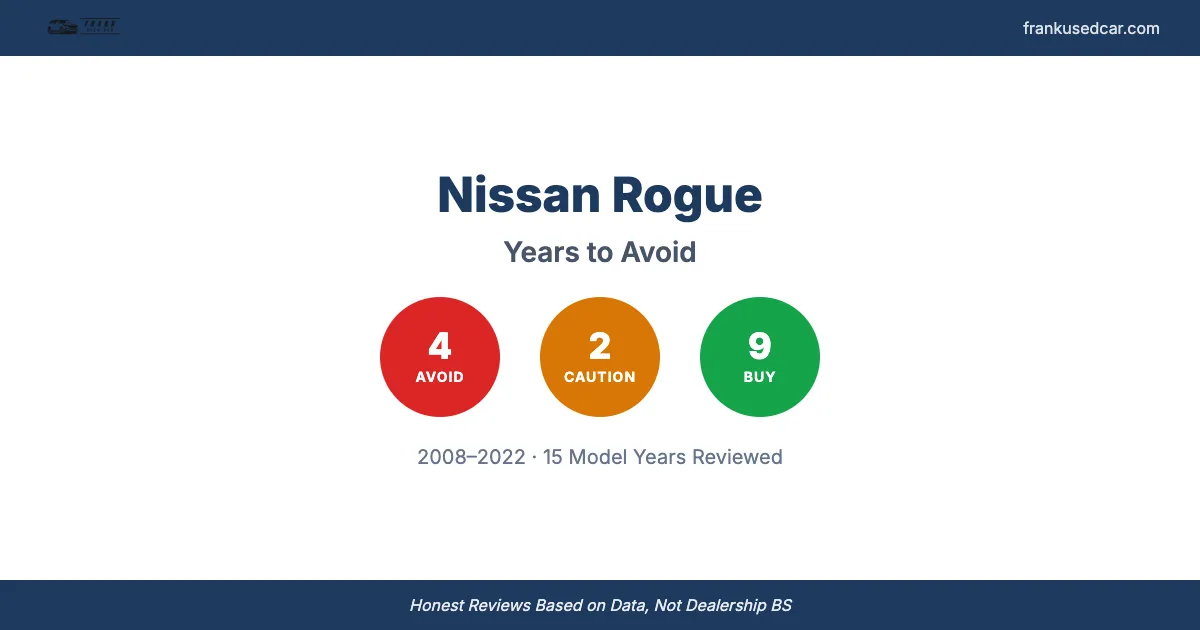
The 2008, 2013, 2014, 2015, and 2016 Nissan Rogue are the five model years to avoid — each has complaint rates 3-6x higher than surrounding model years, with CVT replacement costs that can exceed the car’s resale value.
| Year | Frank’s Verdict | Key Issue | Risk Level |
|---|---|---|---|
| 2014 | AVOID | CVT + 4 recalls + 6x complaint rate | EXTREME |
| 2015 | AVOID | CVT failures + AEB false activations, 5x | HIGH |
| 2013 | AVOID | Worst Gen1, CVT failure spike, 5x | HIGH |
| 2016 | AVOID | CVT still elevated, electrical fire recall, 3x | HIGH |
| 2008 | AVOID | First year, CVT + oil consumption, 4x | HIGH |
| 2017 | CAUTION | CVT improving, facelift, 2x | MODERATE |
| 2021 | CAUTION | First Gen3, new platform teething, 2x | MODERATE |
| 2020 | CAUTION | Last Gen2, key collapse recall | LOW |
The 2014 is the single worst Nissan Rogue model year. Highest complaint density of any year. Four separate NHTSA recalls. A CVT failure rate of 20-25% by 100,000 miles. At any price, it’s a gamble I wouldn’t take.
The pattern: avoid first-year models of any new Rogue generation (2008 Gen1 launch, 2014 Gen2 launch, 2021 Gen3 launch — though 2021 is CAUTION, not AVOID). And avoid the entire 2013-2016 stretch, the worst CVT reliability period in Nissan Rogue history.
For the full breakdown of what goes wrong in each of these years — CVT failures, AC compressor seizures, electrical fire risk — read the complete Nissan Rogue years to avoid guide.
How Reliable Is the Nissan Rogue by Year?
The Nissan Rogue reliability varies dramatically by year — the 2022-2024 Gen3 models earn 7-8/10 ratings while the 2013-2015 models score 2/10 based on NHTSA complaint density, CVT failure rates, and repair cost severity.
| Year | Generation | Frank’s Rating | Key Strength | Key Risk |
|---|---|---|---|---|
| 2008 | Gen1 | 3/10 | — | First year, CVT + oil + stalling |
| 2009 | Gen1 | 5/10 | Improving | CVT still at 2x baseline |
| 2010 | Gen1 | 6/10 | Budget option | CVT risk remains |
| 2011 | Gen1 | 7/10 | Best Gen1 | High-mileage examples only |
| 2012 | Gen1 | 7/10 | Same as 2011 | High-mileage examples only |
| 2013 | Gen1 | 2/10 | — | Worst Gen1, CVT failure spike |
| 2014 | Gen2 | 2/10 | New platform features | Worst overall — CVT + 4 recalls |
| 2015 | Gen2 | 2/10 | Available features | CVT + AEB false activation |
| 2016 | Gen2 | 3/10 | Improving | CVT + electrical fire recall |
| 2017 | Gen2 | 5/10 | Facelift | CVT not yet recalibrated |
| 2018 | Gen2 | 7/10 | ProPilot Assist, CVT improved | Still Jatco CVT |
| 2019 | Gen2 | 7/10 | Safety Shield 360 | Still Jatco CVT |
| 2020 | Gen2 | 7/10 | Last Gen2, solid | Key collapse recall |
| 2021 | Gen3 | 5/10 | New platform, VC-Turbo | First-year teething |
| 2022 | Gen3 | 7/10 | TOP PICK, refined Gen3 | Still Jatco CVT (improved) |
| 2023 | Gen3 | 8/10 | Mature Gen3 | Above depreciation sweet spot |
| 2024 | Gen3 | 8/10 | Best data ever | Above depreciation sweet spot |
RepairPal rates the Nissan Rogue 4.0 out of 5.0 with an average annual repair cost of $467 — well below the $652 industry average. But that average hides the truth. A 2022 Rogue costs closer to $300/year to maintain. A 2014 Rogue can cost $1,500+ if the CVT starts failing.
Notice that no Nissan Rogue model year earns a 9 or 10 from me. That’s not an oversight. Every Rogue has a CVT transmission, and I can’t give a top rating to any car where a single component can cost $3,500-$5,000 to replace. Toyota’s 8-speed automatic in the RAV4 is simply more proven.
My ratings weight severity over frequency. A $300 brake job and a $4,000 CVT replacement both count as “one complaint” in most databases. They shouldn’t. The numbers don’t lie — severity matters more than complaint count.
What Is the Best Used Nissan Rogue for the Money?
The best used Nissan Rogue for the money depends on your budget — the 2011-2012 wins under $8,000, the 2018-2019 wins at $14,000-$18,000, and the 2022 wins at $22,000-$26,000, but every tier requires budgeting for potential CVT maintenance.
| Budget Tier | Recommended Year | Price Range | Typical Mileage | Why |
|---|---|---|---|---|
| Budget | 2011-2012 (Gen1) | $5,000-$8,000 | 120K-150K | Cheapest reliable Rogue, IF CVT maintained |
| Mid-Range | 2018-2019 (Gen2) | $14,000-$18,000 | 40K-80K | Best value-to-reliability, CVT breakthrough year |
| Premium | 2022 (Gen3) | $22,000-$26,000 | 15K-40K | Top pick, VC-Turbo, lowest CVT complaints |
A $15,000 2018 Nissan Rogue with $467/year in average repairs plus a $1,500 extended warranty costs $18,401 over 3 years. A comparable $19,000 RAV4 with $429/year in repairs costs $20,287. The Rogue saves you $1,886 — IF the CVT holds. If the CVT fails, you’re $2,000-$3,500 in the hole.
The Rogue’s pricing advantage over RAV4 and CR-V is $2,000-$4,000. That discount exists BECAUSE of CVT reputation. Smart buyers treat it as a CVT maintenance budget, not as savings.
Keep 15% of your budget in reserve for first-year repairs. On a Nissan Rogue, that 15% might actually get used. A $15,000 budget means $12,750 for the car and $2,250 in the repair fund.
Extended warranty recommendation: $1,500 for a 3-year powertrain warranty on ANY Rogue. Non-negotiable. It’s the cheapest insurance against CVT failure you can buy.
Which Nissan Rogue Generation Is Most Reliable?
The Gen3 Nissan Rogue (2021-present) is the most reliable generation with the lowest complaint rates and the most advanced CVT, followed by the mature Gen2 years (2018-2020), while the early Gen2 (2014-2016) is the least reliable generation of any compact SUV in this price class.
| Rank | Generation | Years | Engine | CVT Type | CVT Failure Rate | Reliability |
|---|---|---|---|---|---|---|
| 1 | Gen3 (2022+) | 2022-present | 2.5L / 1.5L VC-Turbo | Next-gen CVT | <5% | Best overall |
| 2 | Gen2 mature | 2018-2020 | 2.5L QR25DE | CVT8 (mature) | 5-8% | Good |
| 3 | Gen1 mature | 2011-2012 | 2.5L QR25DE | CVT7 (revised) | 10-15% | Acceptable |
| 4 | Gen1 early | 2008-2010 | 2.5L QR25DE | CVT7 (early) | 15-20% | Below average |
| 5 | Gen2 early | 2014-2016 | 2.5L QR25DE | CVT8 (early) | 20-25% | Worst generation |
The ranking tells the Rogue’s entire story: CVT reliability improved generation over generation, but first-year and early-production models of EVERY generation had serious problems. Mid-cycle years are always the sweet spot — 2011-2012, 2018-2019, 2022+.
Gen2 early years (2014-2016) are genuinely worse than Gen1 early years (2008-2010). Nissan launched a new platform with a CVT that wasn’t ready. The 2014-2016 stretch is the worst three-year run of any compact SUV I’ve tracked across all brands.
Mid-generation years are always more reliable than launch years. The Nissan Rogue proves that pattern more dramatically than almost any car on the market.
How Does the Nissan Rogue Compare to Other Compact SUVs?
The Nissan Rogue ranks below the Toyota RAV4, Honda CR-V, and Mazda CX-5 in long-term used car reliability due to its CVT transmission concerns, but its $2,000-$4,000 price discount makes it a legitimate value play for budget-conscious buyers who understand the trade-offs.
| Model | RepairPal Score | Annual Repair Cost | Best Used Years | Worst Years |
|---|---|---|---|---|
| Nissan Rogue | 4.0/5.0 | $467/yr | 2022-2023, 2018-2019 | 2013-2016, 2008, 2014 (worst) |
| Toyota RAV4 | 4.0/5.0 | $429/yr | 2021, 2020, 2015-2016 | 2006-2008, 2013, 2019 |
| Honda CR-V | 4.5/5.0 | $407/yr | 2020-2021, 2015-2016 | 2011-2013, 2007 |
| Mazda CX-5 | 4.0/5.0 | $447/yr | 2019-2022, 2016-2017 | 2013-2014 |
| Chevy Equinox | 3.5/5.0 | $537/yr | 2020-2022, 2018-2019 | 2010-2013, 2005 |
| Subaru Forester | 3.5/5.0 | $467/yr | 2019-2021, 2016-2018 | 2011-2013 |
The Rogue’s RepairPal score (4.0/5.0) matches the RAV4’s. J.D. Power rates the 2022-2024 Rogue above average in reliability — a significant improvement over the below-average marks the 2014-2016 models received. Consumer Reports gives the Gen3 Rogue a recommended rating for the first time in the nameplate’s history. But RepairPal doesn’t capture severity the same way I do. A RAV4’s worst common repair is a $500 brake job. The Nissan Rogue’s worst common repair is a $4,000 CVT replacement. Average cost is similar — catastrophic risk is not.
I’d steer most buyers toward a RAV4 or CX-5 first. The Rogue only makes sense when budget is the primary constraint, you pick a recommended model year (2018-2019 or 2022+), AND you budget for extended warranty and CVT maintenance. If all three conditions are met, the Nissan Rogue is a genuine value play. For the full Nissan lineup analysis, browse the used Nissan buying guide.
The RAV4 costs $2,000-$4,000 more but eliminates the CVT question entirely. For most buyers, that peace of mind is worth the premium. For a detailed year-by-year breakdown, check the Toyota RAV4 best and worst years guide.
What Should You Check Before Buying a Used Nissan Rogue?
Check these seven items before buying any used Nissan Rogue — each targets a specific CVT, engine, or safety problem documented in this guide that varies by generation and model year.
Request complete CVT fluid change records. Verify changes at 30,000-mile intervals, not Nissan’s “lifetime fluid” claim. Missing records means the previous owner didn’t maintain the CVT. Walk away.
Check NHTSA recall status by VIN. Verify completion of electrical fire recalls (15V032000 and 22V024000) on 2008-2016 models and key collapse recall (23V093000) on 2014-2020 models. Three critical recalls spanning most used Rogue years.
Test drive for 20-plus minutes in stop-and-go traffic. Feel for CVT shudder, hesitation, or whining at low speeds. If the transmission hunts for ratios or vibrates between 15-25 mph, the CVT is failing. A 5-minute highway test won’t reveal this.
Check CVT warranty replacement status for 2013-2017 models. Ask if the CVT was replaced under Nissan’s extended warranty (Campaign P8132). A replaced CVT is actually a PLUS — you’re getting a fresh transmission on a depreciated car.
Scan OBD-II for transmission codes. Code P0868 (low CVT fluid pressure) or P17F0 (CVT performance) on any Nissan Rogue year is a dealbreaker. These codes mean CVT failure is imminent.
Inspect AC compressor operation on 2013-2016 models. Run the AC at full blast for 10 minutes and listen for grinding or seizure sounds. AC compressor failure costs $800-$1,500.
Verify forward emergency braking calibration on 2015-2017 models. Test at low speeds in a safe area. False activation — phantom braking — was a documented issue that can cause rear-end collisions.
These aren’t random suggestions. Each item maps to a specific Nissan Rogue problem pattern by generation. A 2022 needs items 1 and 3. A 2014 needs all seven. Start with the used car buying guide for the complete pre-purchase framework.
Also see: Nissan Years to Avoid
- best year nissan rogue to buy
- most reliable nissan rogue year
- nissan rogue reliability by year
- worst nissan rogue years
- best used nissan rogue
- best-and-worst-years