Mazda CX-5 Best and Worst Years: Which Model Years Are Worth Buying?
Mazda CX-5 best and worst years ranked by reliability. Gen1 vs Gen2, turbo analysis, repair costs, and Frank's top picks. Data-driven guide with NHTSA data.
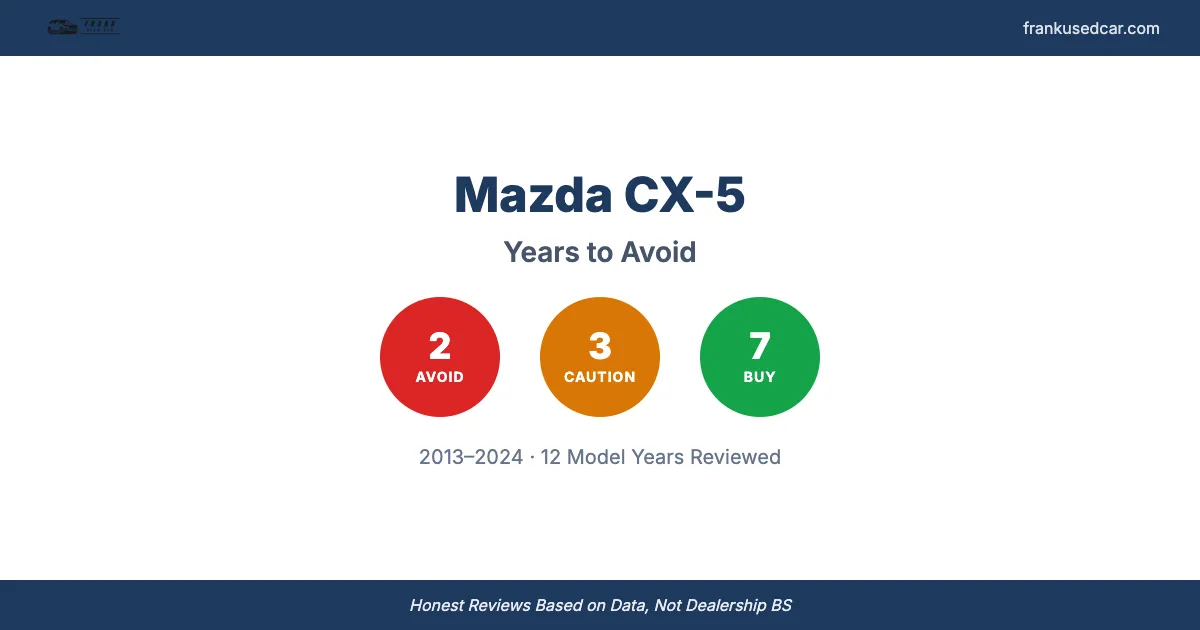
The Mazda CX-5 is the most underrated compact SUV on the used market — but the difference between the best and worst model years is the difference between a premium-feeling $20,000 bargain and a $6,200 head gasket nightmare. The best Mazda CX-5 years are the 2020, 2021, 2019, 2022, and 2017. The worst are the 2016, 2014, and 2013.
Mazda has built the CX-5 across two generations since 2013. The right model year gets you a premium-feeling SUV for used car money. The wrong one gets you a repair bill that exceeds the car’s resale value.
I’ve bought, inspected, or helped friends buy over 50 used cars in 20 years — and the CX-5 is the one I tell people they’re sleeping on. Here’s which years are actually worth your money.
The 2020 CX-5 has 6 total complaints and zero recalls. The 2016 has 183 complaints and 5 recalls. Same nameplate, completely different car. This guide covers Frank’s top pick, best years by generation, years to avoid, reliability by year, value analysis, generation comparison, and what to check before buying.
| Year | Frank’s Verdict | Key Strength or Issue |
|---|---|---|
| 2020 | BUY — TOP PICK | Zero recalls, near-zero complaints, peak Skyactiv |
| 2021 | BUY | Same quality as 2020, updated 10.25” infotainment |
| 2019 | BUY | Turbo debut, 250 HP, Apple CarPlay standard |
| 2022 | BUY | Continued refinement, above sweet spot pricing |
| 2017 | BUY | Cleanest generation launch in segment, 35 complaints |
| 2018 | CAUTION | Fuel pump recall 5321K, A/C compressor failures |
| 2015 | CAUTION | Improved Gen1, windshield cracking persists |
| 2016 | AVOID | 183 complaints, $6,200+ head gasket, 5 recalls |
| 2014 | AVOID | 123 complaints, worst electrical issues |
| 2013 | AVOID | First year, engine stalling, battery drain |
Why Is the 2020 CX-5 Frank’s Top Pick?
The 2020 Mazda CX-5 is Frank’s top pick because it combines J.D. Power’s highest reliability rating of any CX-5 model year with zero recalls, near-zero NHTSA complaints, and IIHS Top Safety Pick+ status — at used prices that have dropped into the sweet spot.
J.D. Power rated the 2020 CX-5 higher than every other model year by 3 points. CarComplaints shows only 6 total complaints. Zero recalls — the only CX-5 year sharing that distinction with the 2021.
Standard i-Activsense safety makes the 2020 CX-5 a complete package. Smart City Brake Support, lane departure warning, blind spot monitoring — all included on every trim.
The available turbo pushes 250 HP on 93 octane with 320 lb-ft of torque. That transforms the CX-5 from a competent SUV into the best-driving compact SUV on the market.
A 2020 CX-5 Touring with 40K miles lists around $20,000-$22,000. Compare that to a new CX-5 at $30,000+. You’re saving $8,000-$10,000 for a car that drives like nothing else in this segment.
The 2018 had fuel pump recalls and A/C failures. The 2020 fixed all of that — plus added the refinement that makes this car feel like a $35,000 SUV at $20,000.
I tell everyone who asks me about compact SUVs: the CX-5 is the one the car magazines love and most buyers overlook. The 2020 is the year where Mazda got everything right.
Frank’s Verdict: BUY — TOP PICK The 2020 CX-5 is the single best used CX-5 you can buy. Zero recalls. Near-zero complaints. J.D. Power’s highest CX-5 rating. Premium driving feel at $20,000. Stop sleeping on this car.
The 2020 is the best CX-5 overall — but even Gen1 has one acceptable option for budget buyers.
What Are the Best Gen1 Mazda CX-5 Years? (2013-2016)
The Gen1 Mazda CX-5 (2013-2016) is the weakest generation overall — the 2015 is the only year worth considering, and even that comes with a CAUTION rating due to lingering windshield cracking and transmission whining issues.
Gen1 was Mazda’s first full Skyactiv platform. KODO design language. Available with a 2.0L or 2.5L Skyactiv-G engine paired to a 6-speed automatic. Clean engineering, but the execution had growing pains.
The 2013 was the first model year. Engine stalling, battery drain, infotainment freezing — 60 complaints. The 2014 pushed the electrical complaints even higher with 123 total on CarComplaints.
The 2016 is the worst CX-5 ever made. NHTSA logged 183 complaints. Blown head gaskets at $6,200-$7,000+. LED DRL recall. Five total recalls. That repair bill alone can exceed the car’s resale value at $10,500-$14,500.
| Year | Frank’s Verdict | Key Issue | Complaints |
|---|---|---|---|
| 2013 | AVOID | Engine stalling, electrical | ~60 |
| 2014 | AVOID | Highest electrical complaints | ~123 |
| 2015 | CAUTION | Windshield cracking, trans whining | ~53 |
| 2016 | AVOID | Head gasket failure, most complaints | ~183 |
A 2015 CX-5 runs $10,000-$14,000 with 80K-130K miles. That’s acceptable IF you get a pre-purchase inspection and verify no windshield or transmission issues.
The 2016 looks tempting on paper — it’s the “newest” Gen1. It’s actually the most problematic CX-5 ever made. More complaints than any other year by a wide margin.
Is the 2015 Mazda CX-5 an Acceptable Budget Buy?
Acceptable — with inspection. The 2015 Mazda CX-5 improved over the troubled 2013-2014 models with fewer complaints (53 vs 123 for the 2014), but still shares the windshield cracking issue and has occasional transmission whining reports.
Not a confident BUY like Gen2 years. It’s the least-bad Gen1 option. The price advantage — $10,000-$14,000 with 80K-130K miles — is real for budget buyers.
I’d only recommend a 2015 CX-5 to someone with a hard budget ceiling under $14,000 who can’t stretch to a 2017. Get a pre-purchase inspection. Check the windshield for stress cracks at the edges and corners. Test the transmission through all gears in stop-and-go traffic.
The 2015 is the one Gen1 CX-5 I won’t argue against — but the 2017 at $14,000-$18,000 is worth the stretch if your budget allows it.
What Are the Best Gen2 Mazda CX-5 Years? (2017-2024)
The best Gen2 Mazda CX-5 years are the 2020, 2021, and 2019, which represent the peak of Skyactiv engineering — the 2020 and 2021 have near-zero complaints and zero recalls, making them the most reliable compact SUVs you can buy in any brand.
Gen2 was a complete redesign for 2017. Premium interior that embarrasses competitors costing $10,000 more new. Improved NVH. New KODO 2.0 design. The 2.5L Skyactiv-G made 187 HP paired to a refined 6-speed automatic — no CVT.
The 2017 launch was one of the cleanest redesigns I’ve ever seen. Only 35 complaints. Compare that to the RAV4’s 2019 Gen5 launch or the CR-V’s 2017 1.5T launch — both had serious first-year issues. Mazda nailed it.
The 2018 introduced a fuel pump recall (5321K) and A/C compressor failures. Fifty complaints — still better than any Gen1 year, but not the clean sheet Gen2 promised.
The 2019 brought the turbo debut. Standard Apple CarPlay and Android Auto across all trims. J.D. Power rated it 80/100 overall and 82/100 for quality and reliability. Only one minor transmission recall.
| Year | Frank’s Verdict | Key Feature | Complaints |
|---|---|---|---|
| 2017 | BUY | Clean redesign, 35 complaints | ~35 |
| 2018 | CAUTION | Fuel pump recall, A/C issues | ~50 |
| 2019 | BUY | Turbo debut, Apple CarPlay | ~33 |
| 2020 | BUY — TOP PICK | Zero recalls, peak reliability | ~6 |
| 2021 | BUY | 10.25” screen, same quality | ~19 |
| 2022 | BUY | Continued refinement | ~10 |
| 2023-2024 | BUY | Approaching new car prices | — |
The CX-5 Turbo is the enthusiast’s pick in this segment. 250 HP on 93 octane, 320 lb-ft of torque, and the best-tuned chassis in the compact SUV class. The $2,000-$4,000 used premium over the base 2.5L is worth every dollar if you care about driving.
Is the 2017 Mazda CX-5 a Good Used Buy?
Yes. The 2017 Mazda CX-5 is the first Gen2 model with a complete redesign, premium interior, standard Smart City Brake Support, and only 35 complaints on CarComplaints — one of the cleanest generation launches in compact SUV history.
IIHS awarded it Top Safety Pick+. The interior quality punches two segments above its price point. At $14,000-$18,000 with 60K-110K miles, it’s the best-value entry into Gen2 CX-5 ownership.
A 2017 CX-5 Grand Touring at $16,000 feels like a $30,000 car inside. I helped a client buy one in 2017 and it completely changed my opinion of Mazda. The precision of that steering — firm, responsive, nothing like the vague floating feel of most crossovers. Mazda’s interior quality embarrasses competitors that cost $10,000 more new.
Is the 2019 Mazda CX-5 Worth Buying Used?
Yes. The 2019 Mazda CX-5 is the first year with the 2.5L turbo option (250 HP / 320 lb-ft), standard Apple CarPlay and Android Auto, and J.D. Power rates it 82/100 for quality and reliability with only one minor transmission recall.
Turbo debut year — the first CX-5 with real performance credentials. At $18,000-$22,000 with 40K-80K miles, it hits the sweet spot between modern features and depreciation savings.
The 2019 turbo CX-5 is the car I recommend to anyone who says “I want something fun to drive but I need an SUV.” Nothing else in this price range drives like this. The low-end torque makes highway merging effortless.
Is the CX-5 Turbo Worth the Premium?
Yes — if you care about driving. The CX-5 Turbo is worth the $2,000-$4,000 used premium over the base 2.5L — you get 250 HP vs 187 HP (34% more power) with the same Skyactiv reliability.
The turbo doesn’t just add power — it changes the character of the car. 320 lb-ft from 2,000 RPM makes the CX-5 feel a class above. On 87 octane you still get 227 HP. On 93 octane, the full 250 HP.
Fuel economy penalty: 2-4 MPG combined (24-25 vs 27-28 MPG). Worth it for drivers who actually enjoy being behind the wheel.
No reliability penalty. Same complaint rates as non-turbo models. Unlike some competitors’ turbo engines — looking at you, Honda 1.5T oil dilution — Mazda’s 2.5T has been rock-solid since its 2019 debut.
Which Mazda CX-5 Years Should You Avoid?
The 2016, 2014, and 2013 Mazda CX-5 are the three model years to avoid — the 2016 alone has 183 complaints and a $6,200+ head gasket repair that can exceed the car’s resale value.
| Year | Frank’s Verdict | Key Issue | Risk Level |
|---|---|---|---|
| 2016 | AVOID | Head gasket failure, 183 complaints, 5 recalls | CRITICAL |
| 2014 | AVOID | Electrical issues, engine shutoff, 123 complaints | HIGH |
| 2013 | AVOID | Engine stalling, battery drain, 60 complaints | HIGH |
| 2015 | CAUTION | Windshield cracking, transmission whining | MODERATE |
| 2018 | CAUTION | Fuel pump recall 5321K, A/C compressor | MODERATE |
The pattern is different from most brands: the LAST Gen1 year (2016) is worse than the first (2013). That’s unusual. Most models improve through a generation. The CX-5 Gen1 got worse. Gen2 is a completely different story.
For the full breakdown of what goes wrong in each of these years — head gasket failures, electrical problems, infotainment freezing, windshield cracking — read the complete Mazda CX-5 years to avoid guide.
How Reliable Is the Mazda CX-5 by Year?
The Mazda CX-5 reliability varies dramatically between Gen1 and Gen2 — the 2020-2022 Gen2 models earn 9/10 ratings with near-zero complaints, while the 2016 Gen1 scores 3/10 with complaint rates 6x the CX-5 average.
| Year | Generation | Frank’s Rating | Key Strength | Key Risk |
|---|---|---|---|---|
| 2013 | Gen1 | 5/10 | Skyactiv debut | Stalling, electrical |
| 2014 | Gen1 | 4/10 | Improved features | Highest electrical complaints |
| 2015 | Gen1 | 6/10 | Reduced complaints | Windshield cracking, trans |
| 2016 | Gen1 | 3/10 | Most Gen1 features | Worst complaints, head gaskets |
| 2017 | Gen2 | 8/10 | Clean redesign | Minor infotainment |
| 2018 | Gen2 | 6/10 | More safety tech | Fuel pump recall, A/C |
| 2019 | Gen2 | 8/10 | Turbo + CarPlay | Minor trans recall |
| 2020 | Gen2 | 9/10 | Peak reliability | Near-zero complaints |
| 2021 | Gen2 | 9/10 | Updated infotainment | Near-zero complaints |
| 2022 | Gen2 | 9/10 | Continued refinement | Near-zero complaints |
RepairPal rates the CX-5 4.0 out of 5.0 with an average annual repair cost of $447 — well below the $652 industry average. Mazda ranks 5th out of 32 brands. But that’s a brand-level average. The difference between a 2016 and a 2020 CX-5 is night and day.
The probability of a severe repair on a CX-5 is 8% — compared to 13% for the average midsize SUV. When a CX-5 breaks, it breaks small. Except the 2016 — that one breaks big.
I spent an afternoon pulling NHTSA complaint data on every CX-5 model year. The 2016 had 183 complaints. The 2020 had 6. Same nameplate. The numbers don’t lie — year selection matters more than brand reputation.
What Is the Best Used CX-5 for the Money?
The best used Mazda CX-5 for the money depends on your budget — the 2017 wins at $14,000-$18,000, the 2019 wins at $18,000-$22,000 with the available turbo, and the 2020-2021 wins at $20,000-$26,000 as Frank’s top value pick.
| Budget Tier | Recommended Year | Price Range | Mileage | Why |
|---|---|---|---|---|
| Budget | 2017 | $14,000-$18,000 | 60K-110K | Clean Gen2 launch, premium interior |
| Mid-Range | 2019 | $18,000-$22,000 | 40K-80K | Turbo option, Apple CarPlay, strong reliability |
| Premium | 2020-2021 | $20,000-$26,000 | 20K-60K | Near-zero complaints, zero recalls, peak CX-5 |
Gen1 is excluded from these value tiers. Too many reliability risks across the board. The 2015 is CAUTION at best.
A $20,000 CX-5 with $447 per year in repairs costs $21,341 over three years. Compare that to a $16,000 Ford Escape with $600 per year — that’s $17,800 over three years. But you’re getting a worse driving experience and lower reliability with the Escape.
The 2019-2021 CX-5 models are entering the 3-5 year depreciation sweet spot right now. Lost 30-40% of sticker price. Reliability barely drops from new.
Keep 15% of your budget in reserve for first-year repairs. A $20,000 budget means $17,000 for the car and $3,000 in the repair fund. I’ve helped over 50 people buy used cars. The ones who regretted it never budgeted for repairs.
Which CX-5 Generation Is Most Reliable?
The Gen2 CX-5 (2017-2024) is dramatically more reliable than Gen1 (2013-2016) — Gen2’s complaint density is 3-4x lower across the board, and Gen2 includes three model years (2020, 2021, 2022) with near-zero complaint rates.
| Rank | Generation | Years | Engine | Transmission | Reliability |
|---|---|---|---|---|---|
| 1 | Gen2 (2019-2022) | 2019-2022 | 2.5L / 2.5T Skyactiv-G | 6-speed auto | Best — near-zero complaints |
| 2 | Gen2 (2017-2018) | 2017-2018 | 2.5L Skyactiv-G | 6-speed auto | Strong — minor recall issues |
| 3 | Gen1 (2015) | 2015 | 2.0L/2.5L Skyactiv-G | 6-speed auto | Acceptable — windshield issues |
| 4 | Gen1 (2013-2014, 2016) | 2013-2014, 2016 | 2.0L/2.5L Skyactiv-G | 6-speed auto | Poor — avoid these years |
With only two generations, the CX-5 comparison is simple. Gen2 is better in every measurable way. Better reliability, better interior, better safety features, better driving experience.
The only reason to buy Gen1 is budget — and even then, stretch for a 2017 if you can. The price gap between a 2015 at $10,000-$14,000 and a 2017 at $14,000-$18,000 is smaller than a single head gasket repair bill on a 2016.
Mid-generation years are always more reliable than launch years. The CX-5 proves this — except the 2016 broke the rule by being WORSE than the 2013 launch year. That’s extremely rare in the industry.
How Does the CX-5 Compare to Other Compact SUVs?
The Mazda CX-5 matches the Toyota RAV4 and Honda CR-V in long-term reliability at $447 per year in average repairs, while offering dramatically better driving dynamics — it’s the enthusiast’s pick in a segment dominated by appliance-like transportation.
| Model | RepairPal Score | Annual Repair Cost | Best Used Years | Worst Years |
|---|---|---|---|---|
| Mazda CX-5 | 4.0/5.0 | $447/yr | 2020, 2021, 2019, 2022, 2017 | 2016, 2014, 2013 |
| Toyota RAV4 | 4.0/5.0 | $429/yr | 2021, 2020, 2015-2016 | 2006-2008, 2013, 2019 |
| Honda CR-V | 4.5/5.0 | $407/yr | 2020-2021, 2015-2016 | 2011-2013, 2017 |
| Subaru Forester | 3.5/5.0 | $467/yr | 2019-2021, 2016-2018 | 2011-2013 |
| Nissan Rogue | 4.0/5.0 | $467/yr | 2021-2022 | 2013-2017 |
The CR-V costs $40 per year less to maintain. The RAV4 has a hybrid option the CX-5 doesn’t match. But neither drives like the CX-5. If you’ve ever felt bored in a RAV4 or CR-V, the CX-5 is the answer.
The CX-5 turbo (250 HP) has no direct competitor in this segment at this price. The RAV4 doesn’t offer a turbo. The CR-V’s turbo 1.5L makes 190 HP and has oil dilution history. The CX-5 Turbo is in a class by itself.
Had never recommended Mazda until a client insisted on a 2017 CX-5. Researched it — Skyactiv engine, traditional automatic, stellar crash ratings. Bought it at $16,800. That car completely changed my opinion of the brand. Mazda is the most underrated used car brand on the market.
For brand-level Mazda guidance, read the used Mazda buying guide. For the RAV4 comparison in full, read the Toyota RAV4 best and worst years guide.
What Should You Check Before Buying a Used CX-5?
Check these seven items before buying any used Mazda CX-5 — each targets a specific problem documented in this guide that varies by generation and model year.
Check NHTSA recall status by VIN. Verify fuel pump recall 5321K completion on 2018-2019 models. Free fix if the recall is still open.
Inspect the windshield for spontaneous stress cracks. Common on 2014-2017 models. Look at edges and corners. Budget $400-$800 for replacement if you find them.
Check oil level cold on any Gen1 (2013-2016). Pull the dipstick before the test drive. Look for low oil and blue exhaust smoke — that’s a head gasket symptom on the 2016.
Test the transmission through all gears in stop-and-go traffic. Feel for harsh shifts or whining. Targets the 2013-2014 torque converter issue and 2018 harsh shifting.
Test the infotainment system for 10+ minutes. Watch for ghost touch, freezing, or rebooting. The 2017-2021 touchscreen issue costs $500-$1,200 to replace.
Run the A/C on max cold for 15 minutes. The 2018 models have A/C compressor failures costing $800-$1,500 to fix.
Request complete service history with oil change intervals. Skyactiv engines reward regular maintenance. Deferred oil changes show up as sludge and accelerated wear.
These aren’t random suggestions. Each item maps to a specific CX-5 problem pattern I’ve documented by generation. A 2020 CX-5 needs items 5 and 7. A 2016 needs items 1, 2, 3, 4, and 7. The inspection list tells you which generation you’re dealing with.
For a broader pre-purchase framework, read the used car buying guide.
- best mazda cx-5 year to buy
- mazda cx 5 reliability by year
- most reliable mazda cx-5 year
- worst mazda cx-5 years
- mazda cx-5 turbo reliability
- best-and-worst-years