Mazda CX-5 Years to Avoid and Best Years to Buy
Avoid the 2014 and 2016 Mazda CX-5. See Frank's year-by-year reliability ratings, repair costs, and which CX-5 models are actually worth buying used.
The Mazda CX-5 is a compact crossover SUV produced since 2013 that earns above-average reliability scores — but two model years have complaint rates high enough to avoid entirely.
Not every Mazda CX-5 model year is worth buying. I’ve reviewed the NHTSA complaint data on every CX-5 from 2013 through 2024, and here’s what the numbers actually show.
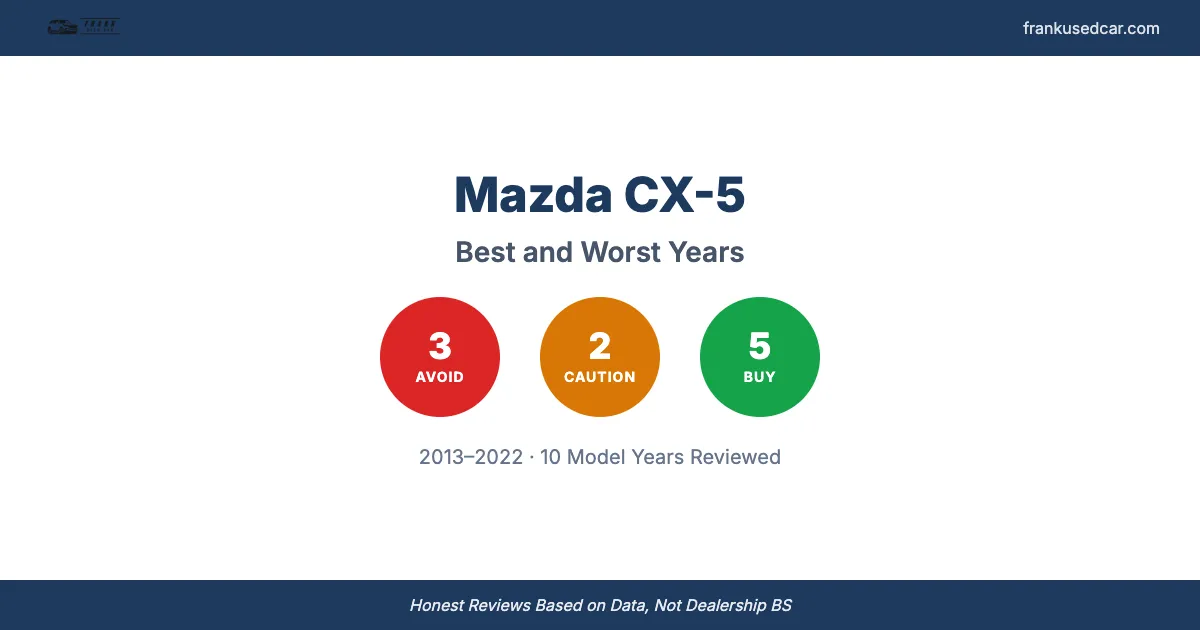
The Mazda CX-5 years to avoid are 2014 and 2016 — the two Skyactiv-powered model years with the highest complaint density. The 2014 has electrical failures and an engine shutoff defect. The 2016 has LED light defects and premature brake wear.
Common CX-5 problems include transmission hesitation and premature brakes across first-generation models. Reliability improves dramatically in 2017+ second-generation models. The 2019 is Frank’s top pick for used buyers.
NHTSA recalls concentrate on 2014-2016 models. Check recalls and service history before buying any used Mazda CX-5.
| Model Year | Frank’s Verdict | Key Issue | Risk Level |
|---|---|---|---|
| 2013 | CAUTION | First-year platform risk | Medium |
| 2014 | AVOID | Electrical + engine shutoff | High |
| 2015 | CAUTION | Transmission noise | Medium |
| 2016 | AVOID | LED light recall + brake wear | High |
| 2017 | BUY | Major redesign, low complaints | Low |
| 2018 | CAUTION | Early 2nd-gen fuel pump issues | Medium |
| 2019 | BUY | Turbo engine, Apple CarPlay | Low |
| 2020 | BUY | Best safety features standard | Low |
| 2021 | BUY | Refined interior, low complaints | Low |
| 2022 | BUY | Exceptional build quality | Low |
| 2023 | BUY | Proven platform, no new issues | Low |
| 2024 | BUY | Latest tech, too new for used deals | Low |
Which Mazda CX-5 Years Should You Avoid?
The 2014 and 2016 Mazda CX-5 are the two model years to avoid, based on NHTSA complaint density and severity of reported issues. These aren’t borderline cases.
The 2014 Mazda CX-5 has the highest complaint count of any model year in the lineup. The 2016 triggered a formal NHTSA recall for LED light failure and shares the same premature brake wear pattern.
Every other Mazda CX-5 model year falls into either BUY or CAUTION territory. The gap between the 2014/2016 and the rest of the lineup is not subtle — it’s a cliff.
What dealers won’t tell you: they push all model years equally because the Mazda CX-5 brand reputation is strong. Frank differentiates. The complaint data tells a clear story — 2014 and 2016 carry risks that the 2017+ models simply don’t.
Let’s start with the worst offender — the 2014 CX-5.
What Problems Does the 2014 Mazda CX-5 Have?
The 2014 Mazda CX-5 has the highest complaint count of any model year, with electrical failures, engine shutoff issues, and premature brake wear reported at unusually high rates. NHTSA complaint data confirms the 2014 as the worst CX-5.
Problems cluster around three categories:
- Electrical system failures — battery drain, accessory malfunctions, complete ignition system failures
- Engine shutoff malfunction — vehicle stalls unexpectedly or refuses to turn off after pressing the stop button
- Premature brake wear — pads and rotors needing replacement at 29,000 miles instead of the expected 50,000+
Mileage at failure tells the story. Owners reported engine rev-and-clunk issues at 17,000 miles, brake replacement at 29,000 miles, and incomplete engine shutdown at 55,000 miles.
These are not high-mileage wear items — they’re premature failures on a Mazda CX-5 that should run trouble-free at those intervals.
Not every 2014 has these issues, but complaint rates run roughly 3x higher than 2017+ models. I see dealers list the 2014 Mazda CX-5 at $12,000+ — the repair risk doesn’t justify that price.
Frank’s Verdict: AVOID — The 2014 CX-5 isn’t worth the risk at any price. Too many electrical gremlins and the engine shutoff issue is a safety concern.
What Electrical Issues Affect the 2014 CX-5?
Electrical issues in the 2014 Mazda CX-5 range from battery drain and accessory malfunctions to complete ignition system failures. The NHTSA complaints database documents three distinct failure modes.
Battery drain kills the battery overnight without warning. Accessory systems — windows, locks, infotainment — malfunction intermittently. The ignition system failure is the most dangerous: the Mazda CX-5 refuses to shut down after pressing the stop button.
This isn’t a minor annoyance — when your car won’t shut off at a gas station, that’s a safety hazard. Repair costs range from $200 for electrical diagnosis to $1,200+ for infotainment unit replacement.
Does the 2014 CX-5 Have Engine Shutoff Problems?
Yes, the 2014 Mazda CX-5 has a documented engine shutoff problem where the vehicle either stalls unexpectedly or refuses to turn off after pressing the stop button. NHTSA owner complaints confirm both failure directions.
At 17,000 miles, owners reported the engine revving unexpectedly and clunking into gear while stopped. At 55,000 miles, the opposite problem: the Mazda CX-5 engine fails to complete its shutdown sequence.
Both failures create dangerous situations — unexpected stalling risks rear-end collisions, and an engine that won’t turn off is a fire hazard near fuel pumps.
The 2016 CX-5 shares some of these problems, plus adds its own.
What Problems Does the 2016 Mazda CX-5 Have?
The 2016 Mazda CX-5 is the second year to avoid, primarily due to a widespread LED daytime running light failure and premature brake wear identical to the 2014 model. NHTSA recall RCAK-20V063 confirms the LED defect.
The 2016 Mazda CX-5 problem list:
- LED daytime running light failure — moisture infiltration destroys the light circuit at approximately 43,000 miles
- Premature brake wear — pads and rotors needing replacement at 27,000 miles
- Windshield bracket detachment — disables Smart City Brake Support safety system (recall RCAK-16E002)
- Transmission hesitation — intermittent rough shifting
The LED light issue is especially frustrating because you can’t just replace a bulb on a Mazda CX-5 — the entire unit is one sealed piece, so a $30 fix becomes a $500+ repair.
Brake pad and rotor replacement runs $300-$600 per axle, and at 27,000 miles that cost hits far too early.
Frank’s Verdict: AVOID — Same brake problems as the 2014, plus the LED light recall. The 2017 is a much better buy for similar money.
Why Do 2016 CX-5 LED Lights Fail?
The 2016 Mazda CX-5 LED daytime running lights fail because Mazda used improper materials in the ceiling gasket, allowing moisture to infiltrate and damage the light circuit. NHTSA recall RCAK-20V063, issued , confirmed this defect.
Mazda’s own investigation found the ceiling gasket materials could not adequately seal against moisture intrusion. Once water reaches the circuit board, the LED unit is dead.
The fix requires dealer replacement of the entire LED DRL assembly on the Mazda CX-5 — not a simple gasket swap.
Does the 2016 CX-5 Have Brake Issues?
Yes, the 2016 Mazda CX-5 has the same premature brake wear problem found in the 2014 model. Owners report brake pad and rotor replacement needed as early as 27,000 miles. Normal brake life on a compact SUV is 50,000-70,000 miles.
Repair cost runs $300-$600 per axle. On a 2016 Mazda CX-5, expect to pay this twice before hitting 60,000 miles if the premature wear pattern affects your vehicle.
The 2013 CX-5 isn’t as bad, but as a first-year model it carries its own risks.
What Problems Does the 2013 Mazda CX-5 Have?
The 2013 Mazda CX-5 was the first model year on the Skyactiv platform. Like most first-year vehicles, it carried teething problems including engine stalling, electrical glitches, and an ignition system that wouldn’t fully shut down.
NHTSA complaints show moderate volume — lower than 2014 but higher than 2017+.
First-generation issues on the 2013 Mazda CX-5:
- Engine stalling/hesitation at idle — Skyactiv tuning issues in early production
- Battery drain in cold weather — electrical system calibration problems
- Infotainment freezing and rebooting — Mazda Connect software instability
- Transmission hesitation — jerky gear changes at low speeds
First-year models are always a gamble. The 2013 Mazda CX-5 isn’t terrible, but why take the risk when 2017+ models sit in the same price range with far fewer documented problems?
Frank’s Verdict: CAUTION — Not as bad as the 2014, but first-year risk is real. Only buy with full maintenance records and a pre-purchase inspection.
The 2015 improved on the 2014’s issues but still had some problems.
What Problems Does the 2015 Mazda CX-5 Have?
The 2015 Mazda CX-5 improved on the 2014’s issues but still had transmission complaints including whining noises and clicking during shifts. The ongoing windshield cracking problem shared with 2014-2016 models persists. Complaint volume dropped from the 2014 peak.
Reported 2015 Mazda CX-5 issues:
- Transmission whining noise — audible at highway speeds, worsens over time
- Clicking during gear shifts — intermittent, most common in stop-and-go traffic
- Windshield cracking — spontaneous cracks without impact, linked to bracket design (NHTSA recall RCAK-16E002 covers 2014-2016)
The 2015 Mazda CX-5 is a gray area — fewer complaints than 2014 or 2016, but the transmission noise is concerning. Test drive in city traffic before buying.
If the seller can show the transmission has been inspected and no whining exists, it’s a reasonable budget option.
Frank’s Verdict: CAUTION — Decent budget pick if maintenance records are clean. Check the transmission and windshield specifically.
The 2018 CX-5 brought a new generation, but also new issues.
What Problems Does the 2018 Mazda CX-5 Have?
The 2018 Mazda CX-5 was the early second-generation model and introduced new issues including fuel pump failures and air conditioning malfunctions. Overall complaint rates were lower than first-gen problem years.
The second-generation Skyactiv platform brought a redesigned exterior and refined interior, but early production had growing pains.
Reported 2018 Mazda CX-5 issues:
- Fuel pump failures — causing stalling or complete loss of power, repair cost $1,500+
- A/C compressor failures — $800-$1,500 to replace
- Harsh transmission shifts — improved over first-gen but present in early 2nd-gen units
- Acceleration lag — delayed throttle response from stop
The 2018 Mazda CX-5 is the least bad of the “caution” years. Most issues were resolved under warranty for original owners.
If you find one with low miles and service records showing warranty repairs completed, it can be a solid buy.
Frank’s Verdict: CAUTION — Early 2nd-gen growing pains. Later 2nd-gen models (2019+) are safer bets.
These individual year problems feed into larger patterns across the Mazda CX-5 lineup.
What Are the Most Common Mazda CX-5 Problems?
The most common Mazda CX-5 problems across all model years are transmission hesitation, premature brake wear, electrical system glitches, and engine issues. Severity and frequency drop significantly from the first generation (2013-2016) to the second generation (2017+).
| Problem Category | Severity | Repair Cost | Worst Years |
|---|---|---|---|
| Transmission | MODERATE | $500-$3,000+ | 2013-2016 |
| Engine | SERIOUS | $1,500+ | 2013-2014, 2018 |
| Electrical | MODERATE | $200-$1,200 | 2013-2014 |
| Brakes | MINOR | $300-$600/axle | 2014, 2016 |
What dealers won’t tell you: they minimize Mazda CX-5 problems because the brand reputation is strong. Frank quantifies them.
A $3,000+ transmission replacement is not a “minor issue.” A $1,500 fuel pump failure at 40,000 miles is not “normal wear.”
Are Mazda CX-5 Transmission Problems Serious?
Mazda CX-5 transmission problems range from minor software-related hesitation that costs $500 to fix, to severe torque converter failures requiring $3,000+ replacements — most common in 2013-2016 models. The severity depends entirely on the root cause.
The good news: most transmission issues in the Mazda CX-5 are software-related and fixable with a dealer update for around $500. The bad news: if it’s the torque converter, you’re looking at a $3,000 bill.
Symptoms include shuddering at low speed and a rubber-band feel during acceleration. A pre-purchase test drive in stop-and-go traffic reveals hesitation before you buy.
What Engine Problems Do Mazda CX-5s Have?
Mazda CX-5 engine problems include unexpected stalling in 2013-2014 models, hesitation under load in 2018 models, and fuel pump failures that can leave drivers stranded. The Skyactiv engine platform is fundamentally sound.
Problems concentrate in specific model years, not the engine design itself. The 2013-2014 Mazda CX-5 stalling issue ties to the engine control module calibration. The 2018 fuel pump failure is a supplier defect. Fuel pump replacement runs $1,500+ on the 2018 model.
Does the Mazda CX-5 Have Electrical Issues?
Yes, the Mazda CX-5 has documented electrical issues primarily in 2013-2014 models, including battery drain, ignition system failures, and the Mazda Connect infotainment system freezing across 2014-2016 models. Second-generation models (2017+) show dramatically fewer electrical complaints.
Battery drain and ignition failures affect the 2013-2014 Mazda CX-5 most severely. The Mazda Connect infotainment freezing spans 2014-2016 but is a frustration issue, not a safety concern. Infotainment replacement costs $1,200+ if the unit fails outside warranty.
These problem patterns map directly onto the year-by-year reliability picture.
How Reliable Is the Mazda CX-5 by Year?
Mazda CX-5 reliability improves significantly from the first generation (2013-2016) to the second generation (2017-present). The 2019 and newer models earn the highest reliability scores across all major rating agencies. The generational divide is the single most important factor in CX-5 reliability.
| Year | Gen | Frank’s Rating (1-10) | Key Strength | Key Risk |
|---|---|---|---|---|
| 2013 | 1st | 5 | Skyactiv efficiency | First-year platform bugs |
| 2014 | 1st | 3 | None significant | Electrical + engine shutoff |
| 2015 | 1st | 6 | Improved over 2014 | Transmission noise |
| 2016 | 1st | 4 | Feature updates | LED recall + brake wear |
| 2017 | 2nd | 8 | Complete redesign | Minor infotainment bugs |
| 2018 | 2nd | 7 | Refined platform | Fuel pump, A/C |
| 2019 | 2nd | 9 | 250 HP turbo option | None significant |
| 2020 | 2nd | 9 | Safety tech standard | None significant |
| 2021 | 2nd | 9 | Premium refinement | None significant |
| 2022 | 2nd | 9 | Sound insulation | None significant |
| 2023 | 2nd | 9 | Proven platform | None significant |
| 2024 | 2nd | 9 | Latest tech | Too new for full data |
J.D. Power gives the Mazda CX-5 high marks overall, but they don’t weight complaint severity. A car that needs $100 brake pads and one that stalls on the highway get similar scores.
My rating accounts for how dangerous and expensive the problems actually are.
Consumer Reports ranks the CX-5 above average for the compact SUV class. That rating is accurate for the lineup as a whole — but misleading if you’re looking at a 2014 or 2016 Mazda CX-5 specifically.
Before buying, check the recall history.
Has the Mazda CX-5 Been Recalled?
The Mazda CX-5 has been subject to several NHTSA recalls, with the most significant affecting the 2016 LED daytime running lights (RCAK-20V063) and the 2014-2016 windshield bracket (RCAK-16E002).
| Recall ID | Year(s) | Issue | Fix Status |
|---|---|---|---|
| RCAK-20V063 | 2016 | LED DRL moisture infiltration — light circuit failure | Dealer replacement (free) |
| RCAK-16E002 | 2014-2016 | Windshield bracket detaches — disables Smart City Brake Support | Dealer repair (free) |
| 16V644000 | 2014-2016 | Rear liftgate struts fail — liftgate drops unexpectedly | Dealer strut replacement (free) |
| 16V203000 | 2016 | Steering knuckle fracture — loss of steering control | Dealer inspection + replacement (free) |
| 16V064000 | 2016 | Fuel filler pipe weld crack — fuel leak and fire risk | Dealer pipe replacement (free) |
A recall isn’t always bad news for a used Mazda CX-5 — it means the manufacturer acknowledged and fixed the problem for free. What matters is whether the recall work was completed on the specific car you’re looking at.
Check any VIN through the NHTSA recall database before signing paperwork.
The 2016 Mazda CX-5 appears in four of five major recalls. That concentration of safety issues is exactly why the 2016 earns an AVOID rating.
Now that you know what to avoid, here are the years worth buying.
What Are the Best Mazda CX-5 Years to Buy?
The best Mazda CX-5 years to buy used are the 2019, 2020, and 2021 models — all second-generation vehicles with the available turbo engine, updated safety features, and significantly lower complaint rates than first-gen models.
These three model years hit the sweet spot of depreciation, features, and reliability.
Frank’s ranked recommendations:
- 2019 Mazda CX-5 — first year with the 250 HP turbocharged engine, standard Apple CarPlay and Android Auto, prices have dropped enough to be a genuine bargain
- 2020 Mazda CX-5 — adds lane keep assist, pedestrian detection, and adaptive cruise control as standard equipment
- 2021 Mazda CX-5 — premium interior refinement with improved sound insulation
- 2017 Mazda CX-5 — budget pick, complete redesign with very low complaint rates
If I were buying a used Mazda CX-5 today, I’d get the 2019. It was the first year with the turbo, Apple CarPlay came standard, and prices have dropped enough to be a genuine bargain.
Price reality: for the cost of a well-equipped 2016 CX-5, you can often find a 2017 — and the difference in reliability is night and day. Check our Mazda reliability guide for model-by-model comparisons across the full Mazda lineup.
Is the 2019 Mazda CX-5 Worth Buying Used?
Yes, the 2019 Mazda CX-5 is one of the best used compact SUVs you can buy, offering a 250-horsepower turbocharged engine option, standard Apple CarPlay and Android Auto, and a sharp drop in owner complaints.
The turbo engine transforms the Mazda CX-5 driving experience from “adequate” to “genuinely fun.” The 2019 brought an improved infotainment system that resolved the freezing issues plaguing 2014-2016 models.
Complaint counts sit at a fraction of the 2014 model — no significant safety recalls, no pattern of premature failures.
Is the 2020 Mazda CX-5 a Good Used Buy?
Yes, the 2020 Mazda CX-5 builds on the 2019’s strengths with added standard safety features including lane keep assist, pedestrian detection, and adaptive cruise control.
The 2020 commands a slight price premium over the 2019 Mazda CX-5. That premium buys a full suite of driver-assistance technology that was optional or unavailable on earlier models.
For buyers who prioritize safety tech, the 2020 justifies the extra cost.
Is the Mazda CX-5 a Reliable SUV Overall?
Yes, the Mazda CX-5 is a reliable compact SUV that ranks above average in its class — but it’s not quite at Toyota RAV4 years to avoid levels of bulletproof dependability.
The CX-5 earns its reputation through the second-generation models that make up the majority of used inventory today.
The Mazda CX-5 is more fun to drive than a RAV4 and better-looking than a Honda CR-V years to avoid. If you pick the right year, reliability is comparable. If you pick the wrong year, it’s not.
Competitive reliability positioning:
- Toyota RAV4 — the benchmark for “it just works,” but bland driving experience
- Mazda CX-5 — nearly as reliable (in 2017+ years) with superior driving dynamics and interior quality
- Honda CR-V — practical and reliable, but has its own oil dilution problems in 2017-2018 models
The Skyactiv engine uses a traditional automatic transmission — no CVT gambling like Nissan or Subaru. That mechanical choice alone eliminates one of the most expensive failure points in the compact SUV class.
How Do You Inspect a Used Mazda CX-5 Before Buying?
Check these seven items before buying any used Mazda CX-5 to avoid the most common and expensive problems reported by owners. These aren’t random suggestions — each item targets a specific CX-5 problem documented above.
- Test all electrical accessories — turn on every switch, button, and screen. Battery drain and accessory failures hit 2013-2014 Mazda CX-5 models hardest.
- Turn the car off and confirm full shutdown — wait 30 seconds after pressing stop. If the engine doesn’t fully power down, walk away. This targets the 2013-2014 ignition defect.
- Inspect LED daytime running lights — check both sides for dimming, flickering, or moisture behind the lens. On a 2016 Mazda CX-5, verify recall RCAK-20V063 was completed.
- Check brake pad thickness — ask the seller or your mechanic to measure. Premature wear under 30,000 miles is a documented issue on the 2014 and 2016 Mazda CX-5.
- Test the transmission in stop-and-go driving — drive at least 15 minutes in city traffic. Feel for hesitation, shuddering, or harsh shifts. First-gen Mazda CX-5 models (2013-2016) are most affected.
- Verify recall completion — enter the VIN through the NHTSA recall database. Confirm all open recalls have been repaired. The 2016 Mazda CX-5 alone has four significant recalls.
- Request full service history — oil changes, transmission fluid, brake replacements. A Mazda CX-5 with no records is a gamble regardless of model year.
Budget $150 for an independent pre-purchase inspection. That $150 can save you $3,000+ in hidden problems. For a complete walkthrough of the used car buying process beyond model-specific checks, see our used car buying guide.
- mazda cx 5 reliability
- mazda cx-5 problems
- 2016 mazda cx-5 problems
- 2014 mazda cx-5 problems
- mazda cx-5 recall
- is mazda cx-5 reliable
- mazda cx-5 common problems
- mazda cx-5 reliability by year
- mazda cx-5 transmission problems
- mazda cx-5 engine problems
- mazda cx-5 best years
- years-to-avoid