Jeep Grand Cherokee Years to Avoid and Best Years to Buy
Avoid the 2011, 2014, and 2015 Jeep Grand Cherokee. See Frank's verdict on every model year, TIPM failures, repair costs, and best years to buy used.
The Jeep Grand Cherokee is a midsize SUV produced since 1993 that combines off-road capability with premium comfort. The Grand Cherokee spans four generations and dozens of model years, but not every one is worth buying.
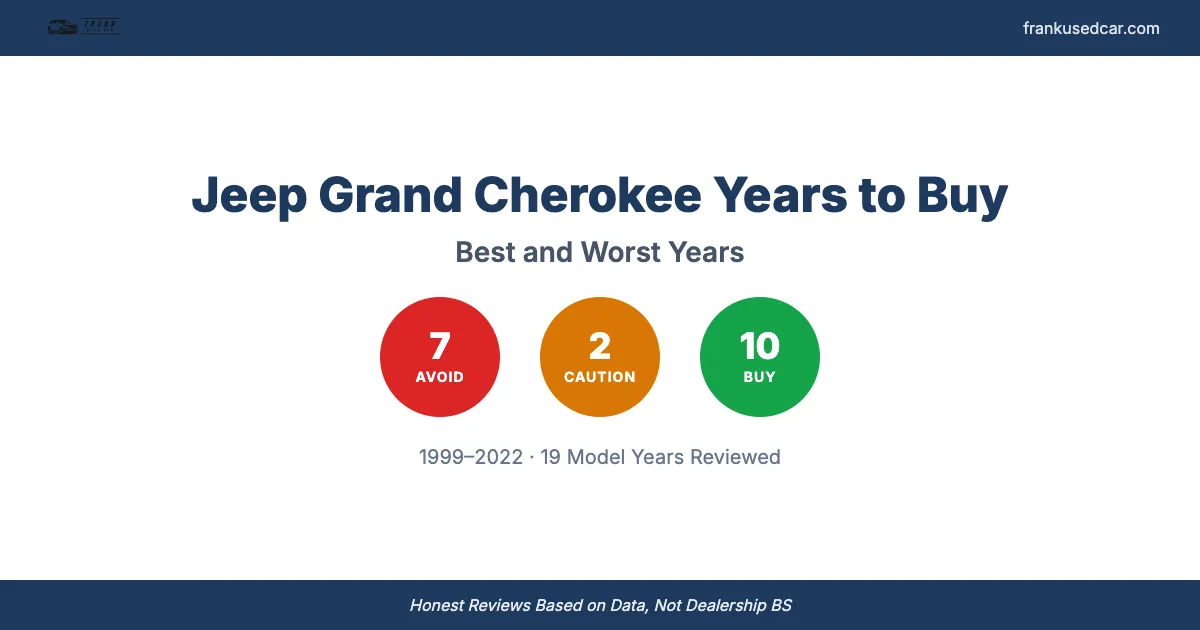
Jeep Grand Cherokee years to avoid are the 2011, 2014, and 2015 — three model years with TIPM electrical failures, transmission shudder, and a deadly shifter recall that set them apart from the rest of the lineup.
I’ve reviewed the NHTSA complaint data on every Grand Cherokee model year, and here’s what the numbers actually show.
The 2011 has the worst TIPM failure rate. The 2014 adds transmission problems. The 2015 introduced a shifter design that killed someone.
Caution years include the 2005, 2012, 2013, and 2022. The best Jeep Grand Cherokee years to buy are the 2016, 2018, and 2019-2021.
| Year | Frank’s Verdict | Key Issue | Risk Level |
|---|---|---|---|
| 2005 | CAUTION | Transfer case + electrical | Moderate |
| 2009-2010 | BUY | Late WK, proven | Low |
| 2011 | AVOID | TIPM failure + engine tick | High |
| 2012 | CAUTION | Declining TIPM + tick | Moderate |
| 2013 | CAUTION | Residual TIPM + early 8-speed | Moderate |
| 2014 | AVOID | TIPM + transmission shudder | High |
| 2015 | AVOID | Shifter recall + TIPM | Critical |
| 2016 | BUY | TIPM resolved, proven | Low |
| 2017 | CAUTION | Mid-cycle refresh first year | Low-Moderate |
| 2018 | BUY | Post-refresh, refined | Low |
| 2019-2021 | BUY | Best WK2 years | Low |
| 2022 | CAUTION | First-year WL platform | Moderate |
| 2023-2024 | BUY | Refined WL | Low |
Which Jeep Grand Cherokee Years Should You Avoid?
The 2011, 2014, and 2015 Jeep Grand Cherokee are the three model years to avoid, based on NHTSA complaint density, TIPM failure rates, and the severity of electrical and transmission problems.
The Grand Cherokee’s electrical problems in these years aren’t minor inconveniences. A TIPM failure kills your engine while you’re driving.
The 2014 stacks transmission shudder on top of that. The 2015 adds a shifter design so dangerous it was recalled after a fatality.
Each of these Jeep Grand Cherokee model years has repair costs that exceed the SUV’s resale value. I’ve seen owners spend $4,000+ fixing a Grand Cherokee worth $8,000. That math doesn’t work.
Let’s start with the worst offender — the 2011 Grand Cherokee.
What Problems Does the 2011 Jeep Grand Cherokee Have?
The 2011 Jeep Grand Cherokee was the first year of the WK2 generation, and it has the highest rate of TIPM failures of any model year. This problem causes random stalling, no-start conditions, and unpredictable electrical behavior.
NHTSA logged hundreds of complaints against the 2011 Grand Cherokee. The TIPM is the headline problem, but this model year stacks three expensive failures on top of each other.
Top problems for the 2011 Jeep Grand Cherokee:
- TIPM failure — fuel pump relay stops working at 40,000-70,000 miles ($800-$1,500)
- Engine tick — 3.6L Pentastar lifter noise at 30,000-50,000 miles ($2,000-$4,000)
- Alternator failure — at 40,000 miles ($500-$900)
- Electrical gremlins — random warning lights, power window failures at 20,000 miles ($300-$1,200)
The TIPM is the Grand Cherokee’s Achilles heel. When it fails, your fuel pump stops working — and your engine dies. Sometimes at highway speed.
I helped a friend evaluate a 2011 Grand Cherokee listed at $9,500. The TIPM had already been replaced once. The engine tick was audible at cold startup. We walked away.
Frank’s Verdict: AVOID The 2011 Grand Cherokee is a ticking electrical time bomb. The TIPM failure alone is enough to avoid it, but add the engine tick and alternator problems and it’s a clear pass.
What Is the Grand Cherokee TIPM Problem?
The Grand Cherokee TIPM (Totally Integrated Power Module) is a central electrical hub that controls the fuel pump relay, power windows, wipers, and horn.
When the TIPM fails, the fuel pump stops working. The Grand Cherokee becomes unable to start or stalls without warning.
TIPM failures in the Jeep Grand Cherokee typically occur between 40,000 and 70,000 miles. The relay contacts inside the module weld together or corrode over time.
These Grand Cherokee TIPM failures start as intermittent electrical glitches and worsen progressively until the fuel pump relay fails completely.
The 2011-2014 Grand Cherokee models are the most affected. NHTSA issued recall 19V813000 specifically for the TIPM-7 fuel pump relay failure in 2011-2013 models.
Replacing the Grand Cherokee TIPM costs $800-$1,500 at a dealer. Some owners install a bypass relay for $50-$100 as a temporary fix.
The bypass doesn’t address the root cause of the Grand Cherokee TIPM failure. Full replacement is the only permanent solution.
Does the 2011 Grand Cherokee Have Engine Tick?
Yes, the 2011 Jeep Grand Cherokee with the 3.6L Pentastar V6 has a documented engine tick. Failed rocker arm rollers and worn lifters cause the noise, typically appearing between 30,000 and 50,000 miles.
The Pentastar engine tick in the Grand Cherokee sounds like a sewing machine at cold startup. It originates from collapsed rocker arm needle bearings inside the cylinder heads.
Repairing the Grand Cherokee engine tick costs $2,000-$4,000 because the fix requires removing the cylinder heads to replace the rocker arms and lifters. This is not a minor repair.
The 5.7L Hemi V8 in the 2011 Grand Cherokee does not have this issue. The tick is specific to the 3.6L Pentastar V6.
The 2014 Grand Cherokee carries over the TIPM problem plus adds new issues.
What Problems Does the 2014 Jeep Grand Cherokee Have?
The 2014 Jeep Grand Cherokee continues the TIPM failure pattern from the 2011 and adds ZF 8-speed automatic transmission shudder. Persistent electrical issues and Uconnect infotainment problems make it the second model year to avoid.
The 2014 Grand Cherokee added a new 8-speed transmission that brought its own problems. TIPM failures AND transmission shudder — two expensive repairs on one SUV.
Top problems for the 2014 Jeep Grand Cherokee:
- TIPM failure — fuel pump relay at 30,000-60,000 miles ($800-$1,500)
- Transmission shudder — ZF 8-speed vibration at 20,000-40,000 miles ($800-$2,500)
- Uconnect freezing — infotainment system reboots at all mileages ($600-$1,500)
- EcoDiesel EGR cooler — cracking at 40,000-80,000 miles on 3.0L diesel ($1,200-$2,500)
- Battery drain — random module failures at 25,000 miles ($300-$1,200)
I’ve seen 2014 Grand Cherokee owners spend more on repairs in two years than they paid for the SUV.
The TIPM and transmission problems in the 2014 Grand Cherokee hit at different mileage intervals, creating a rolling wave of expensive fixes.
Frank’s Verdict: AVOID TIPM failures plus transmission shudder plus electrical gremlins. The 2014 Grand Cherokee has too many expensive problems for an SUV in this price range.
Does the 2014 Grand Cherokee Have Transmission Problems?
Yes, the 2014 Jeep Grand Cherokee has documented ZF 8-speed automatic transmission shudder. The vibration occurs during light acceleration between 20,000 and 40,000 miles, caused by torque converter issues.
The ZF 8-speed in the Grand Cherokee is shared across many FCA vehicles. The torque converter lockup clutch wears prematurely, creating a noticeable vibration at 25-45 mph.
Repairing the Grand Cherokee transmission shudder costs $800-$2,500. The price depends on whether the fix requires a torque converter replacement or a full rebuild.
The 2015 adds a safety recall to the mix.
What Problems Does the 2015 Jeep Grand Cherokee Have?
The 2015 Jeep Grand Cherokee shares the 2014’s electrical and transmission problems and adds a dangerous shifter design flaw. The monostable shifter was recalled after causing multiple rollaway incidents, including the death of actor Anton Yelchin.
The 2015 Grand Cherokee’s shifter is a design failure, not just a defect. Drivers couldn’t tell if the SUV was in Park because the shifter returned to center position after each selection.
Jeep recalled over 1.1 million Grand Cherokee and Dodge Charger vehicles equipped with the monostable shifter.
Top problems for the 2015 Jeep Grand Cherokee:
- Monostable shifter — rollaway risk, fatal design flaw (recall — free repair)
- TIPM failure — at 35,000-55,000 miles ($800-$1,500)
- Transmission shudder — ZF 8-speed at 25,000-45,000 miles ($800-$2,500)
- Half-shaft vibration — at 25,000 miles
- Electrical malfunctions — at 20,000 miles ($300-$1,200)
The fact that this Grand Cherokee shifter design was approved for production is concerning. The recall fixes the issue with a software update.
The underlying design philosophy raises questions about the 2015 Grand Cherokee’s overall engineering quality.
Frank’s Verdict: AVOID A shifter that killed someone, TIPM failures, and transmission shudder. The 2015 Grand Cherokee has too many problems — the 2016+ is a different SUV in terms of quality.
The 2005 Grand Cherokee is a caution year with its own set of first-year WK problems.
What Problems Does the 2005 Jeep Grand Cherokee Have?
The 2005 Jeep Grand Cherokee was the first year of the WK generation, and it has documented electrical failures, transfer case problems during 4WD engagement, and engine overheating on the 4.7L V8.
These issues make the 2005 Grand Cherokee a caution year that warrants thorough inspection before buying.
The 2005 Grand Cherokee arrived during the DaimlerChrysler era. Some Mercedes-influenced engineering improved the ride quality. Other elements introduced complexity that Jeep hadn’t fully sorted out.
Top problems for the 2005 Jeep Grand Cherokee:
- Electrical system failures — multiple module malfunctions from 20,000 miles ($300-$1,200)
- Transfer case failure — grinding during 4WD engagement at 60,000 miles ($1,500-$3,000)
- Engine overheating — 4.7L V8 cooling issues at 70,000 miles
- Window regulator failure — at 30,000 miles ($250-$500)
The 2005 Grand Cherokee was Jeep’s first attempt at the WK platform. First-year models carry the most risk.
The 2005 proves it with transfer case failures and electrical problems that the 2009-2010 Grand Cherokee models resolved.
Frank’s Verdict: CAUTION First-year WK with transfer case failures and electrical problems. The 2009-2010 Grand Cherokee is a much better buy in the same generation. Only buy a 2005 with documented maintenance and a thorough pre-purchase inspection.
The other caution years have less severe issues but still warrant inspection.
What Problems Do the 2012-2013 Jeep Grand Cherokee Have?
The 2012 and 2013 Jeep Grand Cherokee improved on the 2011’s worst problems, but TIPM failures and 3.6L Pentastar engine tick still appear at reduced rates.
By 2013, early ZF 8-speed transmission shudder in the Grand Cherokee was beginning to surface alongside the declining TIPM issue.
The 2012 Grand Cherokee is the 2011 with band-aids. TIPM complaint rates dropped, but the problem wasn’t eliminated.
Engine tick frequency in the 2012 Grand Cherokee declined but still affected a meaningful percentage of 3.6L Pentastar V6 owners.
2012 Jeep Grand Cherokee issues:
- Engine tick — 3.6L Pentastar, declining rate, still present at 40,000 miles ($2,000-$4,000)
- TIPM issues — less frequent than 2011, appearing at 50,000 miles ($800-$1,500)
- Rear differential noise — reported by some owners
The 2013 Grand Cherokee sits in the transition zone where Jeep was still working out WK2 bugs. TIPM failures were less frequent. Engine tick was declining.
Early ZF 8-speed complaints in the 2013 Grand Cherokee were just starting to appear as Jeep introduced the new transmission.
Both the 2012 and 2013 Grand Cherokee are borderline years. Improved over the 2011, but not yet reliable enough for a confident recommendation.
Frank’s Verdict: CAUTION (both years) Improving but not fixed. Only buy a 2012 or 2013 Grand Cherokee with documented maintenance and a pre-purchase inspection focused on TIPM and engine tick. The 2013 also needs a transmission check for early ZF 8-speed shudder.
The 2022 introduced a new generation with its own first-year risks.
What Problems Does the 2022 Jeep Grand Cherokee Have?
The 2022 Jeep Grand Cherokee was the first year of the WL generation, and like most first-year redesigns, it carries higher risk. Early owners have reported infotainment freezing, electrical glitches, and build quality inconsistencies.
The 2022 Grand Cherokee rides on the new STLA Large platform. The interior is a massive upgrade over the WK2. Ride quality and technology are genuinely improved.
The Uconnect 5 infotainment system in the 2022 Grand Cherokee has been the primary complaint source. Screen freezing, random reboots, and Bluetooth drops affect early production units.
The 2022 Grand Cherokee is a fundamentally better SUV than the WK2, but first-year models always carry risk. The 2023-2024 Grand Cherokee will be more refined.
Frank’s Verdict: CAUTION First-year WL generation. The platform is good, but give it a year or two for Jeep to work out the bugs. The 2023+ Grand Cherokee is a safer bet.
These individual year problems feed into larger patterns across the Grand Cherokee lineup.
What Are the Most Common Jeep Grand Cherokee Problems?
The most common Jeep Grand Cherokee problems across all model years are TIPM electrical failures, 3.6L Pentastar engine tick, ZF 8-speed transmission shudder, and general electrical gremlins. The WK2 generation (2011-2021) carries the most issues.
The Grand Cherokee’s electrical system is its weakest link. TIPM failures are the headliner, but smaller electrical gremlins run throughout the WK2 generation.
| Problem | Severity | Estimated Cost | Affected Years |
|---|---|---|---|
| TIPM failure | SERIOUS | $800-$1,500 | 2011-2014 |
| Engine tick (3.6L Pentastar) | SERIOUS | $2,000-$4,000 | 2011-2013 |
| Transfer case failure | SERIOUS | $1,500-$3,000 | 2005-2010 |
| Transmission shudder (ZF 8-speed) | MODERATE | $800-$2,500 | 2014-2016 |
| Electrical module diagnosis | MODERATE | $300-$1,200 | 2005-2015 |
| EGR cooler (EcoDiesel) | MODERATE | $1,200-$2,500 | 2014-2016 |
These Grand Cherokee problem patterns map directly onto the year-by-year reliability picture.
How Serious Is the Grand Cherokee TIPM Issue?
The Grand Cherokee TIPM issue is a SERIOUS problem — it causes the fuel pump to stop working and kills the engine without warning while driving. Replacement costs $800-$1,500.
NHTSA issued two recalls for the Grand Cherokee TIPM: 14V530000 (2011 models) and 19V813000 (2011-2013 models). A stalled engine in highway traffic creates a life-threatening situation.
The TIPM in the 2011-2014 Grand Cherokee is the single most important item to verify before buying. Flickering gauges, intermittent horn, or unresponsive windows signal a failing TIPM.
Does the Jeep Grand Cherokee Have Engine Problems?
Yes, the Jeep Grand Cherokee has documented engine problems — primarily the 3.6L Pentastar V6 engine tick caused by failed rocker arm rollers in 2011-2013 models. The repair costs $2,000-$4,000.
The Grand Cherokee’s 5.7L Hemi V8 is significantly more reliable than the 3.6L Pentastar for long-term ownership. The Hemi doesn’t suffer from the rocker arm issue.
The 3.0L EcoDiesel in the Grand Cherokee has its own problem: EGR cooler cracking between 40,000 and 80,000 miles. The repair costs $1,200-$2,500.
Does the Grand Cherokee Have Transmission Issues?
Yes, the Jeep Grand Cherokee has transmission shudder issues with the ZF 8-speed automatic used in 2014-2021 models. Torque converter problems produce a vibration during light acceleration.
Repairing the Grand Cherokee ZF 8-speed shudder costs $800-$2,500 depending on the extent of torque converter damage.
The ZF 8-speed transmission in the Grand Cherokee improved substantially after the 2016 model year. Jeep refined the software calibration and torque converter design.
Grand Cherokee shudder complaints dropped by a significant margin in 2017+ models after these calibration updates.
Early Grand Cherokee ZF 8-speed units (2014-2016) have the highest failure rates. Late WK2 models (2018-2021) rarely experience shudder.
How Reliable Is the Jeep Grand Cherokee by Year?
The Jeep Grand Cherokee reliability varies significantly by year. The late WK2 models (2017-2021) are the most reliable, while the early WK2 (2011-2015) are the least reliable.
J.D. Power rates the Grand Cherokee as average, but that hides the massive gap between a 2011 and a 2019. Early WK2 Grand Cherokee models are money pits. Late WK2 models are solid SUVs.
| Year | Generation | Frank’s Rating (1-10) | Key Strength | Key Risk |
|---|---|---|---|---|
| 2005 | WK | 5 | Off-road capable | Transfer case, electrical |
| 2006-2008 | WK | 6 | Improving platform | Aging electrical |
| 2009-2010 | WK | 7 | Proven, refined | Higher mileage units now |
| 2011 | WK2 | 2 | New platform features | TIPM, engine tick, electrical |
| 2012 | WK2 | 4 | Improving over 2011 | Residual TIPM, tick |
| 2013 | WK2 | 5 | Further improvements | TIPM declining, early 8-speed |
| 2014 | WK2 | 3 | EcoDiesel option | TIPM + transmission shudder |
| 2015 | WK2 | 2 | Features | Shifter recall, TIPM, shudder |
| 2016 | WK2 | 8 | TIPM resolved | Minor issues only |
| 2017 | WK2 | 7 | Mid-cycle refresh | First refresh year |
| 2018 | WK2 | 8 | Refined refresh | Minor issues only |
| 2019 | WK2 | 9 | Best overall value | Depreciation sweet spot |
| 2020 | WK2 | 9 | Low complaints | Higher prices |
| 2021 | WK2 | 9 | Most refined WK2 | Highest prices |
| 2022 | WL | 6 | New platform | First-year bugs |
| 2023-2024 | WL | 7 | Refined WL | Still newer platform |
The Jeep Grand Cherokee reliability story is a tale of two eras. Pick the right era, and you get a capable, comfortable midsize SUV. Pick the wrong era, and you inherit expensive problems.
Before buying, you should also check the recall history.
Has the Jeep Grand Cherokee Been Recalled?
The Jeep Grand Cherokee has an extensive recall history. The most significant recalls affect the 2011-2014 models for TIPM failures and the 2014-2015 models for the monostable shifter rollaway issue.
| Recall ID | Year(s) | Date Issued | Issue | Fix |
|---|---|---|---|---|
| 19V813000 | 2011-2013 | Nov 2019 | TIPM-7 fuel pump relay failure causing stalling | Dealer relay + harness replacement |
| 14V530000 | 2011 | Sep 2014 | TIPM-7 fuel pump relay failure (3.6L/5.7L) | Dealer external relay installation |
| 14V154000 | 2011-2014 | Apr 2014 | Brake booster corrosion reducing braking | Dealer diverter shield or booster replacement |
| 14V391000 | 2011-2014 | Jul 2014 | Sun visor lamp wiring short — fire risk | Dealer wiring repair + new visor |
Source: NHTSA recall database, verified .*
The Grand Cherokee shifter recall is the most important one to verify on any 2014-2015 model. If the recall repair wasn’t completed, walk away.
Check any Grand Cherokee’s recall status through the NHTSA recall database before signing paperwork.
The monostable shifter recall affected the 2014-2015 Jeep Grand Cherokee after actor Anton Yelchin was killed when his Grand Cherokee rolled into him. NHTSA and Fiat Chrysler recalled over 1.1 million vehicles.
Now that you know what to avoid, here are the years worth buying.
What Are the Best Jeep Grand Cherokee Years to Buy?
The best Jeep Grand Cherokee years to buy used are the 2016, 2018, 2019-2021, and 2009-2010 models. These are late WK2 vehicles with TIPM issues resolved and significantly lower complaint rates than 2011-2015 models.
Frank’s top pick: If I were buying a used Grand Cherokee today, I’d get the 2019. The TIPM is fixed. The 8-speed transmission is properly calibrated. The Uconnect system actually works.
A well-equipped 2019 Grand Cherokee costs thousands less than a new one and delivers the same capability.
Best Jeep Grand Cherokee years ranked:
- 2019 Grand Cherokee — Best overall value, refined WK2, all issues resolved
- 2020-2021 Grand Cherokee — Lowest complaint rates, highest prices
- 2018 Grand Cherokee — Post-refresh, proven, slightly lower cost than 2019
- 2016 Grand Cherokee — TIPM fully resolved, pre-refresh value
- 2009-2010 Grand Cherokee — Budget pick, late WK generation, proven platform
The 2017 Grand Cherokee was the first year of the WK2 mid-cycle refresh. First-year refreshes carry slightly higher risk from early production adjustments.
I’d rate the 2017 Grand Cherokee CAUTION rather than a confident buy. The 2016 and 2018 bracket it as better options.
For a Jeep reliability guide covering other Jeep models, check our brand hub.
Is the 2019 Jeep Grand Cherokee Worth Buying Used?
Yes, the 2019 Jeep Grand Cherokee is one of the best used midsize SUVs for off-road capability and premium features. The 2019 has the refined WK2 platform with TIPM issues resolved.
The 2019 Grand Cherokee offers the 3.6L Pentastar V6, 5.7L Hemi V8, and the 707-hp Trackhawk. The Pentastar engine tick from 2011-2013 is fully resolved.
I’ve seen well-maintained 2019 Grand Cherokee Limiteds in the $22,000-$28,000 range. That’s a lot of SUV for the money compared to a $45,000+ new Grand Cherokee.
Is the 2021 Jeep Grand Cherokee a Good Used Buy?
Yes, the 2021 Jeep Grand Cherokee is the final and most refined year of the WK2 generation. The 2021 has the lowest complaint rates and all TIPM and electrical issues fully resolved.
The 2021 Grand Cherokee is the safest used Grand Cherokee you buy. Every WK2 problem has been addressed by this model year. The tradeoff is price — the 2021 commands a premium over the 2019.
If budget allows, the 2021 Grand Cherokee is the no-compromise pick. If value matters more, the 2019 Grand Cherokee delivers 95% of the experience at a lower price.
Is the Jeep Grand Cherokee a Reliable SUV Overall?
The Jeep Grand Cherokee has mixed reliability overall — the right model years are capable and comfortable SUVs, but the wrong years have expensive problems. The Grand Cherokee falls behind the Toyota 4Runner and Ford Explorer in long-term dependability.
The Grand Cherokee does things the 4Runner doesn’t — premium interior, highway comfort, V8 towing power. But the 4Runner runs for 300,000+ miles without the electrical headaches.
If you want reliability above all else, the Toyota 4Runner years to avoid are fewer and less severe.
The Ford Explorer years to avoid overlap with the Grand Cherokee on similar first-year generation risks.
The Jeep Grand Cherokee earns its place if you pick the right year. A 2019 Grand Cherokee is a genuinely excellent midsize SUV. A 2011 is a rolling repair bill.
How Do You Inspect a Used Jeep Grand Cherokee Before Buying?
Check these seven items before buying any used Jeep Grand Cherokee to avoid the most common and expensive problems reported by owners.
Test all electrical functions — windows, wipers, horn, fuel gauge. Any erratic behavior signals TIPM failure in 2011-2014 Grand Cherokee models.
Listen for engine tick at cold startup with the 3.6L Pentastar. A sewing machine sound from the valve covers indicates failed rocker arm rollers in 2011-2013 Grand Cherokee models.
Test transmission for shudder during light acceleration at 25-45 mph. A vibration or hesitation indicates torque converter issues in 2014-2016 Grand Cherokee models.
Verify shifter recall completion on NHTSA for any 2014-2015 Jeep Grand Cherokee. This is a critical safety item — do not buy without confirmation.
Check transfer case engagement in all 4WD modes. Listen for grinding during mode changes in 2005-2010 Grand Cherokee models.
Test Uconnect system for freezing or rebooting. Let the infotainment run for 10+ minutes in 2014-2016 Grand Cherokee models.
Request full service history. A Grand Cherokee with documented maintenance at a Jeep dealer is worth more than one with no records.
These aren’t random suggestions. Each item targets a specific Grand Cherokee problem documented above. For a complete used car buying guide, see our walkthrough.
Bottom line: the Jeep Grand Cherokee is a great SUV — in the right model year. Avoid the 2011, 2014, and 2015. Use caution with the 2005, 2012, 2013, and 2022.
Buy the 2016, 2018, 2019-2021, or 2009-2010 Grand Cherokee. Check NHTSA recalls before signing anything. Inspect for TIPM, engine tick, and transmission shudder before handing over your money.
Also see: Jeep Best & Worst Years
- jeep grand cherokee reliability
- jeep grand cherokee problems
- jeep grand cherokee best years
- jeep grand cherokee recall
- jeep grand cherokee tipm
- years-to-avoid