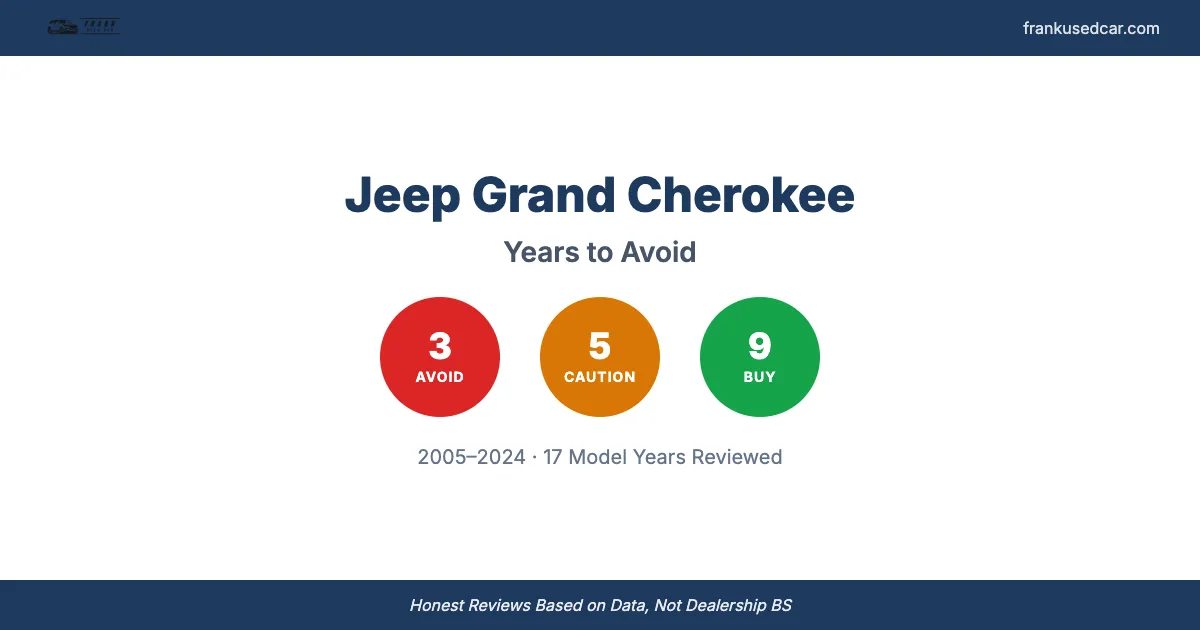
Best and Worst Jeep Grand Cherokee Years to Buy
Jeep Grand Cherokee best and worst years ranked by generation. TIPM data, engine options, and Frank's top picks for used mid-size SUV buyers.
The Jeep Grand Cherokee is America’s most capable midsize SUV — but the difference between the best and worst model years is the difference between a $20,000 trail-ready bargain and a $20,000 electrical nightmare. The Jeep Grand Cherokee has spanned five generations since 1993. Best years deliver legendary 4WD capability with near-zero NHTSA complaints. Worst years come with a $1,500 TIPM repair bill before you make the first payment.
I’ve bought, inspected, or helped friends buy over 50 used cars in 20 years — and the Grand Cherokee is one of the most polarizing. Get the right year and you’ll love it. Get the wrong year and you’ll hate every trip to the shop. The 2018 Jeep Grand Cherokee has near-zero NHTSA complaints while the 2011 has 6x the complaint rate of any other generation. Here’s which model years are worth buying and which ones to skip.
Frank’s Jeep Grand Cherokee Best and Worst Years
| Model Year | Generation | Frank’s Verdict | Key Strength or Issue | Rating |
|---|---|---|---|---|
| 2018 | WK2 | BUY — TOP PICK | TIPM resolved, mature ZF 8-speed, AEB available, $19K-$24K | 9/10 |
| 2019 | WK2 | BUY — TOP PICK | Same quality as 2018, slightly lower used prices | 9/10 |
| 2017 | WK2 | BUY | Mid-cycle refresh, Trailhawk added, Apple CarPlay | 8/10 |
| 2020 | WK2 | BUY | Final WK2, lowest complaints, above depreciation sweet spot | 8/10 |
| 2021 | WK2 | BUY | Last WK2, excellent but pricey | 8/10 |
| 2009 | WK | BUY | Most refined WK, HEMI available, very low complaints | 8/10 |
| 2010 | WK | BUY | Late WK, proven, excellent depreciation value | 8/10 |
| 2006 | WK | BUY | Mercedes-era build, standard ESC, HEMI proven | 7/10 |
| 2007 | WK | BUY | Refined WK, low complaints, budget-friendly | 7/10 |
| 2016 | WK2 | BUY | TIPM resolved, pre-refresh, solid | 7/10 |
| 2005 | WK | CAUTION | First WK year, early TIPM, last 4.0L I6 | 6/10 |
| 2022 | WL | CAUTION | First WL year, new platform risk | 5/10 |
| 2015 | WK2 | AVOID | Shifter rollaway recall, electrical issues | 3/10 |
| 2014 | WK2 | AVOID | TIPM + ZF 8-speed first year + shifter + EcoDiesel | 3/10 |
| 2013 | WK2 | AVOID | TIPM + timing chain tensioner, 3x complaint rate | 4/10 |
| 2012 | WK2 | AVOID | TIPM + Pentastar tick, 4x complaint rate | 4/10 |
| 2011 | WK2 | AVOID | TIPM + Pentastar tick, 6x complaint rate, worst year | 2/10 |
| 1999 | WJ | AVOID | Head gasket failures, overheating, transfer case | 4/10 |
| 2000 | WJ | AVOID | Same 4.7L V8 issues as 1999 | 4/10 |
Why Is the 2018 Grand Cherokee Frank’s Top Pick?
The 2018 Jeep Grand Cherokee is Frank’s top pick because it combines a mature WK2 platform with TIPM issues fully resolved, the proven ZF 8-speed transmission in its fourth year of refinement, and available automatic emergency braking — at used prices that have dropped into the $19,000-$24,000 sweet spot.
BUY — TOP PICK. No hesitation on this one.
The TIPM electrical failures that plagued 2011-2015 models? Completely resolved by 2016. By 2018, that’s three full model years of proven reliability. The ZF 8-speed transmission? Introduced in 2014 with shudder issues. Refined through 2015-2017. Fully mature by 2018. Both major Jeep Grand Cherokee weak points — fixed.
Engine options are strong. The 3.6L Pentastar V6 had its rocker arm tick issue fixed after 2013. Five years of clean production by 2018. The 5.7L HEMI V8 remains one of the strongest powertrains in the midsize SUV class.
Uconnect 4C brought Apple CarPlay and Android Auto. Blind spot monitoring, adaptive cruise control, and automatic emergency braking became available. This is a genuinely modern SUV.
A 2018 Jeep Grand Cherokee Limited with 50K miles lists around $21,000-$24,000. Compare that to a new Grand Cherokee at $42,000+ — you’re saving $18,000-$21,000 for a thoroughly proven SUV.
The 2011 was the first WK2 year with TIPM failures that caused random stalling. The 2018 is the same platform, seven years more refined. Same bones, completely different reliability story.
I recommended a 2018 Grand Cherokee Limited to a coworker’s brother last spring. He found one with the HEMI and 55K miles for $23,500. Eight months in — zero issues. He towed a boat to the lake twice and ran a forest service road in Montana. That’s the Grand Cherokee doing what it was built to do.
Frank’s Verdict: BUY — TOP PICK. The 2018 Grand Cherokee is the best year across all five generations. TIPM resolved. ZF 8-speed mature. Near-zero complaints. If you’re spending $19,000-$24,000 on a used midsize SUV, this is the one to find.
The 2018 is the best WK2 pick — but older generations have strong options too, especially the late WK models.
What Are the Best WK Grand Cherokee Years? (2005-2010)
The best WK Jeep Grand Cherokee years are the 2006-2007 and 2009-2010, which delivered Mercedes-era build quality with the legendary 5.7L HEMI V8 option and consistently low complaint rates — making them the strongest budget picks in the entire Grand Cherokee lineup.
The WK generation came from the Mercedes-Benz partnership era. Jeep shared platform engineering with the Mercedes ML-Class during this period. Interior materials, build quality, and overall refinement jumped significantly over the ZJ and WJ predecessors.
The 2005 was the first WK year. Some early TIPM and electrical teething issues — and it was the last year of the legendary 4.0L inline-six. The 2006-2007 refined everything. Standard electronic stability control arrived in 2006. HEMI V8 proved itself. Complaint rates dropped to consistently low levels.
The 2009-2010 Jeep Grand Cherokee models are the most refined WK years. Very low NHTSA complaints. Excellent depreciation value. The 3.7L V6 is reliable but underpowered for a 4,500-pound SUV. The 5.7L HEMI is the desirable engine — strong towing, real off-road grunt.
| Year | WK Verdict | Key Note |
|---|---|---|
| 2005 | CAUTION | First WK year, early TIPM, last 4.0L I6 |
| 2006 | BUY | Standard ESC, HEMI proven, Mercedes-era quality |
| 2007 | BUY | Refined WK, low complaints |
| 2008 | BUY | Solid year, reliable |
| 2009 | BUY | Most refined WK, very low complaints |
| 2010 | BUY | Late WK, excellent depreciation value |
A 2009-2010 Jeep Grand Cherokee with 100K-170K miles runs $7,000-$11,000. Add the HEMI and budget $2,000-$5,000 more, but you get a genuinely capable trail SUV for under $15,000.
The 2005 was the last Grand Cherokee with the 4.0L inline-six — the most reliable engine Jeep ever put in this SUV. If you find a clean 2005 with the 4.0L, that’s a keeper. Just factor in first-year electrical risk.
Is the 2009 Grand Cherokee a Good Used Buy?
Yes. The 2009 Jeep Grand Cherokee is a strong budget buy — it’s the most refined WK model year with the lowest complaint rate of the entire generation and HEMI V8 availability at used prices under $10,000.
Late WK. All electrical bugs worked out. Available with the 5.7L HEMI or the 3.7L V6. At $7,000-$11,000 with 100K-170K miles, it’s a capable 4WD SUV for well under $15,000.
I helped a friend find a 2009 Jeep Grand Cherokee Limited with the HEMI and 130K miles for $9,500. Two years later, the only repair was a $250 window regulator. Try getting that kind of value from a Toyota 4Runner at that price point.
Budget reality: under $12K with 100K-170K miles. At that price, even a $500 repair doesn’t break the math. Budget for brakes, tires, and transfer case fluid — and you’ve got a genuinely capable 4WD SUV.
Is the 2006 Grand Cherokee Worth Buying?
Yes. The 2006 Jeep Grand Cherokee is worth buying as a budget 4WD SUV — it’s the first fully refined WK year with standard stability control and the proven HEMI V8 option, typically available for $5,000-$9,000.
First year with standard ESC. Mercedes-era build quality. Engine choice matters: the 5.7L HEMI is the desirable option. The 3.7L V6 is reliable but slow — this is a heavy SUV and the V6 works hard in highway merges and mountain grades.
Between the 2006 and 2009, I’d pick the 2009 every time for fewer miles per dollar. But if budget is tight and you find a clean 2006 HEMI under $7,000, that’s a solid deal. Check for rust underneath — these are old enough that corrosion matters in northern states.
What Are the Best WK2 Grand Cherokee Years? (2011-2021)
The best WK2 Jeep Grand Cherokee years are the 2017, 2018, and 2019, which combined TIPM-resolved reliability with the refined ZF 8-speed transmission, updated Uconnect infotainment, and available Trailhawk off-road trim — making them the sweet spot for buyers who want modern features at used car prices.
The WK2 is the longest Grand Cherokee generation — 11 years of production from 2011 to 2021. Massive evolution across that span. Here’s the split:
- 2011-2013: TIPM electrical failures plus Pentastar rocker arm tick. Avoid all three years.
- 2014-2015: TIPM declining but shifter rollaway recall plus ZF 8-speed first year. Avoid both.
- 2016: TIPM resolved, pre-refresh. Solid choice.
- 2017: Mid-cycle refresh. Trailhawk trim added. Apple CarPlay. Strong year.
- 2018-2019: Frank’s top pick territory. Fully mature. Near-zero complaints.
- 2020-2021: Final WK2. Excellent but above the depreciation sweet spot.
| Year | WK2 Verdict | Key Note |
|---|---|---|
| 2011 | AVOID | TIPM + Pentastar tick, 6x complaints, worst year |
| 2012 | AVOID | TIPM + tick, 4x complaints |
| 2013 | AVOID | TIPM + timing chain, 3x complaints |
| 2014 | AVOID | TIPM + ZF shudder + shifter + EcoDiesel |
| 2015 | AVOID | Shifter rollaway recall, electrical, 3x complaints |
| 2016 | BUY | TIPM resolved, pre-refresh, solid |
| 2017 | BUY | Mid-cycle refresh, Trailhawk, Apple CarPlay |
| 2018 | BUY — TOP PICK | Mature platform, near-zero complaints |
| 2019 | BUY — TOP PICK | Same quality as 2018 |
| 2020 | BUY | Final WK2, excellent but pricey |
| 2021 | BUY | Last WK2, excellent but pricey |
The WK2 is the most bipolar Jeep Grand Cherokee generation. The first five years (2011-2015) are the worst Grand Cherokee ever built. The last five years (2017-2021) are the best. The dividing line is the TIPM module.
I’ve seen this pattern repeat with the Dodge Durango — same WK2 platform, same TIPM failures, same timeline. The shared platform means shared problems and shared fixes.
Is the 2017 Grand Cherokee a Good Used Buy?
Yes. The 2017 Jeep Grand Cherokee is a strong used buy — it’s the mid-cycle refresh year with the Trailhawk off-road trim added, Apple CarPlay and Android Auto via Uconnect 8.4, and three full years of TIPM-resolved reliability at prices entering the depreciation sweet spot.
The Trailhawk trim brought Quadra-Lift air suspension and Selec-Speed Control as standard equipment. Genuine off-road capability from the factory. The ZF 8-speed was in its third year — refined, smooth, no shudder complaints.
At $17,000-$22,000 with 60K-100K miles, the 2017 Jeep Grand Cherokee is the value pick in this generation. TIPM is in the rearview mirror. Updated tech. Fresh interior.
The 2017 was when the Grand Cherokee stopped being a reliability gamble and became a recommendation. Minor first-refresh-year caution, but nothing that shows up in complaint data as a pattern.
Is the 2019 Grand Cherokee Worth Buying Used?
Yes. The 2019 Jeep Grand Cherokee is worth buying used — it matches the 2018’s near-zero complaint rate with identical mechanicals, and prices have dropped enough to make the Limited and Overland trims accessible at $21,000-$26,000.
Essentially identical to the 2018 — Frank’s top pick — with minor trim updates. Same 3.6L Pentastar or 5.7L HEMI. Same ZF 8-speed. Same refined WK2 platform.
Between the 2018 and 2019, pick whichever has lower miles and better maintenance records. The reliability difference is zero. The price difference is usually $1,000-$2,000 for the same mileage.
HEMI premium runs $2,000-$5,000 over the V6. Worth it for towing and off-road power. If you’re mostly commuting, the Pentastar V6 saves fuel at 21 MPG combined vs 17 MPG for the HEMI.
Are the 2020-2021 Grand Cherokee Models Worth the Premium?
The 2020 and 2021 Jeep Grand Cherokee are the most refined WK2 models ever built with the lowest complaint rates of any Grand Cherokee year — but at $25,000-$32,000, they sit above the depreciation sweet spot and may not justify the $6,000-$8,000 premium over a 2018-2019.
Final WK2 years. Excellent reliability across the board. Very low NHTSA complaints. The platform had 10 years of refinement by this point.
At $28,000 for a 2020 Limited, you’re paying new-car-adjacent prices for a 5-year-old SUV. Compare that to a 2018 Limited at $22,000 with the same reliability — you’re paying $6,000 for two fewer years of age. The reliability difference between 2018 and 2020? Negligible. Both score 8-9 out of 10.
When it makes sense: low-mileage examples under $27,000. HEMI models hold value better than V6 trims. If you find a 2021 Jeep Grand Cherokee Overland with the HEMI under $30,000 and under 40K miles, that’s a genuinely good deal. Above that, you’re in new Grand Cherokee WL territory.
I steered a family member away from a 2021 Grand Cherokee at $33,000 last fall. Found a 2018 with the same trim, same HEMI, 20K more miles for $22,500. She saved $10,500 and the reliability data is almost identical. That $10,500 buys a lot of maintenance and gas.
Frank’s Verdict: BUY — but only at the right price. The 2020-2021 Grand Cherokee is excellent. Just don’t overpay for two extra model years of essentially the same SUV. Compare prices to 2018-2019 before deciding.
Which Grand Cherokee 4WD System Should You Choose?
The Jeep Grand Cherokee’s 4WD system is what separates it from the Toyota Highlander and Honda Pilot — Quadra-Drive II with Selec-Terrain is genuinely capable off-road, but the Quadra-Lift air suspension adds $2,000-$4,000 in replacement risk on used models.
| System | Description | Available On | Frank’s Verdict |
|---|---|---|---|
| Quadra-Trac I | Full-time single-speed transfer case | Laredo | Adequate for snow and light trails |
| Quadra-Trac II | Full-time two-speed transfer case with low range | Limited | Real low range — solid choice |
| Quadra-Drive II | Electronic LSD + two-speed | Overland, Summit | Serious off-road capability |
| Quadra-Lift | Air suspension, 4 height settings, 10.7” ground clearance | Trailhawk (standard), Overland/Summit (optional) | Capable but $2,000-$4,000 replacement risk |
| Selec-Terrain | 5 drive modes: Auto, Snow, Sand, Mud, Rock | Most trims (2014+) | Genuinely useful — not a gimmick |
Quadra-Drive II plus Quadra-Lift is genuinely capable off-road. This is not a mall-crawler setup — it’s a real trail system with low range, locking differentials, and modes that actually work. No Highlander or Pilot comes close.
But air suspension replacement at $2,000-$4,000 is a budget killer on used Jeep Grand Cherokee models. I’ve inspected three separate Grand Cherokees with sagging rear ends from failed air springs. Two owners didn’t know the repair cost until they got the estimate. Both sold the car instead of fixing it.
Stick with steel-spring models unless you actually need the capability and budget for the risk. HEMI plus Quadra-Drive II is the best combination for towing and off-road. Pentastar V6 plus Quadra-Trac I is best for daily driving and budget.
Which Jeep Grand Cherokee Years Should You Avoid?
The 2011, 2012, 2013, 2014, and 2015 Jeep Grand Cherokee are the five worst model years to avoid — the 2011 alone has 6x the complaint rate of the average Grand Cherokee year, driven almost entirely by TIPM module failures.
| Year | Frank’s Verdict | Key Issue | Risk Level |
|---|---|---|---|
| 2011 | AVOID | TIPM + Pentastar tick, 6x complaint rate | HIGH |
| 2012 | AVOID | TIPM + Pentastar tick, 4x complaint rate | HIGH |
| 2013 | AVOID | TIPM + timing chain tensioner, 3x | HIGH |
| 2014 | AVOID | TIPM + ZF shudder + EcoDiesel + shifter | HIGH |
| 2015 | AVOID | Shifter rollaway recall, electrical, 3x | HIGH |
| 1999 | AVOID | 4.7L head gasket failure, overheating | HIGH |
| 2000 | AVOID | Same 4.7L V8 issues as 1999 | HIGH |
| 2005 | CAUTION | First WK year, early TIPM teething | MODERATE |
| 2016 | CAUTION | Pre-refresh, TIPM resolved, strong | LOW |
| 2022 | CAUTION | First WL year, new platform risk | MODERATE |
The TIPM — Totally Integrated Power Module — is THE defining issue. It controls the fuel pump relay, headlights, wipers, horn, and power windows. When it fails, the car stalls without warning. Replacement costs $800-$1,500, and it affected 2011-2015 models across the entire Chrysler lineup — Jeep Grand Cherokee, Dodge Durango, Ram, Town and Country.
I’ve seen two 2011 Grand Cherokees stall at intersections because of TIPM failure. One was a customer’s daughter. The fuel pump relay stopped sending power mid-drive. No warning light. No gradual loss of power. Just dead. That’s not a nuisance — that’s dangerous.
The 2015 also carries the monostable shifter rollaway recall (NHTSA 16V240000). The shifter design didn’t return to a clear park position. The car could roll away after the driver exited. This recall is linked to the Anton Yelchin fatality.
For the full breakdown of what goes wrong in each of these years — TIPM diagnostics, Pentastar tick repair costs, and the shifter recall details — read the complete Jeep Grand Cherokee years to avoid guide.
The pattern is clear: avoid first-generation WK2 years (2011-2015). Once Chrysler resolved the TIPM and the ZF 8-speed matured, the Grand Cherokee became one of the best used SUVs you can buy.
How Reliable Is the Grand Cherokee by Year?
The Jeep Grand Cherokee reliability varies dramatically by generation and year — the 2018-2019 WK2 models earn 9/10 ratings while the 2011 WK2 launch year scores 2/10, making year selection more critical for the Grand Cherokee than almost any other SUV on the market.
| Year | Generation | Frank’s Rating | Key Strength | Key Risk |
|---|---|---|---|---|
| 2005 | WK | 6/10 | Last 4.0L I6 | First WK year, early TIPM |
| 2006 | WK | 7/10 | Standard ESC, HEMI proven | Aging V6 |
| 2007 | WK | 7/10 | Refined WK | Aging platform |
| 2008 | WK | 7/10 | Solid year | Pre-recession pricing |
| 2009 | WK | 8/10 | Most refined WK | High-mileage examples |
| 2010 | WK | 8/10 | Late WK, low complaints | High-mileage examples |
| 2011 | WK2 | 2/10 | New platform features | TIPM + Pentastar tick, worst year |
| 2012 | WK2 | 4/10 | Improving | TIPM + tick declining |
| 2013 | WK2 | 4/10 | Pentastar improving | TIPM + timing chain |
| 2014 | WK2 | 3/10 | ZF 8-speed (new) | TIPM + ZF shudder + shifter + EcoDiesel |
| 2015 | WK2 | 3/10 | Available features | Shifter rollaway, electrical |
| 2016 | WK2 | 7/10 | TIPM resolved | Pre-refresh |
| 2017 | WK2 | 8/10 | Mid-cycle refresh | Minor first-refresh risk |
| 2018 | WK2 | 9/10 | TOP PICK — best reliability-to-price | None significant |
| 2019 | WK2 | 9/10 | TOP PICK — same as 2018 | None significant |
| 2020 | WK2 | 8/10 | Final WK2, lowest complaints | Above depreciation sweet spot |
| 2021 | WK2 | 8/10 | Last WK2, excellent | Above depreciation sweet spot |
| 2022 | WL | 5/10 | New platform, 4xe PHEV | First WL year risk |
| 2023 | WL | 6/10 | Improving | Limited used data |
RepairPal rates the Jeep Grand Cherokee 3.5 out of 5.0 with an average annual repair cost of $666 — slightly above the $652 industry average. But that’s a brand-level average spanning 30+ years. The 2018 costs closer to $400/year while the 2011 averages $1,200+ when you factor in TIPM and Pentastar repairs. The average is meaningless without year context.
J.D. Power gives recent Grand Cherokee models high dependability marks. But they don’t weight the $4,000 air suspension failure the same way I do. My rating focuses on one thing: how likely is this Jeep Grand Cherokee to cost you serious money in repairs?
I base my ratings on complaint density weighted by severity. A $250 window regulator and a $1,500 TIPM replacement both count as “one complaint” in most databases. They shouldn’t. The numbers don’t lie — severity matters more than frequency.
What Is the Best Used Grand Cherokee for the Money?
The best used Jeep Grand Cherokee for the money depends on your budget — the 2009-2010 WK wins under $12,000, the 2016-2017 WK2 wins at $14,000-$22,000, and the 2018-2019 WK2 wins at $19,000-$26,000, with each tier offering the best reliability-to-price ratio in its range.
| Budget Tier | Recommended Year | Price Range | Typical Mileage | Why |
|---|---|---|---|---|
| Budget | 2009-2010 (WK) | $7,000-$11,000 | 100K-170K | HEMI available, low complaints, proven |
| Mid-Range | 2016-2017 (WK2) | $14,000-$22,000 | 60K-120K | TIPM resolved, modern features, depreciation sweet spot |
| Premium | 2018-2019 (WK2) | $19,000-$26,000 | 40K-90K | Frank’s top picks, near-zero complaints |
A $10,000 Grand Cherokee WK with the HEMI and $666/year in repairs costs $11,998 over 3 years. A $20,000 WK2 with the same repair cost is $21,998. The WK wins on total cost — but the WK2 wins on features, safety, and daily livability. Both are good buys if you pick the right year.
Keep 15% of your budget in reserve for first-year repairs. A $20,000 budget means $17,000 for the car and $3,000 in the repair fund. With a Jeep Grand Cherokee, that repair fund matters more than with a RAV4 or CR-V.
Skip the EcoDiesel. Emissions scandal stigma, EGR cooler failures running $1,200-$2,500, and DPF complexity make it a poor used value despite the 25 MPG combined rating. The $1,000-$3,000 EcoDiesel price premium on used lots isn’t worth the maintenance risk.
The Jeep Grand Cherokee depreciates faster than the 4Runner but slower than the Ford Explorer. That middle ground means solid deals on 3-5 year old WK2 models without the rapid value collapse you see on some domestic SUVs.
Frank’s Verdict: Best Value. The 2017 Grand Cherokee at $17,000-$22,000 is the best dollar-for-dollar buy in the entire lineup. TIPM resolved. Trailhawk available. Depreciation sweet spot. If I had $20K for a midsize SUV with real 4WD capability, that’s where my money goes.
Which Grand Cherokee Generation Is Most Reliable?
The late WK2 Jeep Grand Cherokee (2016-2021) is the most reliable generation overall with the lowest complaint rates per unit sold, followed by the late WK (2006-2010), while the early WK2 (2011-2015) sits dead last — though every generation has at least one model year to avoid.
| Rank | Generation | Years | Key Engine | Reliability |
|---|---|---|---|---|
| 1 | Late WK2 | 2016-2021 | 3.6L Pentastar (fixed) / 5.7L HEMI | Best overall |
| 2 | Late WK | 2006-2010 | 5.7L HEMI / 3.7L V6 | Strong budget tier |
| 3 | WL (pending) | 2022-present | 3.6L V6 / 2.0L 4xe PHEV | Too early to judge |
| 4 | Late WJ | 2003-2004 | 4.0L I6 / 4.7L V8 (improved) | Decent for age |
| 5 | Early WK2 | 2011-2015 | 3.6L Pentastar (flawed) | Worst generation |
| 6 | Early WJ | 1999-2002 | 4.7L V8 (head gaskets) | Avoid |
Engine reliability summary for the Jeep Grand Cherokee: the 4.0L I6 is legendary — best engine ever in a Grand Cherokee. The 5.7L HEMI is good but budget for MDS solenoid work at $600-$1,200 past 150K miles. The 3.6L Pentastar is excellent after 2014 — avoid 2011-2013. The 3.7L V6 is reliable but underpowered. The 3.0L EcoDiesel is mixed — skip the complexity. The 4.7L V8 is mixed — avoid 1999-2002 head gaskets.
The early WK2 drags down the entire generation’s average. If you separate 2011-2015 from 2016-2021, they look like two completely different SUVs — because they practically are. The TIPM fix changed everything.
Mid-generation years are always more reliable than launch years — that’s the single most important lesson in used car buying. The Jeep Grand Cherokee proves it more dramatically than any other SUV I’ve tracked. First-year models carry the engineering risk. Third-year models get the fixes.
How Does the Grand Cherokee Compare to Other Midsize SUVs?
The Jeep Grand Cherokee matches the Ford Explorer in reliability variance but trails the Toyota Highlander and Honda Pilot in annual repair costs — though no competitor matches the Grand Cherokee’s off-road capability with Quadra-Drive II and Selec-Terrain.
| Model | RepairPal Score | Annual Repair Cost | Best Used Years | Worst Years |
|---|---|---|---|---|
| Jeep Grand Cherokee | 3.5/5.0 | $666/yr | 2018-2019, 2017, 2009-2010 | 2011-2015, 1999-2000 |
| Ford Explorer | 3.5/5.0 | $732/yr | 2017-2019, 2008-2010 | 2002-2005, 2011-2013, 2020 |
| Toyota Highlander | 4.0/5.0 | $489/yr | 2017-2019, 2021-2022 | 2003, 2008 |
| Honda Pilot | 4.0/5.0 | $542/yr | 2017-2019, 2021 | 2003-2004, 2016 |
| Dodge Durango | 3.5/5.0 | $675/yr | 2017-2019, 2020-2021 | 2011-2013, 2014-2015 |
The Highlander and Pilot are more reliable. That’s a fact. But they’re front-wheel-drive-based crossovers pretending to be SUVs. The Jeep Grand Cherokee is a genuine 4WD platform with low range, locking differentials, and trail modes that actually work. If you need real off-road capability, the Highlander and Pilot aren’t even in the conversation.
The Durango shares the WK2 platform and most mechanical components — TIPM and Pentastar issues affect both equally. If you want three rows, consider the Durango. If you want off-road, the Grand Cherokee wins. For the full sibling analysis, check the Dodge Durango best and worst years guide.
A 2018 Jeep Grand Cherokee at $22,000 delivers 4WD capability that a $28,000 Highlander can’t match. If reliability is your only priority, buy the Highlander. If trail capability and interior luxury matter, the Grand Cherokee earns its place. Browse the used Jeep buying guide for the full Jeep lineup analysis.
What Should You Check Before Buying a Used Grand Cherokee?
Check these seven items before buying any used Jeep Grand Cherokee — each targets a specific problem documented in this guide that varies by generation and model year.
Verify TIPM recall completion by VIN on any 2011-2015 model. NHTSA recall 19V813000 covers fuel pump relay failure causing stalling without warning. Check nhtsa.gov/recalls with the VIN. An open TIPM recall is free to fix at any Jeep dealer — but only if you catch it before buying.
Confirm shifter rollaway recall (16V240000) completed on 2014-2015 models. This is a safety-critical recall linked to the Anton Yelchin fatality. The monostable shifter design could let the car roll away after the driver exits. Non-negotiable.
Test engine for Pentastar tick and lifter noise on cold start. On 2011-2013 Jeep Grand Cherokee models with the 3.6L V6, listen for 30-plus seconds at startup. A ticking noise that doesn’t fade means rocker arm or roller follower wear. Repair costs run $2,000-$4,000.
Check air suspension operation through all four height settings if equipped with Quadra-Lift. Bounce each corner and listen for compressor cycling. A sagging corner or a compressor that runs constantly means replacement at $2,000-$4,000. I’ve caught this on three separate inspections.
Scan for transmission shudder during 2-3 and 3-4 upshifts at light throttle. This affects 2014-2016 ZF 8-speed Jeep Grand Cherokee models. Budget 20 minutes in city driving. A 5-minute highway test won’t reveal it.
Inspect for rust on brake booster center shell. NHTSA recall 14V154000 covers 2011-2014 models, especially in rust-belt states. Corroded boosters allow water inside, reducing brake performance.
Request complete service history with transfer case fluid change intervals. Quadra-Trac and Quadra-Drive systems need fluid changes every 60,000 miles. Skipped fluid changes lead to $1,500-$3,000 transfer case rebuilds.
These aren’t random suggestions. Each item maps to a specific Jeep Grand Cherokee problem pattern I’ve documented by generation. A 2018 needs items 4 and 7. A 2012 needs all seven. Start with the used car buying guide for the complete pre-purchase framework.
Also see: Jeep Years to Avoid
- best year jeep grand cherokee to buy
- most reliable jeep grand cherokee year
- jeep grand cherokee reliability by year
- worst jeep grand cherokee years
- best used jeep grand cherokee
- best-and-worst-years