Ford Escape Years to Avoid and Best Years to Buy
Avoid the 2013-2014 Ford Escape with the 1.6L EcoBoost — fire risk from coolant leaks. See which years are safe and Frank's top picks for used buyers.
The Ford Escape is a compact crossover SUV produced since 2001 that sells in massive numbers. It spans four generations and remains one of Ford’s best-selling vehicles.
Not every model year is worth buying — and the Escape has a few that are genuinely dangerous.
The 2013-2014 Ford Escape with the 1.6L EcoBoost has a coolant leak defect serious enough to cause engine fires. Three separate NHTSA recalls were issued for this single engine.
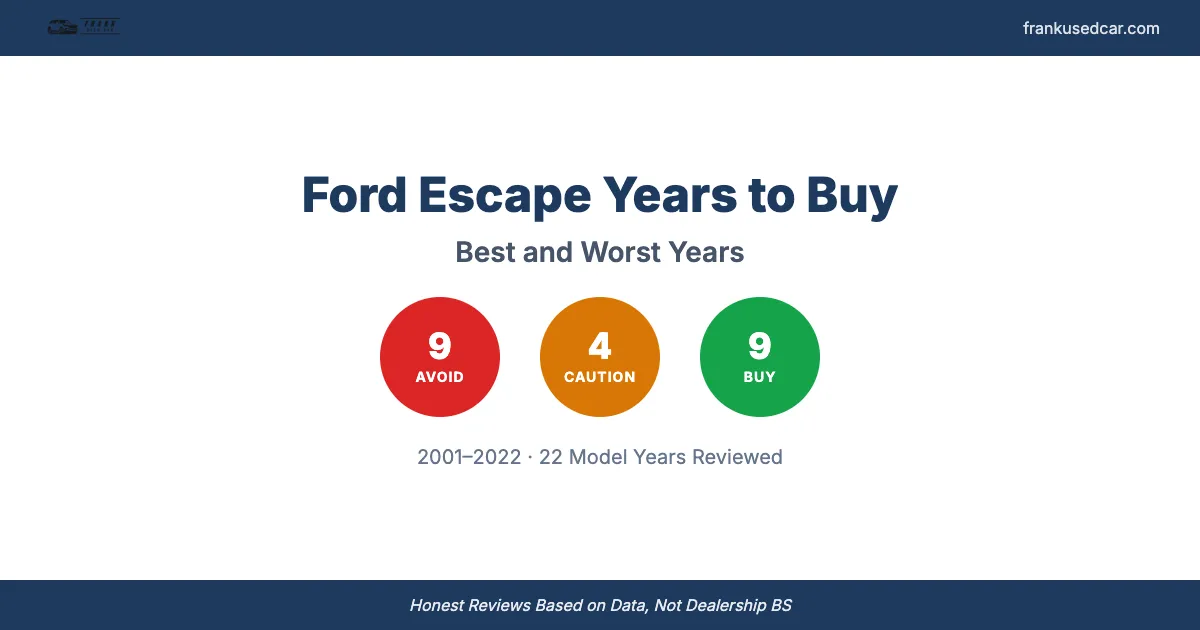
Years to avoid include the 2005, 2006, 2008, 2013, 2014, and 2017. The best Ford Escape years to buy are the 2009-2012, 2015-2016 (with the 2.0L EcoBoost), and 2021-2022.
I’ve reviewed the complaint data on every Escape model year, and the 2013-2014 fire risk is the most serious defect I’ve seen in any compact SUV.
This article covers which Ford Escape years to avoid, 2013 and 2014 problems, the 1.6L EcoBoost coolant leak mechanism, 2005-2006 and 2008 problems, 2017 and 2020 issues, common problems, reliability by year, recalls, best years, and an inspection checklist.
| Year(s) | Frank’s Verdict | Key Issue | Risk Level |
|---|---|---|---|
| 2001-2004 | CAUTION | Early Gen1, aging platform | Moderate |
| 2005 | AVOID | Transmission failure at 60K-100K miles | High |
| 2006 | AVOID | Same Gen1 transmission failure | High |
| 2007 | CAUTION | Late Gen1, improved but aging | Moderate |
| 2008 | AVOID | Ignition coil pack failures | Moderate-High |
| 2009-2012 | BUY | Mature Gen2, proven Duratec | Low |
| 2013 | AVOID | 1.6L EcoBoost fire risk — 3 recalls | Severe |
| 2014 | AVOID | Same 1.6L coolant intrusion | Severe |
| 2015-2016 | BUY (2.0L only) | Improved Gen3, lower complaints | Low |
| 2017 | AVOID | Transmission shudder/hesitation | Moderate-High |
| 2018-2019 | BUY | Late Gen3, refined | Low |
| 2020 | CAUTION | First Gen4, teething issues | Low-Moderate |
| 2021-2022 | BUY | Refined Gen4, hybrid available | Very Low |
Which Ford Escape Years Should You Avoid?
The 2005, 2006, 2008, 2013, 2014, and 2017 Ford Escape are the six model years to avoid, with the 2013-2014 carrying a dangerous 1.6L EcoBoost coolant leak and the others plagued by transmission or ignition failures.
Every AVOID year has a specific, well-documented defect pattern. NHTSA complaint density confirms these six Ford Escape years stand apart from the rest.
The 2013-2014 stand out as genuinely dangerous — not just unreliable, but a fire hazard. The others are standard avoid-years for reliability reasons.
The 2020 Ford Escape earns CAUTION as a first-year Gen4 model with teething issues. Everything else is either BUY or CAUTION.
Let’s start with the most dangerous — the 2013 Escape.
What Problems Does the 2013 Ford Escape Have?
The 2013 Ford Escape has the most serious defect of any model year — a 1.6L EcoBoost engine that leaks coolant into the cylinders, causing overheating, engine failure, and engine fires. Three separate NHTSA recalls were issued for this defect.
The 2013 was the first year of the Gen3 redesign. Ford replaced the proven Duratec with the turbocharged 1.6L EcoBoost and introduced a critical engineering flaw.
Coolant leaks in the 2013 Escape begin at 30,000-60,000 miles. Engine overheating and failure follow at 40,000-80,000 miles.
Three separate fire-risk recalls were issued for this single model year. Three. For the same basic problem.
- 1.6L EcoBoost coolant leak — coolant enters cylinders at 30,000-60,000 miles
- Engine overheating and failure — at 40,000-80,000 miles ($4,000-$7,000 replacement)
- Three fire-risk recalls — 12V551000, 13V583000, 12V336000
- Transmission shudder — at 20,000-50,000 miles
- Power steering failures — at 30,000-60,000 miles
This isn’t just an expensive repair — this is a safety hazard. Ford issued three separate fire-related recalls for the 2013 Ford Escape.
I see these listed at $8,000-$10,000. At that price, you can get a 2011 or 2012 Escape with the proven Duratec engine and none of the fire risk.
Frank’s Verdict: AVOID Engine fires. Three recalls. Coolant leaking into cylinders. The 2013 Escape with the 1.6L EcoBoost is the most dangerous used compact SUV I know of.
The 2014 Escape carries the same engine defect.
Why Does the 2013-2014 Escape 1.6L EcoBoost Leak Coolant?
The 2013-2014 Escape 1.6L EcoBoost leaks coolant because of a design flaw in the cylinder head that allows coolant to seep past the head gasket into the combustion chamber.
Overheating follows the coolant intrusion. When coolant drips onto the hot exhaust manifold, it creates a fire risk.
Ford’s response was three recalls addressing variations of the same underlying defect. The cylinder head cracks under thermal stress, allowing oil and coolant to reach the exhaust.
Coolant leak repair on the Ford Escape 1.6L costs $1,500-$2,500. Engine replacement if the head is damaged runs $4,000-$7,000.
Ford knew about this problem in 2013 and still sold the same engine in 2014. That tells you everything about their priorities.
What Problems Does the 2014 Ford Escape Have?
The 2014 Ford Escape carries the same 1.6L EcoBoost coolant intrusion problem as the 2013, with engine failures occurring at 35,000-70,000 miles, plus additional transmission shudder and brake booster complaints.
Ford had a full year of fire recalls from the 2013 Escape. The 2014 rolled off the line with the same engine.
Engine stalling in the 2014 Ford Escape occurs at 25,000-55,000 miles. Transmission jerking and hesitation appear at 30,000-60,000 miles.
- 1.6L EcoBoost coolant intrusion — same defect as 2013
- Engine stalling while driving — at 25,000-55,000 miles
- Transmission jerking/hesitation — at 30,000-60,000 miles
- SYNC infotainment freezing — requires hard reset
- Brake booster failure — $600-$1,000 replacement
A separate recall (17V209000) was issued in March 2017 for the 2014 Ford Escape 1.6L — a cracked cylinder head causing oil leak and fire risk. Ford added a coolant level sensor as the fix.
One year of fire recalls wasn’t enough to change the engine. That’s not a quality issue — that’s a corporate decision.
Frank’s Verdict: AVOID Same engine defect as 2013, same fire risk, same verdict. Ford didn’t fix the problem, they just kept selling it.
The older Gen1 models have their own problems.
What Problems Do the 2005 and 2006 Ford Escape Have?
The 2005 and 2006 Ford Escape suffer from premature transmission failure in the 4-speed automatic, with the transmission slipping and eventually failing between 60,000 and 100,000 miles — a $3,000-$5,000 repair that often exceeds the car’s value.
These are late Gen1 models sharing the CD2 platform with the Mazda Tribute. Both have the same transmission weak point.
Engine stalling and rough idle in the 2005-2006 Ford Escape appear at 80,000-120,000 miles. Power steering pump failures compound the repair bills.
- Transmission failure — slipping, won’t engage, at 60,000-100,000 miles ($3,000-$5,000)
- Engine stalling/rough idle — at 80,000-120,000 miles
- Power steering pump failure — at higher mileages
- ABS module corrosion — triggers warning lights
- Ball joint wear — causes clunking over bumps
These are 20-year-old SUVs with a known transmission failure point. The repair costs more than the car is worth.
Frank’s Verdict: AVOID Aging Gen1 with a known transmission failure point. There’s no reason to buy a 2005-2006 Escape when better options exist at every price point.
The 2008 had its own issues.
What Problems Does the 2008 Ford Escape Have?
The 2008 Ford Escape launched the Gen2 platform with ignition coil pack failures causing misfires, plus some carried-over transmission harshness from Gen1 — problems that are fixable but frequent enough to warrant avoidance.
Ignition coil packs in the 2008 Ford Escape fail at 50,000-80,000 miles. Each coil costs $200-$400 to replace, but they often fail in sets.
- Ignition coil pack failures — at 50,000-80,000 miles ($200-$400 per coil)
- Cylinder misfires — caused by coil failure
- Throttle body failure — rough idle and stalling
- Transmission harsh shifting — carried over from Gen1
Four coils failing over 20,000 miles adds up to $800-$1,600 in parts and labor. The 2009-2012 Ford Escape models are significantly more refined on the same platform.
Frank’s Verdict: AVOID Ignition coil failures are cheap to fix individually but add up when multiple coils fail. The 2009-2012 are significantly more refined.
The 2017 brought yet another problem.
What Problems Does the 2017 Ford Escape Have?
The 2017 Ford Escape has transmission shudder and hesitation in the 6-speed automatic that’s severe enough to make the car feel unsafe during highway merging — a problem Ford addressed with software updates but never fully eliminated.
The transmission in the 2017 Escape hesitates during acceleration. Merging onto a highway with delayed throttle response is a safety concern, not a convenience issue.
Some electrical issues also affect the 2017 Ford Escape, though these are less severe than the transmission behavior.
The 2017 transmission issue isn’t as dangerous as the 2013 fire risk, but it’s annoying enough that I’d skip it. The 2015-2016 and 2019 are better choices at similar prices.
Frank’s Verdict: AVOID Transmission hesitation during highway merging is a safety concern. The 2015-2016 with the 2.0L EcoBoost are much better buys.
One more year deserves a look.
What Problems Does the 2020 Ford Escape Have?
The 2020 Ford Escape launched the fourth generation with a completely new design on the C2 platform, and as a first-year model it carried some early teething issues including infotainment glitches and drivetrain software calibration complaints.
Most 2020 Ford Escape issues were minor and resolved under warranty. Build quality complaints surfaced in early production units but tapered off quickly.
- Infotainment glitches and freezing — from new
- Drivetrain software calibration — hesitation from stop
- Minor build quality complaints — panel gaps, trim rattles
The 2020 isn’t a bad car — it’s a first-year car. If you find one with service records showing all updates were applied, it’s a reasonable buy.
Frank’s Verdict: CAUTION First-year Gen4 growing pains, but nothing approaching the 2013-2014 severity. The 2021-2022 are the safer bet.
These year-specific problems feed into larger patterns.
What Are the Most Common Ford Escape Problems?
The most common Ford Escape problems are the 1.6L EcoBoost coolant leak and fire risk (2013-2015), transmission failures across multiple generations, ignition coil pack failures in Gen2, and power steering pump failures.
Severity depends almost entirely on which engine and generation your Ford Escape has.
| Problem | Severity | Estimated Cost | Affected Years |
|---|---|---|---|
| Coolant intrusion/fire (1.6L) | SERIOUS | $1,500-$7,000 + safety hazard | 2013-2015 |
| Transmission failure | SERIOUS | $3,000-$5,000 | 2005-2006, 2017 |
| Brake booster failure | MODERATE | $600-$1,000 | 2014-2015 |
| Power steering pump | MODERATE | $500-$900 | Gen1, Gen2 |
| Ignition coil packs | MINOR | $200-$400 per coil | 2008-2012 |
The 1.6L EcoBoost coolant leak isn’t just expensive — it’s dangerous. Every other Ford Escape problem is a normal car repair. This one is a fire hazard.
Is the Ford 1.6L EcoBoost Engine Reliable?
No. The Ford 1.6L EcoBoost engine is not reliable. It has a well-documented coolant intrusion defect in 2013-2015 Escapes that can cause engine overheating, failure, and fire.
The 1.6L is one of the least reliable engines Ford has ever produced. Contrast it with the 2.0L EcoBoost, which has no coolant leak history and solid long-term reliability.
If you’re shopping for a used Ford Escape, the single most important question is: which engine? The 2.0L EcoBoost is fine. The 1.6L is a dealbreaker.
Are Ford Escape Transmission Problems Serious?
Ford Escape transmission problems range from minor hesitation fixable with a $200-$500 software update in Gen3-Gen4 models, to complete transmission failure in 2005-2006 Gen1 models requiring $3,000-$5,000 replacements.
The older the Ford Escape, the more serious the transmission risk. Gen1 failures are catastrophic. Gen3-Gen4 issues are usually software-fixable.
The 2017 Escape transmission shudder sits between these extremes — not a complete failure, but severe enough to affect driving safety during highway merging.
Does the Ford Escape Have Electrical Issues?
Yes. The Ford Escape has electrical issues including ignition coil pack failures in Gen2 models (2008-2012), SYNC infotainment freezing in Gen3 (2013-2019), and ABS module corrosion in Gen1 (2001-2007).
Gen2 Ford Escape ignition coil failures are the most expensive electrical problem — $200-$400 per coil, and they tend to fail in sets.
SYNC freezing in Gen3 Escape models requires a hard reset. The system locks up mid-drive and loses Bluetooth connectivity until restarted.
These problem patterns map directly onto the year-by-year reliability picture.
How Reliable Is the Ford Escape by Year?
The Ford Escape reliability varies dramatically by generation and engine choice. The 2009-2012 Gen2 with the Duratec engine earns solid ratings. The 2013-2014 Gen3 with the 1.6L EcoBoost earns the lowest scores of any compact SUV.
| Year | Generation | Frank’s Rating (1-10) | Key Strength | Key Risk |
|---|---|---|---|---|
| 2005 | Gen1 | 3 | Low price | Transmission failure |
| 2006 | Gen1 | 3 | Low price | Transmission failure |
| 2007 | Gen1 | 4 | Improved Gen1 | Aging platform |
| 2008 | Gen2 | 4 | New platform | Ignition coil failures |
| 2009 | Gen2 | 7 | Refined Gen2 | Minor issues |
| 2010 | Gen2 | 7 | Proven Duratec | Minor issues |
| 2011 | Gen2 | 8 | Mature platform | Minimal |
| 2012 | Gen2 | 8 | Best Gen2 | Minimal |
| 2013 | Gen3 | 1 | Modern design | 1.6L fire risk |
| 2014 | Gen3 | 1 | Features | 1.6L fire risk |
| 2015 | Gen3 | 6 | Improved (2.0L) | 1.6L still offered |
| 2016 | Gen3 | 7 | Mid-cycle refresh | Fewer complaints |
| 2017 | Gen3 | 4 | Updated features | Transmission shudder |
| 2018 | Gen3 | 7 | Late Gen3 | Minor issues |
| 2019 | Gen3 | 7 | Final Gen3 | Minor issues |
| 2020 | Gen4 | 6 | New platform | First-year teething |
| 2021 | Gen4 | 8 | Refined Gen4 | Minimal |
| 2022 | Gen4 | 8 | Mature Gen4 | Minimal |
The same year Ford Escape can be great or terrible depending on which engine is under the hood. Always check: 2.0L EcoBoost = generally fine. 1.6L EcoBoost = avoid at all costs.
J.D. Power and Consumer Reports rate the Escape as “average” overall. That average hides a massive gap between the fire-prone 2013-2014 and the reliable 2009-2012.
Before buying, check the recall history — especially fire recalls.
Has the Ford Escape Been Recalled?
The Ford Escape has been subject to multiple significant NHTSA recalls, with the 2013-2014 models receiving at least three fire-related recalls for the 1.6L EcoBoost engine — an unusually high number for a single defect in a single model.
| Recall ID | Year(s) | Date Issued | Issue | Fix |
|---|---|---|---|---|
| 12V551000 | 2013 | December 2012 | 1.6L EcoBoost coolant system leaks causing engine overheating and potential fire | Dealer engine inspection and powertrain control module reprogramming |
| 13V583000 | 2013 | November 2013 | 1.6L cylinder head may overheat and crack, leaking oil onto hot surfaces — fire risk | Dealer engine shielding, cooling, and control system modification |
| 12V336000 | 2013 | July 2012 | 1.6L engine fuel line may split, causing fuel leak and fire risk | Dealer fuel line replacement |
| 17V209000 | 2014 | March 2017 | 1.6L cylinder head may crack if driven with low coolant — oil leak and fire | Dealer installation of coolant level sensor and software update |
| 22V413000 | 2013-2019 | June 2022 | Transmission shifter cable bushing may degrade — rollaway risk | Dealer shift bushing and protective cap replacement |
Source: NHTSA recall database, verified .
Three fire recalls for the same basic problem on the same engine in the same car. That’s not a minor quality issue — that’s a pattern Ford should have caught during development.
The 2014 Ford Escape received its fire recall (17V209000) four years after production. Unverified recall completion is a serious risk for any used 2013-2014 Escape buyer.
Now that you know what to avoid, here are the years worth buying.
What Are the Best Ford Escape Years to Buy?
The best Ford Escape years to buy used are the 2021-2022, 2015-2016, and 2009-2012 — refined models with proven engines and significantly lower complaint rates than the problem years.
- 2021 Ford Escape — Frank’s TOP PICK. Refined Gen4 with the proven 2.0L EcoBoost, available hybrid and PHEV powertrains, and all the first-year 2020 teething issues resolved.
- 2022 Ford Escape — Mature Gen4 platform. Nearly identical to 2021 with slightly better availability.
- 2015-2016 Ford Escape — Good Gen3 picks IF you get the 2.0L EcoBoost. Never the 1.6L.
- 2009-2012 Ford Escape — Bulletproof budget pick. Duratec engine, no turbo, no coolant leak, no drama.
If I were buying a used Escape today, I’d get the 2021 with the 2.0L EcoBoost or the hybrid. It’s the refined Gen4, everything is sorted, and prices are reasonable.
For budget buyers, the 2009-2012 Ford Escape with the Duratec engine offers simple, reliable transportation at bargain prices.
A 2015-2016 Escape with the 2.0L EcoBoost costs roughly what a 2013 costs — and doesn’t carry fire risk. Check our Ford reliability guide for more on the brand’s best models.
Is the 2021 Ford Escape Worth Buying Used?
Yes. The 2021 Ford Escape is a strong used buy — it’s the refined Gen4 with the proven 2.0L EcoBoost, available hybrid and PHEV powertrains, and all first-year 2020 teething issues resolved.
Reliability data places the 2021 Escape above average for the compact SUV segment. The 1.6L problems are ancient history by this model year.
Prices for the 2021 Ford Escape typically run $3,000-$5,000 below a comparable Toyota RAV4. That price gap makes it a compelling value pick.
Is the 2010 Ford Escape a Good Budget Buy?
Yes. The 2010 Ford Escape is a solid budget pick with the mature Gen2 Duratec engine that avoids all the turbo-related problems of the Gen3.
No turbo means no coolant leak, no cracked cylinder head, no fire risk. The Duratec offers simple, reliable transportation at bargain prices.
The 2010 Escape typically sells for $4,000-$6,000 in decent condition. At that price, it’s one of the best budget compact SUVs available.
Is the Ford Escape a Reliable SUV Overall?
The Ford Escape is a moderately reliable compact SUV that ranks behind the Toyota RAV4 and Honda CR-V in long-term dependability — primarily because of the 2013-2014 1.6L EcoBoost debacle that damaged the nameplate’s reputation across all generations.
Pick the right engine and the right year, and the Ford Escape is a perfectly fine daily driver. Pick wrong, and you’re looking at a potential engine fire.
That’s not a risk you take with a Toyota or Honda. A RAV4 buyer rarely worries about which engine to avoid. A Ford Escape buyer has to research carefully.
The Chevy Equinox shares a similar story — great recent models, terrible older ones with a specific engine defect.
Compare the Ford Escape to its direct competitors before deciding. Read our Toyota RAV4 years to avoid and Chevy Equinox years to avoid guides for the full picture.
How Do You Inspect a Used Ford Escape Before Buying?
Check these seven items before buying any used Ford Escape to catch the most common and expensive problems — especially the potentially dangerous 1.6L EcoBoost coolant leak.
Identify the engine immediately. The 1.6L EcoBoost is the dealbreaker — walk away. The 2.0L EcoBoost is acceptable. The Duratec is safe. Check the engine cover or VIN decode.
Check coolant level and look for milky residue on the oil dipstick. Milky oil in a 2013-2015 Ford Escape with the 1.6L means coolant is leaking into the engine. Walk away immediately.
Smell for sweet coolant odor from the exhaust pipe with the engine running. A sweet smell from the tailpipe of any 1.6L EcoBoost Escape confirms active coolant intrusion into the combustion chamber.
Test the transmission in city stop-and-go driving. Drive the Ford Escape for at least 15 minutes in traffic. Hesitation, shudder, or jerking during acceleration flags transmission problems across all generations.
Verify all fire recall completions by VIN through the NHTSA recall database. Enter the Ford Escape VIN and confirm every recall is marked complete. Unresolved fire recalls on a 2013-2014 Escape are a safety emergency.
Test SYNC infotainment for freezing and Bluetooth connectivity. Pair your phone, play music, switch sources. Gen3 Ford Escape SYNC systems freeze mid-drive and require hard resets.
Request full service history with coolant system and transmission records. A Ford Escape without maintenance records is a gamble. Coolant system service history is critical for any 2013-2015 model.
These aren’t random suggestions. Each item targets a specific Escape problem documented in this article. For a complete process, read our used car buying guide.
Also see: Ford Best & Worst Years
- escape years to avoid
- ford escape problems
- ford escape reliability
- 2013 ford escape problems
- 2014 ford escape problems
- ford escape transmission problems
- ford escape ecoboost problems
- ford escape best years
- ford escape coolant leak
- ford escape common problems
- years-to-avoid