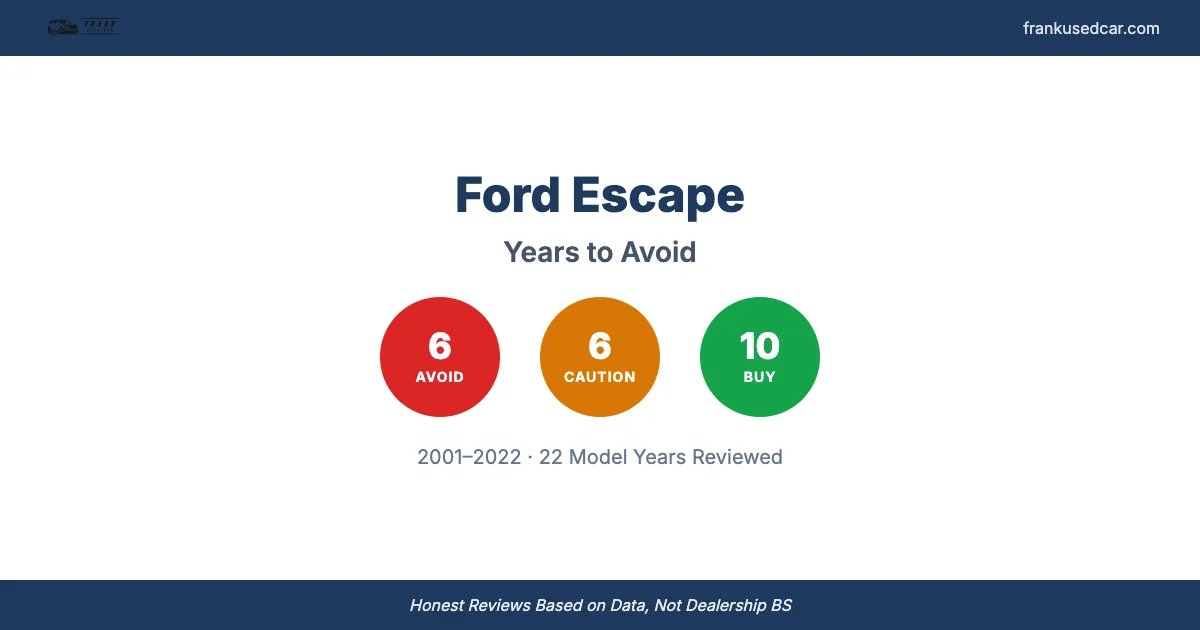
Best and Worst Ford Escape Years to Buy
Ford Escape best and worst years ranked by generation and engine. 1.6L EcoBoost data, repair costs, and Frank's top picks for used compact SUV buyers.
The Ford Escape is one of America’s best-selling compact SUVs — but the difference between the best and worst model years is the difference between a $15,000 bargain and a $4,000-$7,000 engine replacement. The Ford Escape has spanned four generations since 2001. Best years like the 2018-2019 have near-zero NHTSA complaints. Worst years like the 2013 have 8x the complaint rate of any other model year — and four fire-related recalls tied to the 1.6L EcoBoost.
I’ve bought, inspected, or helped friends buy over 50 used cars in 20 years — and the Escape is one of the most requested. The engine matters more than the model year with this SUV. The 2.5L Duratec and 2.0L EcoBoost are both reliable. The 1.6L EcoBoost is a dealbreaker at any price. Here’s which years are actually worth your money.
Frank’s Ford Escape Best and Worst Years
| Model Year | Generation | Frank’s Verdict | Key Strength or Issue | Rating |
|---|---|---|---|---|
| 2019 | Gen3 | BUY — TOP PICK | Most refined Gen3, 1.6L gone, low complaints | 8/10 |
| 2018 | Gen3 | BUY | Near-identical to 2019, mature 2.0L EcoBoost | 8/10 |
| 2021 | Gen4 | BUY | Fixed 2020 bugs, Co-Pilot360 standard, hybrid option | 8/10 |
| 2022 | Gen4 | BUY | Continued refinement, above depreciation sweet spot | 8/10 |
| 2012 | Gen2 | BUY | Last Gen2, proven 2.5L Duratec, best budget pick | 8/10 |
| 2011 | Gen2 | BUY | Mature Gen2, low complaints | 8/10 |
| 2010 | Gen2 | BUY | Stability control standard, refined | 8/10 |
| 2009 | Gen2 | BUY | 6-speed auto, 2.5L Duratec, budget-friendly | 7/10 |
| 2017 | Gen3 | BUY | First year without 1.6L, minor transmission shudder | 7/10 |
| 2016 | Gen3 | CAUTION | Last 1.6L year — OK with 2.0L/2.5L only | 7/10 |
| 2015 | Gen3 | CAUTION | 1.6L still available, residual coolant risk | 6/10 |
| 2020 | Gen4 | CAUTION | First Gen4, infotainment glitches | 6/10 |
| 2007 | Gen1 | CAUTION | Last Gen1, most issues known | 6/10 |
| 2008 | Gen2 | AVOID | Gen2 launch, coil pack failures, misfires | 4/10 |
| 2005 | Gen1 | AVOID | Transmission failures, power steering pump | 4/10 |
| 2006 | Gen1 | AVOID | Same as 2005, ABS module corrosion | 4/10 |
| 2001-2004 | Gen1 | AVOID | Early Gen1 teething, transmission problems | 4/10 |
| 2014 | Gen3 | AVOID | Same 1.6L problems, engine stalling | 3/10 |
| 2013 | Gen3 | AVOID | 1.6L EcoBoost disaster, 8x complaints, fire recalls | 2/10 |
Why Is the 2019 Ford Escape Frank’s Top Pick?
The 2019 Ford Escape is Frank’s top pick because it’s the most refined Gen3 model — the 1.6L EcoBoost is gone (replaced by the proven 1.5L in 2017), the 2.0L EcoBoost is fully mature, the 6-speed transmission is calibrated, and complaint rates are at their lowest in the entire Gen3 run. That makes it one of the best compact SUV values on the used market.
The 2013 was the first Gen3 year with four fire-related recalls, coolant leaks, and engine failures all tied to the 1.6L EcoBoost. The 2019 shares none of those problems. Six model years apart — completely different reliability story.
Engine guidance matters here. The 2019 offers three options: the 1.5L EcoBoost (base and SE trims), the 2.0L EcoBoost (SEL and Titanium), and the 2.5L Duratec (S trim). All three are reliable. The 1.5L EcoBoost is a completely different design from the 1.6L that caused the recalls — different block, different cooling system, different failure profile.
Available blind spot monitoring and adaptive cruise control come on upper trims. Standard backup camera on all trims. Fuel economy hits 26 MPG combined with the 1.5L EcoBoost FWD.
A 2019 Escape SE with 50K miles lists around $15,000-$17,000. Compare that to a new Escape at $30,000+ — you’re saving $13,000-$15,000 for a proven Gen3 platform.
I helped a friend buy a 2018 Escape with the 2.0L EcoBoost. At 85,000 miles it still drives like it did at 30,000. Zero unscheduled repairs. That’s what a mature generation looks like. Between 2018 and 2019, I lean 2019 — last year of a generation means every issue has been identified and addressed. Both are excellent.
Frank’s Verdict: BUY — TOP PICK. The 2019 Escape is the best year across all four generations. Mature Gen3 platform, no 1.6L EcoBoost, low complaints, and prices in the $13,000-$18,000 range. Worth every penny.
The 2018-2019 is the best Gen3 pick — but older generations have strong options too, especially on a budget.
What Are the Best Gen2 Ford Escape Years? (2008-2012)
The best Gen2 Ford Escape years are the 2009, 2010, 2011, and 2012, which run the naturally aspirated 2.5L Duratec I4 — the most reliable engine Ford ever put in an Escape — with a refined 6-speed automatic that replaced the troublesome 4-speed from 2008. Gen2 brought the CD2 platform revision with available hybrid and optional V6.
The 2008 was the launch year with ignition coil failures at 50,000-80,000 miles, cylinder misfires, and harsh shifting from the carried-over 4-speed automatic. NHTSA complaint density ran 2.5x baseline. By 2009, the 6-speed automatic replaced the 4-speed and stability control became standard by 2010. Complaint density dropped to low levels for 2009-2012.
| Year | Gen2 Verdict | Key Note |
|---|---|---|
| 2008 | AVOID | Coil pack failures, misfires, 4-speed — Gen2 launch |
| 2009 | BUY | 6-speed auto, Duratec 2.5L, refined |
| 2010 | BUY | Stability control standard, mature |
| 2011 | BUY | Same quality, low complaints |
| 2012 | BUY | Last Gen2, most refined, best budget pick |
A 2010-2012 Escape with 120K-150K miles runs $5,000-$9,000. That’s real transportation for under $10K with a naturally aspirated engine that can reach 200,000+ miles on regular maintenance.
The 3.0L Duratec V6 option provides AWD capability, but fuel economy drops to 20 MPG combined. For most buyers, the 2.5L I4 is the smarter pick — simpler, cheaper to maintain, and plenty of power for daily driving.
Is the 2012 Ford Escape a Good Used Buy?
Yes, the 2012 Ford Escape is the best budget Escape you can buy — it’s the last and most refined Gen2 year, running the proven 2.5L Duratec with a 6-speed automatic and zero turbo complexity.
No turbo to fail. No direct injection to carbon up. No coolant leak risk. At $6,000-$9,000 with 100K-150K miles, the 2012 delivers reliable transportation that can reach 200,000+ miles.
The 2012 is the Escape I recommend to friends on a tight budget. A naturally aspirated engine that runs forever if you change the oil. Zero of the problems that plague the Gen3 models one year later.
What Are the Best Gen3 Ford Escape Years? (2013-2019)
The best Gen3 Ford Escape years are the 2017, 2018, and 2019, which dropped the disastrous 1.6L EcoBoost, replaced it with a redesigned 1.5L, and refined the 2.0L EcoBoost and 6-speed transmission — making them the reliability sweet spot of the entire Escape lineup.
The 2013-2014 were the worst Escape years ever made. The 1.6L EcoBoost leaked coolant into cylinders, caused engine overheating, and triggered four separate fire-risk recalls — recall IDs 12V551000, 13V583000, 12V336000, and 14V153000. Engine replacement costs $4,000-$7,000. Ford recalled these cars multiple times because the engine could literally catch fire.
The 2015-2016 improved but still offered the 1.6L as an option. The 2017 was the turning point — Ford replaced the 1.6L with the 1.5L EcoBoost, a completely different design with no shared failure modes.
| Year | Gen3 Verdict | Key Note |
|---|---|---|
| 2013 | AVOID | 1.6L disaster, 8x complaints, fire recalls — worst year |
| 2014 | AVOID | Same 1.6L problems, engine stalling |
| 2015 | CAUTION | 1.6L still available — OK with 2.0L/2.5L only |
| 2016 | CAUTION | Last 1.6L year — OK with 2.0L/2.5L only |
| 2017 | BUY | 1.5L replaces 1.6L, minor transmission shudder |
| 2018 | BUY | Refined Gen3, low complaints |
| 2019 | BUY — TOP PICK | Last Gen3, most mature, near-zero complaints |
The single most important question when buying a Gen3 Escape: which engine does it have? The 2.0L EcoBoost and 2.5L Duratec are both reliable. The 1.6L EcoBoost is a dealbreaker — walk away regardless of price.
Is the 2018 Ford Escape a Good Used Buy?
Yes, the 2018 Ford Escape is one of the best used compact SUVs you can buy — it combines a refined Gen3 platform with low complaint rates, available blind spot monitoring, and prices that have hit the depreciation sweet spot at $13,000-$17,000.
The 1.6L EcoBoost has been gone since 2017. Available with the 1.5L EcoBoost (base/SE), 2.0L EcoBoost (SEL/Titanium), or 2.5L Duratec (S trim). All three are reliable choices.
The 2018 is virtually identical to the 2019 in reliability. If you find a 2018 priced $1,000-$2,000 less than a comparable 2019, take it. The reliability difference is negligible.
Is the 2017 Ford Escape Worth Buying Used?
Yes, the 2017 Ford Escape is worth buying used — it’s the first Gen3 year without the 1.6L EcoBoost, which means zero coolant leak risk from the engine that caused four fire recalls in the 2013-2014 models.
The 2017 is the dividing line in Escape history. Before 2017: check the engine. After 2017: just buy it. Some 2017 owners report occasional transmission hesitation in the 6-speed auto, but it’s minor compared to the 1.6L disasters that came before.
What Are the Best Gen4 Ford Escape Years? (2020-Present)
The best Gen4 Ford Escape years are the 2021 and 2022, which fixed the 2020’s first-year infotainment glitches and drivetrain software issues — and introduced proven hybrid and PHEV options that compete directly with the RAV4 Hybrid on fuel economy. Gen4 rides on the C2 platform with an 8-speed automatic (gas models) or CVT (hybrid).
The 2020 was a first-year model with infotainment bugs, software calibration issues, and build quality complaints. Not 2013-level catastrophic — but enough to warrant caution. NHTSA complaint density ran 2x baseline.
Standard Ford Co-Pilot360 on all 2020+ trims includes automatic emergency braking, blind spot monitoring, lane keep assist, and auto high beams. No options upgrade needed.
| Year | Gen4 Verdict | Key Note |
|---|---|---|
| 2020 | CAUTION | First Gen4, infotainment and software bugs |
| 2021 | BUY | Software fixed, hybrid option strong |
| 2022 | BUY | Continued refinement, above sweet spot |
| 2023-2024 | BUY | Approaching new prices |
The 2021 Escape is the first Gen4 year I’d recommend without reservation. Ford fixed the software issues, the 8-speed auto is calibrated, and the hybrid option at 41 MPG combined is genuinely competitive.
Is the 2021 Ford Escape a Good Used Buy?
Yes, the 2021 Ford Escape is an excellent used buy that resolved nearly all of the 2020’s first-year software and infotainment issues, with standard Co-Pilot360 safety tech and an available hybrid powertrain rated at 41 MPG combined.
The 2021 is the Gen4 entry point I recommend. Standard AEB, blind spot monitoring, and lane keep assist on every trim. At $19,000-$23,000 with 20K-50K miles, you’re getting the newest Escape tech with reliability that’s caught up to the features.
Is the Ford Escape Hybrid Worth Buying Used?
Yes, with a caveat — the 2021-2022 Ford Escape Hybrid delivers 41 MPG combined with a $2,000-$4,000 used premium over gas models that takes 5-11 years to recoup in fuel savings at current gas prices.
The fuel savings math at $3.50/gallon driving 12,000 miles/year: the hybrid saves roughly $376/year over the 1.5L EcoBoost gas model (41 vs 30 MPG combined). At a $2,000-$4,000 used premium, break-even takes 5-11 years.
The PHEV scenario is different. With 50% electric driving and a home charger, annual savings run about $800/year against the gas model. But the $4,000-$7,000 used premium means 5-9 years to break even. Only makes sense with a home charger and a short commute.
I’ll be straight: the RAV4 Hybrid has a far better reliability track record. If reliability is your top priority, the RAV4 Hybrid wins. If you want a Ford or found a good deal on a 2021+ Escape Hybrid, it’s a solid choice. Avoid the 2020 hybrid — first-year software issues.
Which Ford Escape Years Should You Avoid?
The 2013, 2014, 2005-2006, 2008, and 2001-2004 Ford Escape are the model years to avoid — the 2013 alone has 8x the complaint rate of a typical Escape year and four fire-related recalls tied to the 1.6L EcoBoost.
| Year | Frank’s Verdict | Key Issue | Risk Level |
|---|---|---|---|
| 2013 | AVOID | 8x complaints, 1.6L coolant leak, 4 fire recalls | EXTREME |
| 2014 | AVOID | Same 1.6L problems, engine stalling | EXTREME |
| 2005 | AVOID | Transmission failures, power steering pump | HIGH |
| 2006 | AVOID | Same as 2005, ABS module corrosion | HIGH |
| 2008 | AVOID | Gen2 launch, coil pack failures, misfires | HIGH |
| 2001-2004 | AVOID | Early Gen1, transmission + engine mount issues | MODERATE |
| 2015-2016 | CAUTION | 1.6L still available — OK with 2.0L/2.5L only | MODERATE |
| 2020 | CAUTION | First Gen4, infotainment bugs | MODERATE |
The pattern is clear: avoid first-year models of any new Escape generation. The 2001 (Gen1 launch), 2008 (Gen2 launch), 2013 (Gen3 launch), and 2020 (Gen4 launch) all had first-year problems.
For the full breakdown of what goes wrong in each of these years — coolant leaks, transmission failures, power steering pump failures — read the complete Ford Escape years to avoid guide.
How Reliable Is the Ford Escape by Year?
The Ford Escape reliability varies dramatically by generation and engine choice — the 2009-2012 Gen2 and 2017-2019 Gen3 models earn 7-8/10 ratings, while the 2013-2014 Gen3 launch years score 2-3/10 based on NHTSA complaint density, recall severity, and repair cost catastrophe potential.
RepairPal rates the Escape 3.5 out of 5.0 with an average annual repair cost of $600 — just below the $652 industry average. That brand-level average hides the single most important fact: the 2013 Escape is one of the most recalled compact SUVs in history, while the 2012 Escape is one of the most reliable.
| Year | Generation | Frank’s Rating | Key Strength | Key Risk |
|---|---|---|---|---|
| 2001-2004 | Gen1 | 4/10 | — | Transmission, engine mounts |
| 2005-2006 | Gen1 | 4/10 | — | Trans failures, power steering |
| 2007 | Gen1 | 6/10 | Last Gen1 | Aging platform |
| 2008 | Gen2 | 4/10 | — | Coil packs, misfires |
| 2009 | Gen2 | 7/10 | 6-speed auto | — |
| 2010-2011 | Gen2 | 8/10 | Mature, low complaints | — |
| 2012 | Gen2 | 8/10 | Last Gen2, best budget | — |
| 2013 | Gen3 | 2/10 | — | 1.6L disaster, fire recalls |
| 2014 | Gen3 | 3/10 | — | Same 1.6L problems |
| 2015-2016 | Gen3 | 6-7/10 | Improving | 1.6L still available |
| 2017 | Gen3 | 7/10 | 1.5L replaces 1.6L | Minor trans shudder |
| 2018-2019 | Gen3 | 8/10 | Mature Gen3 | — |
| 2020 | Gen4 | 6/10 | Co-Pilot360 | First-year software |
| 2021-2022 | Gen4 | 8/10 | Hybrid option, refined | — |
The Escape’s reliability story is really an engine story. The 2.5L Duratec: excellent. The 2.0L EcoBoost: good. The 1.5L EcoBoost (2017+): good. The 1.6L EcoBoost (2013-2016): catastrophic. Choose the right engine, and the Escape is competitive with anything in its class.
What Is the Best Used Ford Escape for the Money?
The best used Ford Escape for the money depends on your budget — the 2009-2012 wins under $10,000, the 2017-2019 wins at $13,000-$18,000, and the 2021 wins at $19,000-$23,000, with each tier offering the best reliability-to-price ratio in its range.
| Budget Tier | Recommended Year | Engine | Price Range | Annual Repair Cost |
|---|---|---|---|---|
| Budget ($5K-$10K) | 2009-2012 Gen2 | 2.5L Duratec I4 | $5,000-$9,000 | $600/yr |
| Mid ($13K-$18K) | 2017-2019 Gen3 | 1.5L or 2.0L EcoBoost | $13,000-$18,000 | $600/yr |
| Premium ($19K-$23K) | 2021 Gen4 | 1.5L EcoBoost or Hybrid | $19,000-$23,000 | $600/yr |
Total cost math: a $7,000 2012 Escape with $600/year in repairs costs $8,800 over 3 years. A $15,000 2018 Escape with the same repair cost runs $16,800. But a $7,000 2013 Escape with a $4,000-$7,000 engine replacement costs MORE than the $15,000 2018 — and you still won’t trust it.
At every price tier, check the engine FIRST. The difference between a 2015 Escape with the 2.0L EcoBoost and a 2015 with the 1.6L EcoBoost is the difference between a good buy and a ticking time bomb.
Keep 15% of your budget in reserve for first-year repairs. A $15,000 budget means $12,750 for the car and $2,250 in the repair fund.
Which Ford Escape Generation Is Most Reliable?
The Gen2 Ford Escape (2009-2012) is the most reliable generation overall with the lowest complaint rates and simplest mechanicals, followed by late Gen3 (2017-2019), while early Gen3 (2013-2016) sits lowest — the 1.6L EcoBoost makes it the least reliable Escape generation ever built.
| Rank | Generation | Years | Engine | Reliability |
|---|---|---|---|---|
| 1 | Gen2 (2009-2012) | 2009-2012 | 2.5L Duratec | Lowest complaints, simplest engine |
| 2 | Late Gen3 (2017-2019) | 2017-2019 | 1.5L/2.0L EcoBoost | 1.6L eliminated, mature platform |
| 3 | Gen4 (2021+) | 2021-present | 1.5L/2.0L/Hybrid | Modern safety, hybrid option |
| 4 | Gen1 (2005-2007) | 2005-2007 | 2.0L/3.0L Duratec | Aging, transmission issues |
| 5 | Early Gen3 (2013-2016) | 2013-2016 | 1.6L EcoBoost | Worst generation, fire recalls |
The ranking splits Gen3 in half because the engine change in 2017 fundamentally altered the generation’s reliability profile. A 2019 Escape has more in common with a 2021 in reliability than with a 2013. Mid-generation years are always more reliable than launch years — and with the Escape, the engine you pick matters just as much as the model year.
How Does the Ford Escape Compare to Other Compact SUVs?
The Ford Escape sits in the middle of the compact SUV pack on long-term reliability — behind the Toyota RAV4 and Honda CR-V, roughly even with the Subaru Forester, and ahead of the Nissan Rogue in used car dependability.
| Model | RepairPal Score | Annual Repair Cost | Best Used Years | Worst Years |
|---|---|---|---|---|
| Ford Escape | 3.5/5.0 | $600/yr | 2017-2019, 2021-2022, 2009-2012 | 2013-2014 (1.6L) |
| Toyota RAV4 | 4.0/5.0 | $429/yr | 2021, 2020, 2015-2016 | 2006-2008, 2019 |
| Honda CR-V | 4.5/5.0 | $407/yr | 2020-2021, 2015-2016 | 2011-2013 |
| Mazda CX-5 | 4.0/5.0 | $447/yr | 2019-2022, 2016-2017 | 2013-2014 |
| Subaru Forester | 3.5/5.0 | $467/yr | 2019-2021, 2016-2018 | 2011-2013 |
| Chevy Equinox | 3.5/5.0 | $537/yr | 2018-2022 | 2010-2013 |
The Escape’s $600/year average repair cost is the highest in this group — but that number is heavily skewed by the 2013-2014 disasters. A 2017-2019 Escape with the 2.0L EcoBoost is competitive with a CR-V or CX-5 on reliability.
If reliability is your absolute top priority and nothing else matters, buy a RAV4. If you want more power, available AWD with a turbo engine, and you’re willing to check the engine code before buying, the Escape is a strong value.
For more Ford models, see the used Ford buying guide, the best and worst Ford F-150 years, and the best and worst Ford Explorer years.
What Should You Check Before Buying a Used Ford Escape?
Check these 7 items before buying any used Ford Escape — each targets a specific problem documented in this guide that varies by generation and engine.
Verify the engine on 2013-2016 models. Check the door sticker or VIN decode for the engine code. If it says “1.6L EcoBoost” or “GTDI 1.6L,” walk away unless you budget $2,500+ for coolant leak repair. The 2.0L and 2.5L are safe.
Check NHTSA recall status by VIN. The shifter cable bushing recall (22V413000) affects ALL 2013-2019 models — verify completion. Fire-related recalls on 2013-2014 models must be completed before purchase.
Test the transmission through all gears in stop-and-go traffic. Feel for shudder or hesitation in the 6-speed auto (Gen3) and 8-speed auto (Gen4). Delayed engagement from a stop is a warning sign.
Check coolant level and look for milky residue on the oil cap. On 1.6L EcoBoost models, coolant intrusion leaves traces even after repair. Milky oil = coolant mixing with oil = internal engine damage.
Scan for OBD-II codes on 2013-2016 models. P0217 (engine overtemp) or P0128 (coolant thermostat malfunction) are dealbreakers on any 1.6L-equipped Escape. These codes indicate the coolant leak problem is active or was recently active.
Test all infotainment functions and backup camera on 2020+ models. Early Gen4 had SYNC glitches and camera display failures covered under recall 20V750000. Verify the recall was performed.
Request complete service history with oil change intervals. EcoBoost engines are more sensitive to oil change neglect than naturally aspirated engines. Gaps longer than 7,000 miles between changes are a warning sign.
These aren’t random suggestions. Each item maps to a specific Escape problem pattern I’ve documented by generation. A 2019 Escape needs items 3 and 7. A 2014 needs items 1, 2, 3, 4, 5, and 7 — and honestly, you probably shouldn’t be buying a 2014. For a general pre-purchase inspection process, follow the used car buying guide.
Bottom line: the Ford Escape rewards careful year AND engine selection. The 2019 and 2018 are the best years to buy with the right engine. The 2012 is the best budget pick under $10K. The 2021 is the best Gen4 pick with hybrid options. Avoid the 2013-2014 entirely — no price is low enough to justify the 1.6L EcoBoost risk.
Also see: Ford Years to Avoid
- best year ford escape to buy
- most reliable ford escape year
- ford escape reliability by year
- worst ford escape years
- best used ford escape
- ford escape ecoboost reliability
- best-and-worst-years