Chevy Equinox Years to Avoid and Best Years to Buy
Avoid the 2010-2013 Chevy Equinox. See which years have 2.4L Ecotec oil consumption, engine seizure risk, and which Gen3 models are worth buying used.
The Chevy Equinox is a compact crossover SUV produced since 2005 that sells well on price and features. The Equinox spans three generations and remains one of GM’s best-selling SUVs.
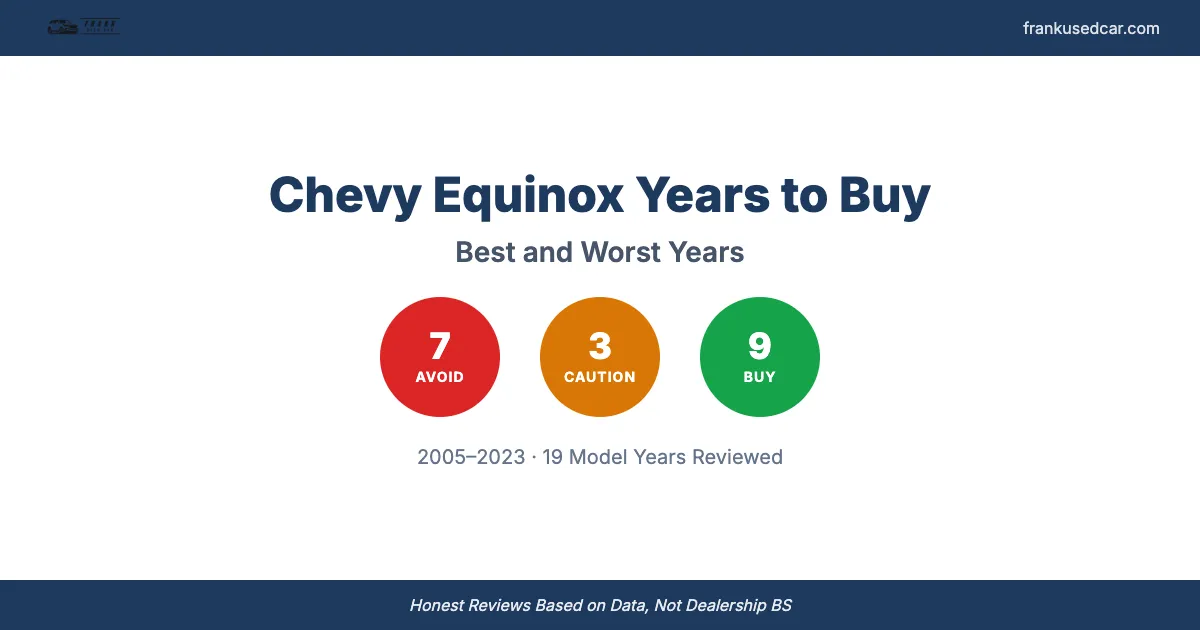
Years to avoid cluster around one engine: the 2.4L Ecotec. NHTSA complaint data shows the 2010, 2011, 2012, and 2013 Chevy Equinox have complaint rates high enough to avoid entirely.
The 2005-2007 Gen1 models and 2014-2015 late Gen2 models earn CAUTION ratings for lingering electrical and oil consumption risks. The best Chevy Equinox years to buy are the 2018-2021 Gen3 models with the proven 1.5L turbo engine.
I’ve reviewed the complaint data on every Equinox model year, and the 2.4L Ecotec engine is the common thread. Four model years have complaint rates high enough to avoid — all tied to a single engine.
This article covers which Chevy Equinox years to avoid, Gen1 problems, 2010-2011 problems, 2012 problems, 2013 problems, caution years, common Equinox problems, reliability by year, recalls, best years to buy, overall reliability, and an inspection checklist.
| Year(s) | Frank’s Verdict | Key Issue | Risk Level |
|---|---|---|---|
| 2005-2007 | CAUTION | 3.4L V6 electrical/head gasket | Moderate |
| 2008-2009 | CAUTION | Late Gen1, improved but aging | Low-Moderate |
| 2010 | AVOID | 2.4L Ecotec oil consumption | High |
| 2011 | AVOID | 2.4L oil consumption + stalling | High |
| 2012 | AVOID | 2.4L piston ring failure | High |
| 2013 | AVOID | Engine seizure from oil starvation | Severe |
| 2014-2015 | CAUTION | 2.4L oil consumption (reduced) | Moderate |
| 2016-2017 | BUY | Late Gen2, updated calibration | Low |
| 2018 | BUY | New Gen3 1.5L turbo platform | Low |
| 2019 | BUY | Refined Gen3, better infotainment | Low |
| 2020-2021 | BUY | Mature Gen3, lowest complaints | Very Low |
Which Chevy Equinox Years Should You Avoid?
The 2010-2013 Chevy Equinox are the four model years to avoid, based on NHTSA complaint density, engine failure rates, and the severity of the 2.4L Ecotec oil consumption problem.
Every single AVOID year shares the same 2.4L Ecotec engine. The Equinox complaint pattern across these four years follows an escalating curve from bad to catastrophic.
The 2005-2007 Gen1 Equinox models earn CAUTION for electrical gremlins and head gasket failures. The 2014-2015 models earn CAUTION for lingering oil consumption risk.
GM knew about the 2.4L oil consumption problem for years and kept selling it. That tells you everything about whether to trust those Chevy Equinox model years.
Let’s start with the early Gen1 models.
What Problems Do the 2005-2007 Chevy Equinox Have?
The 2005, 2006, and 2007 Chevy Equinox were the first three years of Gen1 production, plagued by engine failures, head gasket leaks, and electrical gremlins in the 3.4L V6 that proved unreliable at higher mileages.
The Gen1 Equinox shared GM’s Theta platform with the Pontiac Torrent. Both suffered from the same underlying engineering shortcuts.
- Engine failures — 3.4L V6 head gasket leaks at 80,000-120,000 miles
- Electrical system problems — random warning lights, instrument cluster failures
- Power steering pump failures — common at 60,000-100,000 miles
- Transmission hesitation — delayed engagement from stop
These Chevy Equinox models are cheap on the used market for a reason — $3,000-$5,000. One engine failure erases any savings on the purchase price.
Frank’s Verdict: CAUTION The Gen1 Equinox was GM’s first attempt at a compact crossover. It shows. Electrical issues and power steering failures are common — buy only with a thorough inspection and full service records.
The Gen2 redesign in 2010 should have fixed everything — instead it introduced a worse problem.
What Problems Do the 2010 and 2011 Chevy Equinox Have?
The 2010 and 2011 Chevy Equinox launched the second generation with the 2.4L Ecotec engine that would become GM’s biggest reliability headache.
Excessive oil consumption starting as early as 30,000 miles, timing chain stretch, and power steering motor failures define these two Equinox model years.
Oil consumption rates for the 2010 and 2011 Equinox reach 1 quart per 1,500-2,000 miles between 30,000-70,000 miles. That rate accelerates as the piston rings deteriorate further.
- Excessive oil consumption — 2.4L Ecotec burns oil starting at 30,000 miles
- Timing chain stretch — occurs at 60,000-120,000 miles, triggers P0017 camshaft position code
- Power steering motor failure — at 40,000-80,000 miles
- Engine stalling at idle — 2011 Equinox at 50,000+ miles
- Stabilitrak/traction control warning lights — recurring false alerts
I see these Chevy Equinox models listed at $6,000-$8,000. That sounds reasonable until you realize the engine might need $2,000-$4,000 in work within the first year.
Frank’s Verdict: AVOID First years of the 2.4L oil consumption epidemic. The timing chain and oil consumption together can total the car. Don’t let the low price fool you.
The 2012 continued the same problems.
What Problems Does the 2012 Chevy Equinox Have?
The 2012 Chevy Equinox accelerates the oil consumption problem, with owners reporting consumption rates as high as 1 quart every 1,000-1,500 miles. Piston ring failures became more common at lower mileages than 2010-2011 Equinox models.
The 2012 Equinox oil consumption starts earlier — some owners report it at 30,000-60,000 miles. The 2.4L Ecotec piston rings fail at 40,000-80,000 miles in this model year.
- Worsened oil consumption — 1 quart per 1,000-1,500 miles
- Piston ring failure — at 40,000-80,000 miles ($2,000-$3,500 repair)
- Timing chain noise — rattle on cold startup, eventual failure
- A/C compressor failure — $800-$1,500 replacement
- Transmission shudder — intermittent vibration under load
By 2012, the pattern was clear — three years of the same Equinox defect, and GM still hadn’t redesigned the piston rings. Checking the oil every 500 miles isn’t maintenance. It’s a warning sign.
Frank’s Verdict: AVOID Oil consumption gets worse, not better. The 2012 Chevy Equinox burns through oil faster than the 2010-2011 models. The piston ring failure mileage dropped — that’s the opposite of progress.
The 2013 is the worst of them all.
What Problems Does the 2013 Chevy Equinox Have?
The 2013 Chevy Equinox is the worst model year in the entire lineup — highest complaint count, most severe oil consumption at 1 quart per 500-1,000 miles.
Multiple reports document complete engine seizure from oil starvation in the 2013 Equinox at just 60,000-90,000 miles.
NHTSA complaint data confirms the 2013 Equinox leads all model years in total complaints filed. Oil consumption at these rates qualifies as a design defect, not normal wear.
- Severe oil consumption — 1 quart per 500-1,000 miles starting at 25,000-50,000 miles
- Engine seizure from oil starvation — at 60,000-90,000 miles ($4,000-$6,000 engine replacement)
- Timing chain failure — at 50,000-80,000 miles ($1,500-$2,500)
- Power steering failure — at 30,000-60,000 miles ($800-$1,200)
- Fuel injector failures — causing misfires and rough idle
The 2013 Equinox is the car I warn people about the most. It looks great on paper, the price is tempting, and then the engine seizes at 65,000 miles.
A friend brought me a 2013 Equinox with 68,000 miles — the engine was toast.
Frank’s Verdict: AVOID Worst Chevy Equinox ever made. Engine seizure risk is real and documented by NHTSA. No price is low enough to justify this risk.
Why Does the 2.4L Ecotec Burn Oil?
The 2.4L Ecotec engine in 2010-2015 Equinox models burns oil because of a design flaw in the piston rings. The rings allow oil to slip past into the combustion chamber — a problem that gets progressively worse over time.
Low oil levels trigger a chain reaction in the Chevy Equinox. The timing chain needs oil for lubrication. Starved of oil, the chain stretches prematurely, causing the P0017 camshaft code.
Complete oil starvation causes engine seizure. At that point, the Equinox needs a full engine replacement at $4,000-$6,000.
Piston ring replacement costs $2,000-$3,500 if caught early. GM acknowledged the problem with a Technical Service Bulletin but never issued a full recall.
A class action settlement existed, but the payouts barely covered the diagnostic fee. Equinox owners with the 2.4L pay out of pocket for a design flaw GM knew about.
A few other Chevy Equinox years deserve a closer look.
What Problems Do the 2014-2015 Chevy Equinox Have?
The 2014 and 2015 Chevy Equinox improved over the disastrous 2013 but still carry the 2.4L Ecotec engine with lingering oil consumption risk. Complaint rates dropped, but the underlying piston ring design flaw wasn’t fully resolved.
The oil consumption in these Equinox models runs less severe than 2010-2013 — closer to 1 quart per 2,000-3,000 miles in affected units. Not every 2014-2015 Equinox develops the problem.
- Reduced but present oil consumption — depends on individual engine history
- Timing chain complaints — less frequent than 2010-2013
- Improved overall reliability — fewer total NHTSA complaints
If you must buy a Gen2 Equinox, the 2016-2017 with the updated engine calibration is a safer bet. The 2014-2015 Chevy Equinox are a gamble that depends entirely on the individual car’s oil consumption history.
Frank’s Verdict: CAUTION Better than 2010-2013 Equinox, but the 2.4L oil consumption risk hasn’t disappeared. Only buy with full service records showing regular oil monitoring and no consumption complaints.
The 2018 brought a completely new platform.
What Problems Does the 2018 Chevy Equinox Have?
The 2018 Chevy Equinox introduced the third generation on GM’s D2XX platform with a new 1.5L turbo engine that eliminated the 2.4L oil consumption plague.
As a first-year Gen3 model, the 2018 Equinox had some turbo-related teething issues and transmission calibration complaints.
The 1.5L turbo in the 2018 Equinox does not share the oil consumption defect. Complaint rates dropped dramatically compared to any Gen2 model year.
- Minor turbo lag — noticeable from stop in early production units
- Transmission hesitation — calibration issue fixable with $200-$500 software update
- No oil consumption epidemic — the 2.4L is gone
The 2018 Chevy Equinox is a massive improvement over any Gen2. Most issues were resolved under warranty or with software updates. An Equinox with service records showing the transmission software update is a reasonable buy.
Frank’s Verdict: BUY The 2018 Equinox eliminated the 2.4L oil consumption plague with a new 1.5L turbo engine on a completely new platform. Complaint rates dropped dramatically — this is a genuinely reliable model year.
These individual year problems feed into larger patterns across the Chevy Equinox lineup.
What Are the Most Common Chevy Equinox Problems?
The most common Chevy Equinox problems center on the 2.4L Ecotec engine — excessive oil consumption, timing chain stretch and failure, and piston ring deterioration that can lead to complete engine seizure. The Gen3 1.5L turbo has largely eliminated these issues.
| Problem | Severity | Estimated Cost | Affected Years |
|---|---|---|---|
| Oil consumption (2.4L) | SERIOUS | $2,000-$4,000 engine work | 2010-2015 |
| Timing chain failure | SERIOUS | $1,500-$2,500 | 2010-2013 |
| Piston ring deterioration | SERIOUS | $2,000-$3,500 | 2010-2015 |
| Power steering motor | MODERATE | $800-$1,200 | 2010-2013, Gen1 |
| A/C compressor failure | MODERATE | $800-$1,500 | 2012-2015 |
| Electrical/Stabilitrak | MINOR | $200-$500 | 2005-2007, 2011 |
The single best thing you can do when shopping for a used Chevy Equinox is check which engine it has. The 2.4L is the problem. The 1.5T and 2.0T are significantly better.
Is the Chevy Equinox Timing Chain a Serious Problem?
Yes. The Chevy Equinox 2.4L timing chain is a serious problem. The chain stretches prematurely between 60,000 and 100,000 miles, causing a loud rattle on startup and triggering P0017 codes.
Replacement costs $1,500-$2,500 for the Equinox timing chain. Ignoring the rattle leads to engine damage that costs far more.
The timing chain problem is actually caused by the oil consumption problem. Low oil in the Equinox means poor chain lubrication, which causes premature stretch.
A rattle on cold start in any 2010-2013 Chevy Equinox is an immediate dealbreaker. That sound means $1,500+ in repairs is already overdue.
Does the Chevy Equinox Have Transmission Problems?
Chevy Equinox transmission problems are most common in Gen1 (2005-2009) with hesitation from stop, and early Gen3 (2018) with calibration issues. The Gen2 Equinox transmission is generally reliable when the engine isn’t starving it of oil.
Gen1 Equinox transmission hesitation stems from valve body wear. The Gen3 2018 Equinox calibration issue is fixable with a $200-$500 software update at the dealer.
The Gen2 Equinox transmission rarely fails on its own. Engine-related oil starvation causes most drivetrain problems in 2010-2013 models.
These Chevy Equinox problem patterns map directly onto the year-by-year reliability picture.
How Reliable Is the Chevy Equinox by Year?
The Chevy Equinox reliability story is a tale of two engines. The 2.4L Ecotec years (2010-2015) score poorly across every rating system. The 1.5L turbo years (2018+) score well enough to compete with Japanese rivals.
| Year | Generation | Frank’s Rating (1-10) | Key Strength | Key Risk |
|---|---|---|---|---|
| 2005 | Gen1 | 4 | Low price | 3.4L V6 head gasket |
| 2006 | Gen1 | 4 | Low price | Electrical gremlins |
| 2007 | Gen1 | 4 | Low price | Power steering pump |
| 2008 | Gen1 | 5 | Improved refinement | Aging platform |
| 2009 | Gen1 | 5 | Last Gen1 | Aging platform |
| 2010 | Gen2 | 2 | Redesigned interior | 2.4L oil consumption |
| 2011 | Gen2 | 2 | Good features | 2.4L oil + stalling |
| 2012 | Gen2 | 2 | Spacious cabin | Piston ring failure |
| 2013 | Gen2 | 1 | None | Engine seizure risk |
| 2014 | Gen2 | 4 | Improved over 2013 | Lingering 2.4L risk |
| 2015 | Gen2 | 4 | Reduced complaints | Lingering 2.4L risk |
| 2016 | Gen2 | 6 | Updated calibration | Late Gen2 aging |
| 2017 | Gen2 | 6 | Final Gen2 refinement | Last of 2.4L era |
| 2018 | Gen3 | 7 | New 1.5T engine | First-year teething |
| 2019 | Gen3 | 8 | Better infotainment | Minor turbo lag |
| 2020 | Gen3 | 8 | Mature platform | Few complaints |
| 2021 | Gen3 | 9 | Wireless CarPlay | Minimal issues |
Don’t let the overall “Chevy Equinox reliability” score fool you. It averages terrible Gen2 years with good Gen3 years. You need to know which generation you’re looking at.
J.D. Power and Consumer Reports rate the Equinox as “average” overall. That average hides a massive gap between generations.
The 2018 Chevy Equinox is practically a different SUV. New engine, new platform, new reliability profile. Before buying, check the recall history.
Has the Chevy Equinox Been Recalled?
The Chevy Equinox has been subject to multiple NHTSA recalls, with the most significant affecting the 2010-2013 model years for park lock, seat, and wiper issues.
| Recall ID | Year(s) | Date Issued | Issue | Fix |
|---|---|---|---|---|
| 16V582000 | 2013 | August 2016 | Windshield wiper module ball joints corrode, wipers become inoperative | Dealer wiper module replacement |
| 16V502000 | 2010-2013 | July 2016 | Electronic park lock allows key removal without transmission in PARK — rollaway risk | Dealer key cylinder lock housing replacement |
| 14V447000 | 2010-2012 | July 2014 | Power seat height adjuster bolt falls out, seat drops to lowest position | Dealer replacement of shoulder bolts |
| 09V489000 | 2010 | December 2009 | Instrument panel software causes HVAC and radio controls to become inoperative | Dealer module replacement |
Source: NHTSA recall database, verified .
The biggest Chevy Equinox problem — 2.4L oil consumption — was never formally recalled. GM issued a Technical Service Bulletin instead, which means you pay for the fix yourself.
A class action settlement existed for the Equinox 2.4L oil issue. Payouts barely covered the diagnostic fee. NHTSA recall checks remain essential before buying any used Equinox.
Now that you know what to avoid, here are the Chevy Equinox years worth buying.
What Are the Best Chevy Equinox Years to Buy?
The best Chevy Equinox years to buy used are the 2018, 2019, 2020, and 2021 models — Gen3 SUVs with the proven 1.5L turbo engine and complaint rates that rival Japanese competitors.
- 2021 Chevy Equinox — Frank’s TOP PICK. Mature 1.5T, wireless Apple CarPlay, lowest complaint rates of any Equinox ever produced.
- 2020 Chevy Equinox — Nearly identical to 2021. Excellent value as prices drop faster than the 2021.
- 2019 Chevy Equinox — Improved infotainment over 2018. Strong reliability track record.
- 2018 Chevy Equinox — First Gen3 year. Eliminated the 2.4L oil consumption problem entirely. Best value pick.
If I were buying a used Equinox today, I’d get the 2021. The 1.5T is proven by then, prices have dropped sharply, and the reliability is genuinely good.
A 2021 Chevy Equinox often costs $5,000 less than a comparable Toyota RAV4 — and the reliability gap has nearly closed. Check our Chevy reliability guide for more on the brand’s best models.
Is the 2021 Chevy Equinox Worth Buying Used?
Yes. The 2021 Chevy Equinox is a strong used buy that offers the mature 1.5L turbo engine, updated infotainment with wireless Apple CarPlay, and significantly lower complaint rates than any Gen2 model.
The 2021 Equinox typically sells for $5,000-$8,000 less than a comparable Toyota RAV4. That price gap makes the Equinox a compelling value for budget-conscious buyers.
Reliability data from J.D. Power places the 2021 Equinox above average for the compact SUV segment. The 2.4L problems are ancient history by this model year.
Is the 2016 Chevy Equinox a Good Budget Buy?
Yes, if you choose the 3.6L V6 over the problematic 2.4L. The 2016 Chevy Equinox with the V6 avoids the oil consumption issues entirely, and the late Gen2 platform had most kinks worked out by then.
The 3.6L V6 Equinox uses a completely different engine family. No piston ring defect, no oil consumption epidemic, no timing chain stretch at 60,000 miles.
Fuel economy suffers with the V6 — roughly 17 city / 24 highway. The trade-off is an Equinox engine that won’t seize at 65,000 miles.
Is the Chevy Equinox a Reliable SUV Overall?
The Chevy Equinox is a mixed reliability story. Gen3 models (2018+) are genuinely competitive with the Toyota RAV4 and Honda CR-V. Gen2 models (2010-2017) rank among the least reliable compact SUVs you can buy.
The Equinox improved post-2018 to the point where I’d recommend it over a Ford Escape with the 1.6L EcoBoost. That engine has its own set of cooling and head gasket problems.
The Chevy Equinox still hasn’t matched Toyota or Honda consistency across all generations. A RAV4 buyer rarely worries about which year to pick. An Equinox buyer has to research carefully.
Compare the Equinox to its direct competitors before deciding. Read our Toyota RAV4 years to avoid and Ford Escape years to avoid guides for the full picture.
How Do You Inspect a Used Chevy Equinox Before Buying?
Check these 7 critical items before buying any used Chevy Equinox — especially if it has the 2.4L Ecotec engine, which requires extra scrutiny.
Identify the engine first. The 2.4L is the dealbreaker. The 1.5T and 3.6L V6 avoid the oil consumption defect entirely. Check the engine cover or VIN decode.
Pull the dipstick and check oil level cold. Low oil on a cold Chevy Equinox with the 2.4L means the consumption problem is active. Walk away.
Listen for timing chain rattle on cold start. Start the Equinox after it sits overnight. A rattle in the first 5-10 seconds means $1,500+ in timing chain repairs.
Scan for P0017 code with an OBD-II scanner. This camshaft position code indicates timing chain stretch in the Chevy Equinox. A $30 scanner saves thousands.
Test power steering at low-speed parking maneuvers. Gen2 Equinox power steering motors fail at 40,000-80,000 miles. Heavy or jerky steering is a $800-$1,200 repair.
Run a recall check by VIN. Use the NHTSA recall database and enter the Equinox VIN. Unresolved recalls are free fixes the previous owner skipped.
Request full service history showing oil change intervals. If the Chevy Equinox owner topped off oil between changes, that’s a dealbreaker — it confirms active oil consumption.
These aren’t random suggestions. Each item targets a specific Equinox problem documented in this article. For a complete process, read our used car buying guide.
Also see: Chevrolet Best & Worst Years
- equinox years to avoid
- chevy equinox problems
- chevy equinox reliability
- chevy equinox oil consumption
- chevy equinox timing chain
- chevy equinox best years
- chevy equinox common problems
- years-to-avoid